Meta Platforms’ plan to spend $13 billion building an AI data centre in Alberta turns Canada into a larger player in the artificial-intelligence infrastructure boom and adds another major source of demand for power, chips, cooling systems and construction capacity.
Meta Alberta AI Data Center Broadens Infrastructure Trade

The project, described as Meta’s largest AI data centre outside the United States, matters well beyond one company’s expansion plan. Hyperscale AI facilities are becoming industrial assets: they absorb large amounts of electricity, require grid and cooling investment, and redirect capital toward regions that can offer land, energy and political stability. Alberta’s appeal is clear in that context — abundant natural gas, a power market geared toward large industrial users and a climate that can help reduce cooling costs.

For investors, the announcement reinforces the central market narrative of 2026: AI is no longer just a software and semiconductor story. It is a capital-expenditure cycle running through utilities, gas producers, electrical equipment suppliers, cooling specialists and data-centre landlords. Meta’s own filings have already warned that infrastructure spending tied to AI — including servers, data centres, network infrastructure and third-party cloud capacity — is rising and expected to keep increasing.
That creates a two-sided investment case. For Meta shareholders, the Alberta buildout supports the company’s push into generative AI and superintelligence, potentially strengthening advertising tools, recommendation systems and consumer AI products. But it also raises the hurdle for free cash flow, especially if returns from AI products take longer to materialize than spending on land, power and Nvidia-class compute.
Meta shares have recently recovered momentum. The stock closed at $669.21 on July 10, above both its 50-day moving average of about $600 and its 200-day moving average near $642, with volume rising to more than 40 million shares. Those are conventional technical indicators, but they show investors have been willing to reprice the company despite concerns over the scale of AI spending.
The spillover is likely to be more immediate for the AI supply chain. Nvidia remains the key beneficiary of hyperscale demand for accelerators, while companies such as Vertiv, which provides power and thermal-management systems, sit closer to the physical bottlenecks of the buildout. Nvidia closed July 10 above its 50-day and 200-day moving averages, while Vertiv remained well above its 200-day average despite trading below its 50-day line, suggesting investors are still separating the long-term infrastructure theme from shorter-term positioning.
Alberta also becomes part of a broader macro trade. Large data-centre projects can support local employment, construction activity and tax revenue, while lifting demand for power generation, transmission and natural gas. That may be modest at the national level, but for provincial assets it strengthens the case for infrastructure investment and could add support to Canadian energy-linked cash flows.
The foreign-exchange implications are narrower but real. Big-ticket foreign direct investment into Canada can marginally support the Canadian dollar, particularly when tied to energy and technology infrastructure. At the same time, higher electricity demand may intensify debates over grid costs, emissions and who pays for new capacity — issues already shaping policy responses in other data-centre markets.
The project also adds a geopolitical dimension to the AI race. By placing a major facility in Canada, Meta diversifies infrastructure outside the United States while staying within a closely aligned jurisdiction. That matters as governments increasingly treat compute capacity as strategic infrastructure, comparable to energy security or semiconductor supply.
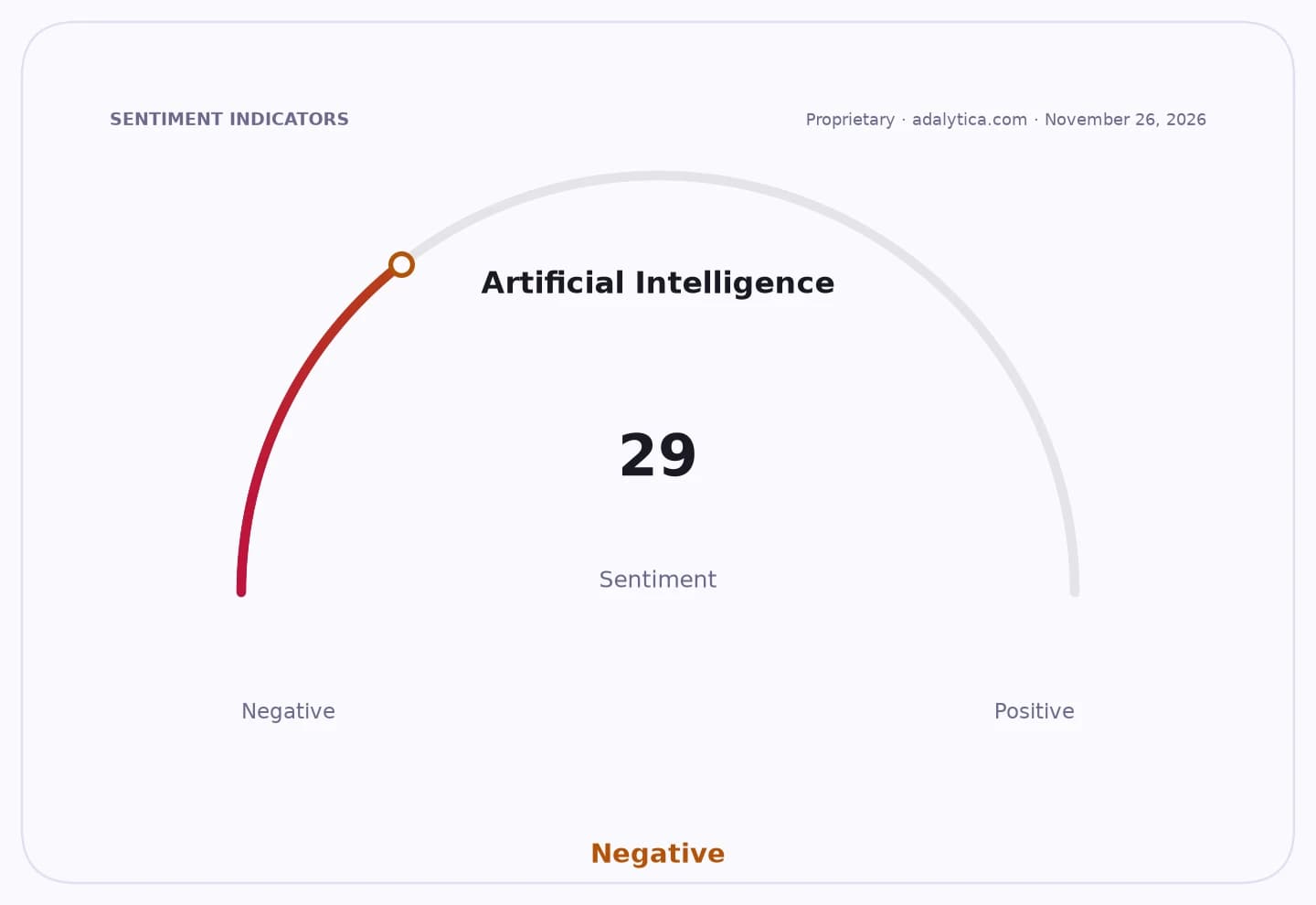
Adalytica.com’s proprietary sentiment gauge for AI data centres is mildly positive, reflecting strong growth expectations tempered by energy and environmental constraints. That balance is likely to define the next phase of the trade: investors will reward companies that can secure power, cooling and chips at scale, while punishing projects that run into permitting, grid or margin pressure.
The Alberta data centre is therefore less a standalone corporate announcement than another sign that AI is reshaping capital allocation across the economy. Portfolio managers should treat the buildout as a cross-asset signal: supportive for AI infrastructure equities and selected energy exposure, potentially mixed for Meta’s near-term cash generation, and increasingly relevant for Canadian power policy and regional growth.
| Entity | Gains | Losses |
|---|---|---|
| Meta Platforms | ▲More AI compute capacity | ▼Higher capital intensity |
| Alberta energy and infrastructure | ▲New industrial demand | ▼Grid and emissions pressure |
| Nvidia and cooling suppliers | ▲Larger AI hardware market | ▼Supply-chain bottlenecks |
| AI bulls | ▲Stronger capex confirmation | ▼Valuation discipline |