A federal MP’s open letter urging New Brunswick’s premier to reject a proposed AI data centre underscores the rising political and regulatory risk surrounding the capital-intensive buildout of artificial intelligence infrastructure.
New Brunswick AI data centre faces political risk

The fight matters because AI data centres are no longer just a technology story; they are an energy, land-use and public-policy story as well. The projects require vast amounts of power, water and transmission capacity, and that is increasingly putting them under scrutiny from provincial governments, local communities and environmental advocates. For investors, the key issue is not whether AI demand exists — it clearly does — but how quickly projects can clear permitting, grid and political hurdles.
Sentiment IndicatorsⓘProprietary · adalytica.com · September 21, 2026
This is a snapshot — live sentiment, awareness and momentum for 130+ markets update continuously in the dashboard.Open AlphaPulse

That tension is showing up across the sector. Big technology groups and infrastructure investors are pouring money into AI facilities, but the economics depend on securing reliable, low-cost electricity and winning public acceptance. Reuters previously reported that Google has committed €13 billion to expand digital and AI data centre facilities in Finland, backed by a long-term power arrangement from a nuclear plant, while industry groups are forming alliances to improve energy efficiency inside data centres. Those developments reflect a global race to lock in compute capacity, but they also highlight how power access is becoming a competitive moat.
The New Brunswick dispute fits that pattern. A project that looks attractive on paper can become far more expensive if it faces delays, redesigns or outright rejection. That raises financing risk, stretches payback periods and can weaken returns for developers and their backers. For a sector already sensitive to capital costs and operating leverage, even a single provincial objection can ripple through broader valuation assumptions for AI infrastructure names.
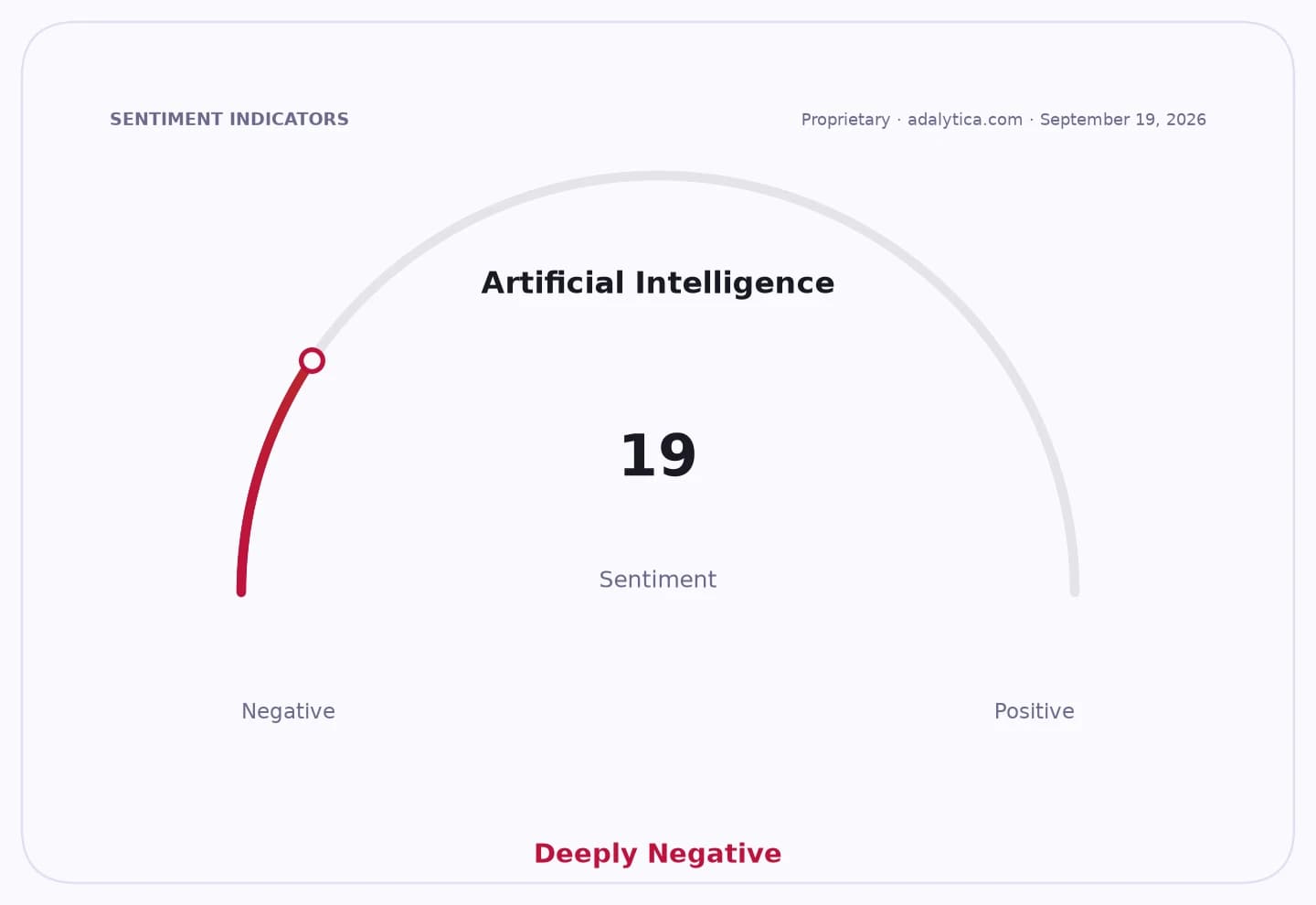
Investor sentiment around the theme remains mixed. Adalytica’s AI sentiment gauge shows fear at 26, even as awareness sits at 78, suggesting the market is paying close attention but remains cautious about execution and policy risk. That caution is consistent with recent trading in AI-related infrastructure names: AIB has seen sharp swings this year, while AIIA-UN has traded in a narrow band around the 10.20-10.36 area, with its 50-day moving average close to current levels and the RSI hovering near neutral, a sign that investors are waiting for clearer catalysts rather than chasing momentum.
The bullish case remains intact if governments decide AI infrastructure is strategic and work to speed approvals, grid hookups and long-term power deals. The bearish case is that public backlash turns into a more durable political constraint, forcing developers to accept slower rollouts, higher utility costs or smaller projects. For now, the New Brunswick episode is a reminder that the next bottleneck for AI growth may be as much political as it is technical.
| Entity | Gains | Losses |
|---|---|---|
| Provincial opponents | ▲Political leverage | ▼None if project stalls |
| AI data centre developers | ▲Long-term demand story | ▼Permitting certainty |
| Utilities and power providers | ▲Higher power demand | ▼Pressure for cheap rates |
| AI infrastructure investors | ▲Capacity growth if approved | ▼Delay and valuation risk |