Nvidia’s latest move higher underscores a simple but market-shaking truth: in a cap-weighted index, the identity of the biggest stock can change fast enough to alter the shape of the S&P 500 itself.
Nvidia Rises as S&P 500 Concentration Grows
The stock rose 1.3% to $234.58 on Friday, lifting Nvidia further above its 50-day moving average of $218.13 and pushing its relative strength index to 83.3, a level that points to stretched momentum even after a powerful rebound. That matters because Nvidia is not just another large component of the benchmark — it is one of the few names heavy enough to influence the index’s behavior, valuation and sector balance in a single session.
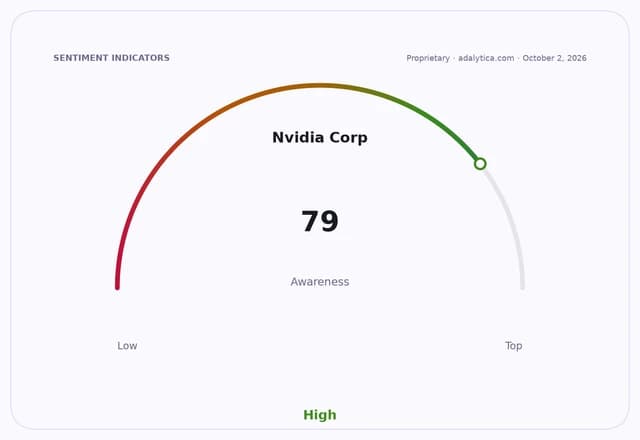
Sentiment IndicatorsⓘProprietary · adalytica.com · October 2, 2026
This is a snapshot — live sentiment, awareness and momentum for 130+ markets update continuously in the dashboard.Open AlphaPulse
For investors, the issue is not just whether Nvidia keeps rallying. It is whether the market’s narrow concentration in a handful of mega-cap technology shares can continue without a reset in leadership. The S&P 500 is still trading close to record territory, with SPY up to $768.59 and above both its 50-day and 200-day moving averages, but the index’s gains remain vulnerable to rotation. If Nvidia were to slip materially, the knock-on effect would be disproportionate because of its size and its role as the poster child for artificial intelligence spending.
That concentration cuts both ways. The bull case is that Nvidia remains the clearest beneficiary of capital spending on AI infrastructure, and the stock’s ability to reclaim momentum after a sharp pullback shows institutions are still willing to buy dips. Adalytica’s earnings sentiment reading on Nvidia has improved to neutral from deeply pessimistic levels earlier in the year, even though it slipped on the day, suggesting the market is no longer in panic mode around the name.
The bear case is that the stock has already priced in a very large share of the AI buildout, leaving little room for disappointment if demand, margins or delivery schedules soften. At 83.3, Nvidia’s RSI is in overbought territory by conventional technical measures, and the price sits only a few dollars below its upper Bollinger Band, a sign that the move is extended. A sharp reversal would not just hit Nvidia holders; it could drag on the index itself and expose how dependent broader market returns have become on a very small group of leaders.
That is why the “who is the top stock in the S&P 500” question matters more than it sounds. In a market this concentrated, the leaderboard is not trivia. It is a map of where passive flows, earnings expectations and index-level risk are being absorbed. If Nvidia keeps climbing, it reinforces the AI trade and the dominance of mega-cap technology. If it falls out of favor overnight, the S&P 500’s apparent stability could prove far more fragile than the headline index suggests.
| Entity | Gains | Losses |
|---|---|---|
| Nvidia bulls | ▲Index leadership | ▼Valuation discipline |
| S&P 500 passive investors | ▲Benchmark support | ▼Diversification |
| Mega-cap tech peers | ▲Sector halo | ▼Rotation risk |
| Nvidia shorts | ▲Mean reversion trade | ▼Momentum squeeze |