The S&P 500 is still pushing to record highs, but the market’s underneath-the-surface message is far less reassuring: at the last all-time high, more stocks in the index were making 52-week lows than 52-week highs. For investors, that kind of narrow leadership matters because it often means the index can keep rising on the back of a few giants even as the average stock struggles — a pattern that can persist for a while, but rarely for free.
S&P 500 Breadth Weakens as Records Continue

That is the core lesson long-term investors should take from this rally. Headlines about a booming index can obscure the fact that the gains are not being shared evenly. When breadth weakens, the market becomes more dependent on a small group of large-cap winners, usually the biggest technology and growth names, while smaller and more cyclical companies lag behind. That kind of concentration can keep passive index funds looking healthy in the short run, but it also leaves portfolios more exposed if the leaders stumble.

The price action in exchange-traded funds tells the same story. SPY, which tracks the S&P 500, recently sat at 767.22, with its 50-day moving average near 760.42 and its 200-day average around 715.30, showing the index remains in an uptrend. But Russell 2000 proxy IWM was far weaker at 280.05, still below its 50-day moving average of 293.11 and with a relative strength index of 23.4, a reading that points to significant weakness in small caps. That divergence is exactly what breadth watchers mean when they say the market is advancing with a narrow base.
The Nasdaq-100 has been stronger than small caps, but it too shows how concentrated leadership can distort the picture. QQQ closed at 737.6, above both its 50-day and 200-day moving averages, while its RSI sat at 61.6. That suggests large-cap technology continues to carry the tape. In other words, investors who own broad-market index funds are benefiting from the strength of a handful of mega-cap names — a powerful compounding engine when it works, but not a sign of a healthy, evenly distributed advance.
Macro conditions help explain why this matters. The U.S. unemployment rate is around 4.1% to 4.2%, which is not recessionary, but the 10-year Treasury yield is hovering near 5.19%, a level that keeps pressure on valuations and makes it harder for weaker companies to justify growth-heavy multiples. Higher yields typically reward earnings quality and balance sheet strength, which is one reason investors have kept crowding into the market’s biggest, most profitable franchises. The flip side is that more rate-sensitive and cyclical stocks can get left behind even as the index hits new highs.
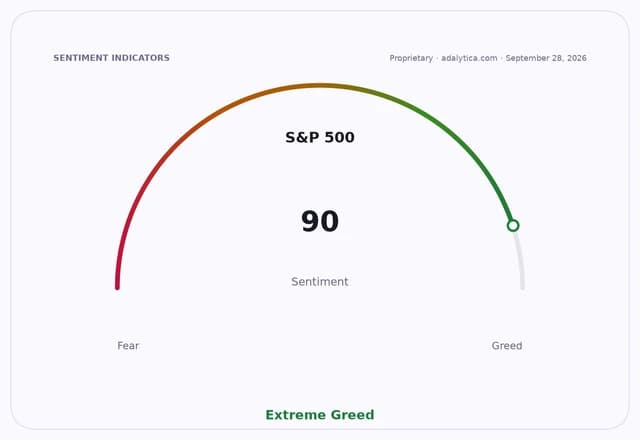
Adalytica.com’s S&P 500 trade signals snapshot also shows how stretched sentiment can get when the market is climbing on a narrow base. The gauge reads “Extreme Greed,” with sentiment at 90. That does not mean a sell-off is imminent, but it does suggest the market is priced for a lot of good news. When positioning is that optimistic and breadth remains weak, the risk is not just a pullback — it is that returns become increasingly dependent on the same few winners continuing to outrun expectations.
For investors, the takeaway is not to fight the trend. The S&P 500’s advance still reflects real corporate strength, especially among the largest firms. But it is a reminder to stay diversified and not confuse index highs with broad participation. Over a 3- to 10-year horizon, broad exposure still makes sense, yet it is worth paying attention to whether more stocks start confirming the rally. If breadth improves, this bull market gets stronger. If it does not, leadership may remain impressive — but fragile.
| Entity | Gains | Losses |
|---|---|---|
| Mega-cap tech leaders | ▲Index leadership, higher multiples | ▼Concentration risk if momentum fades |
| Broad-market index funds | ▲Record-level headline gains | ▼Weak participation beneath the surface |
| Small caps / IWM | ▲Little from this rally | ▼Relative underperformance and weak breadth |
| Long-term diversified investors | ▲Exposure to market compounding | ▼Need patience while leadership stays narrow |