The simplest trade in the market is still working: buy broad index funds and let the biggest companies do the heavy lifting. The S&P 500 ETF, SPY, closed at 771.35 on Sept. 25, while the Nasdaq-100 ETF, QQQ, finished at 744.50, both hovering near record territory as investors continued to pile into U.S. stocks despite pockets of volatility.
SPY and QQQ Near Record Highs

That matters because it shows where the real economic power sits. When the market keeps making higher highs, it usually isn’t because every stock is firing at once. It’s because the largest, most profitable companies are still growing earnings fast enough to carry the index. For long-term investors, that is the whole point of owning the market: you don’t have to guess the next winner if you already own the winners.
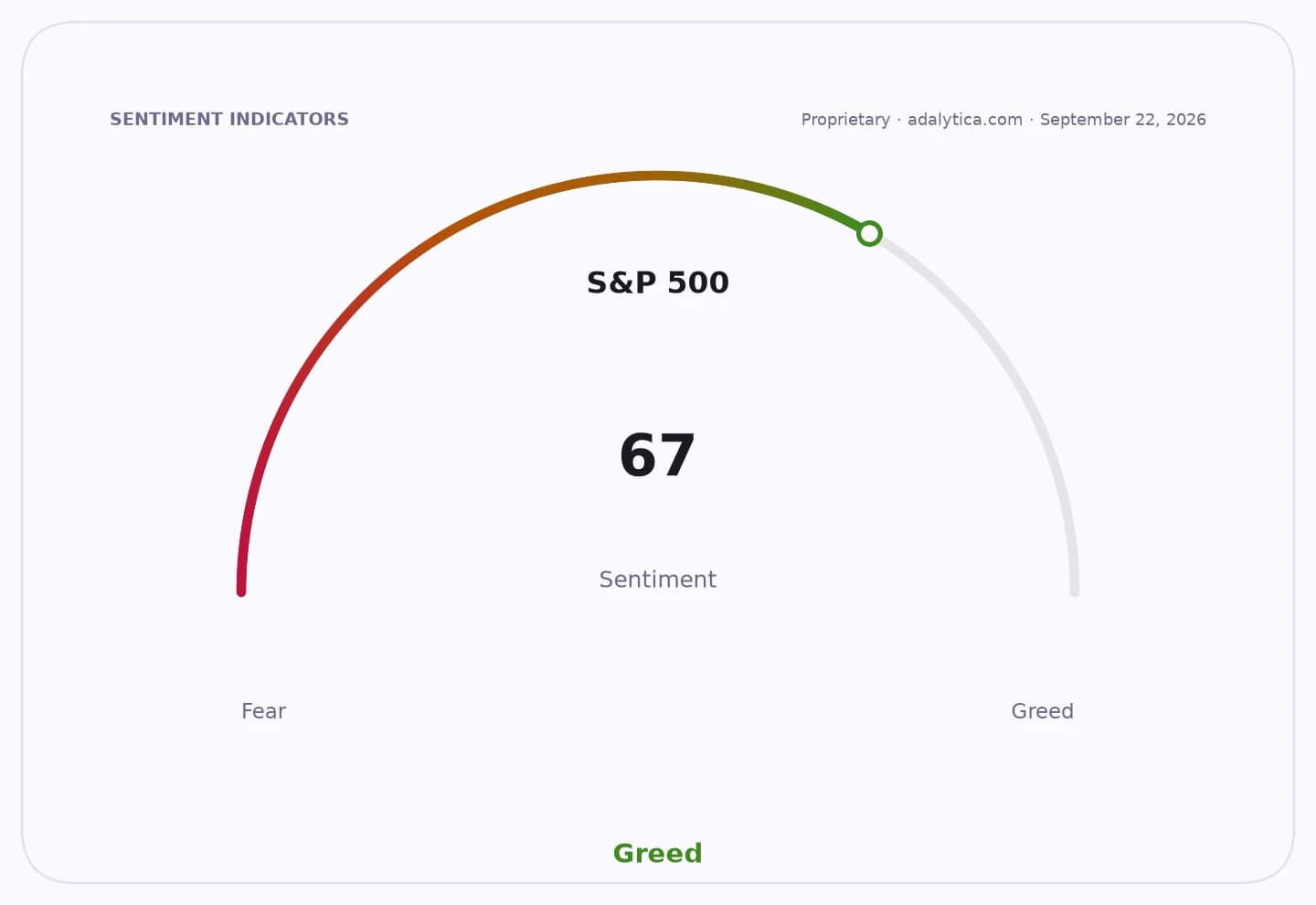
Sentiment IndicatorsⓘProprietary · adalytica.com · September 25, 2026
This is a snapshot — live sentiment, awareness and momentum for 130+ markets update continuously in the dashboard.Open AlphaPulse

The numbers back that up. SPY is trading above its 50-day and 200-day moving averages, a sign the uptrend remains intact even after some recent chop. QQQ is doing the same, and its stronger momentum reflects continued demand for large-cap technology stocks, especially the AI-linked names that have powered this cycle. In other words, the market’s leadership remains concentrated, but it is still leadership.
There’s also a practical investing lesson here. Broad funds like SPY and QQQ keep attracting money because they offer something most active stock pickers struggle to deliver consistently: exposure to the market’s long-term compounding engine. The data may look technical on the surface, with SPY’s RSI around 52.5 and QQQ’s at 66.4, but the bigger story is behavioral. Investors are willing to pay up for growth, scale and cash flow when the macro backdrop feels stable enough.

Adalytica’s S&P 500 Trade Signals snapshot also points to that shift. Sentiment sits at a neutral 56, but awareness is in the greed zone at 75, suggesting investors are still engaged even after a volatile stretch. That is not usually a market that is ready to roll over immediately. It is a market where dips keep getting bought, especially by investors with a years-long horizon.
The flip side is obvious: if you are betting against the market in this environment, you are fighting two powerful forces at once — corporate earnings and passive inflows. Short sellers and cautious traders may get sharp pullbacks, but buy-and-hold investors continue to benefit from the market’s long-term upward drift. That is why “just buy the market” remains such a durable strategy.
For investors, the takeaway is straightforward. If you are trying to time every headline, you risk missing the compounding that comes from simply staying exposed to the broad market. For most people, the smartest move is still to own diversified index funds, add on weakness, and hold for the long term. That approach has worked through every cycle, and it still looks worth sticking with now.
| Entity | Gains | Losses |
|---|---|---|
| SPY investors | ▲Broad market exposure | ▼Market timers |
| QQQ holders | ▲AI and tech leadership | ▼Value laggards |
| Mega-cap growth stocks | ▲Higher valuations | ▼Short sellers |
| Cash hoarders | ▲Liquidity optionality | ▼Equity compounding |