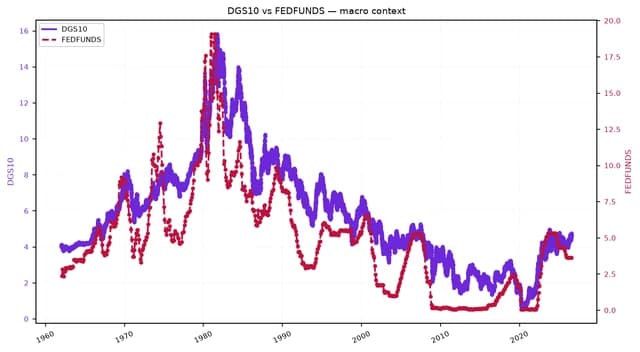
U.S. technology stocks are facing a fresh valuation squeeze as Treasury yields climb toward 5%, reinforcing the market’s sensitivity to higher discount rates and narrowing the appeal of future earnings that sit far out on the horizon.
Tech Stocks Face Pressure as Treasury Yields Near 5%

That shift matters because the tech sector’s market value is built less on current cash flow than on expectations for earnings years ahead. When the risk-free rate rises, those future profits are discounted more heavily, lowering their present value even if company fundamentals remain intact. The move has coincided with a broader selloff in rate-sensitive equities, with the Nasdaq and S&P 500 retreating as investors recalibrate for a longer period of restrictive policy.
Sentiment IndicatorsⓘProprietary · adalytica.com · September 25, 2026
This is a snapshot — live sentiment, awareness and momentum for 130+ markets update continuously in the dashboard.Open AlphaPulse
The macro backdrop is still doing the heavy lifting. Federal Reserve officials, including John Williams and Michael Barr, have signaled that more tightening may still be needed as inflation remains stubborn. Core consumer prices rose faster than expected in August, keeping pressure on policymakers to hold a hawkish line. With the Fed still focused on inflation control and the 10-year note near 5%, the cost of capital is rising across the economy, from corporate borrowing to equity valuation models.
That is showing up in market behavior. The QQQ, which tracks the Nasdaq-100, ended the latest session at 741.1, well above its 50-day moving average of 711.2 and 200-day average of 663.53, but its RSI reading of 65.5 suggests the rebound is starting to look stretched after a sharp recovery from a July low near 661.04. The technology-heavy XLK has been stronger, closing at 194.71, above both its 50-day average of 183.6 and 200-day average of 162.81, but the move has largely reflected a rapid reassessment of growth exposure rather than a clean return to low-rate complacency.
The sector’s sensitivity to rates is also visible in ARKK, the Ark Innovation ETF, which has clawed back to 91.7 from a February trough of 66.33. Its bounce underscores how aggressively long-duration growth assets can reprice when investors think policy easing is coming — and how quickly that trade can reverse when yields rise instead. In that sense, the recent strength in speculative growth names is less evidence that rates no longer matter than a test of how much macro pressure investors are willing to ignore.
The bull case is that the earnings power of megacap software, chips and platform companies can still overwhelm the math of higher discount rates if artificial intelligence spending lifts revenue and margins fast enough. The bear case is that the market has already done much of the work for them, leaving valuations vulnerable if yields stay elevated, the Fed stays hawkish or earnings fail to justify stretched multiples. The fact that U.S. dollar trade signals show extreme greed while S&P 500 sentiment is in greed territory suggests positioning is no longer defensive.
For investors, the immediate implication is that rate direction may matter as much as earnings revisions in determining which tech names lead the next leg of the market. A sustained move in the 10-year above 5% would likely keep pressure on the long-duration end of equities, even if the Fed stops short of the most aggressive tightening scenarios. If yields ease, the market could quickly re-rate the same cash flows it is now discounting more harshly. Until then, tech remains a macro trade as much as a fundamental one.
| Entity | Gains | Losses |
|---|---|---|
| Cash-heavy value stocks | ▲Higher relative appeal | ▼Less rotation from tech |
| Big Tech with near-term profits | ▲Better earnings cushion | ▼Lower valuation multiples |
| Long-duration growth stocks | ▲Potential rebound if yields fall | ▼Most exposed to discount-rate pressure |
| Treasury bulls | ▲Higher yields support returns | ▼Tech valuation multiples |