The S&P 500 is still pressing record highs, but the market is flashing a classic late-cycle warning: rates are rising, long bonds are weakening, and investors are pricing in less room for error.
S&P 500 Faces Rate Risk Near Record Highs
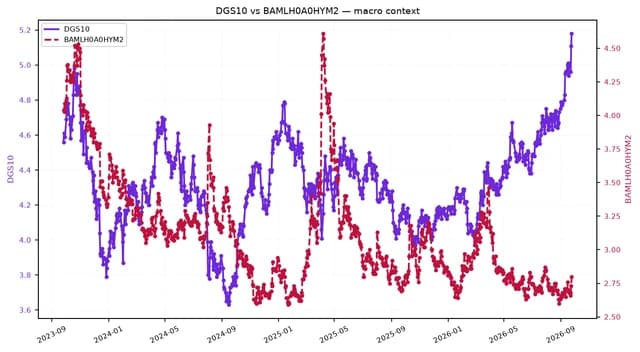
That matters because the rally is no longer being powered by easy money. The 10-year Treasury yield climbed to 5.11% on Sept. 23, its highest level in the data provided, while the iShares 20+ Year Treasury Bond ETF, or TLT, fell to 79.32, below both its 50-day moving average and 200-day moving average. In plain terms, the bond market is telling you borrowing costs are still too high for comfort, and that pressure eventually works its way into equity valuations, corporate financing and consumer demand.
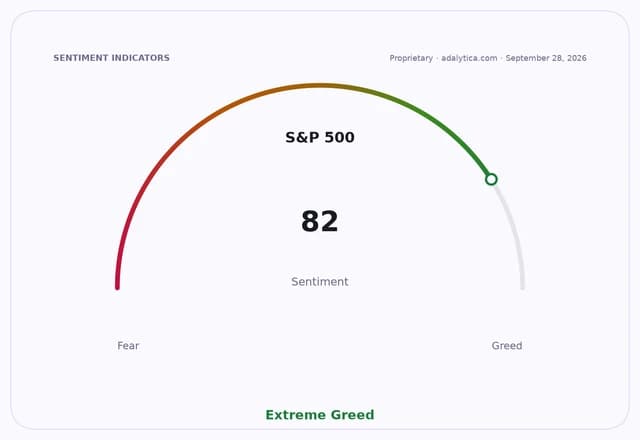
Sentiment IndicatorsⓘProprietary · adalytica.com · September 28, 2026
This is a snapshot — live sentiment, awareness and momentum for 130+ markets update continuously in the dashboard.Open AlphaPulse
At the same time, the S&P 500 ETF, SPY, closed at 771.35 on Sept. 25 after trading as high as 773.05 two days earlier. The index remains well above its 50-day moving average of 759.91 and its 200-day moving average of 714.84, which is a sign the uptrend is intact. But the underlying setup is stretched. The cyclically adjusted price-to-earnings ratio cited in the source material is above 41, close to dot-com-era extremes, and Adalytica’s S&P 500 trade signals show sentiment at 82, labeled “Greed,” even as awareness sits at a neutral 39. That combination rarely marks a low-risk entry point.
This is why the market underestimates the second-order effect of higher yields. A 5.11% benchmark rate does not just hit homebuyers or speculative tech. It raises the discount rate on future cash flows, compresses multiples across the market and makes buybacks and debt refinancing more expensive. The S&P 500’s heavy tilt toward megacap technology leaves it especially exposed if earnings growth slows or AI-related capital spending fails to translate into near-term profits.
Credit markets are not screaming panic, but they are not offering comfort either. The ICE BofA high-yield spread remains at 2.80%, up from 2.68% on Sept. 22, suggesting investors are still being paid only modestly more to own riskier debt even as Treasury yields climb. That gap can narrow fast when growth expectations deteriorate, which is exactly when index-heavy portfolios tend to get hit.
For investors, the key question is not whether the S&P 500 is doomed. It is whether broad index funds remain the best vehicle for money that may be needed within the next few years. I believe the answer is increasingly no. In a market where valuations are elevated, rates are restrictive and sentiment is euphoric, the better setup often lies in quality dividend payers, value stocks and balance-sheet strength rather than passive concentration in the most expensive names.
That does not mean abandoning equities. It means recognizing that the next leg of returns may favor cash-rich companies, defensive income and sectors less dependent on perpetual multiple expansion. If the Fed keeps policy tight or if inflation proves sticky, the market’s current calm could give way to a sharper rotation. For now, the message is clear: stay invested, but stop assuming the S&P 500 is the safest place to hide.
| Entity | Gains | Losses |
|---|---|---|
| Quality dividend ETFs | ▲Defensive income appeal | ▼Less upside in a melt-up |
| S&P 500 index funds | ▲Current momentum | ▼Valuation and rate risk |
| Long-duration Treasuries | ▲Potential relief if growth weakens | ▼Immediate price pressure |
| High-multiple tech stocks | ▲AI enthusiasm | ▼Higher discount rates |