Investors poured more than $1 billion into the new one-year state bond, underscoring how badly the market wants short-dated, government-backed yield at a time when higher borrowing costs are rippling across global debt markets.
One-Year State Bond Draws Over $1 Billion
That kind of demand matters because it is not just a one-off auction quirk — it is a sign that cash-rich investors are still willing to lock money into low-duration public debt if the return is compelling enough. With benchmark borrowing costs elevated, the bid for short-term sovereign-like paper tells us the market is still prioritizing safety, income and rapid turnover over long-term duration risk.
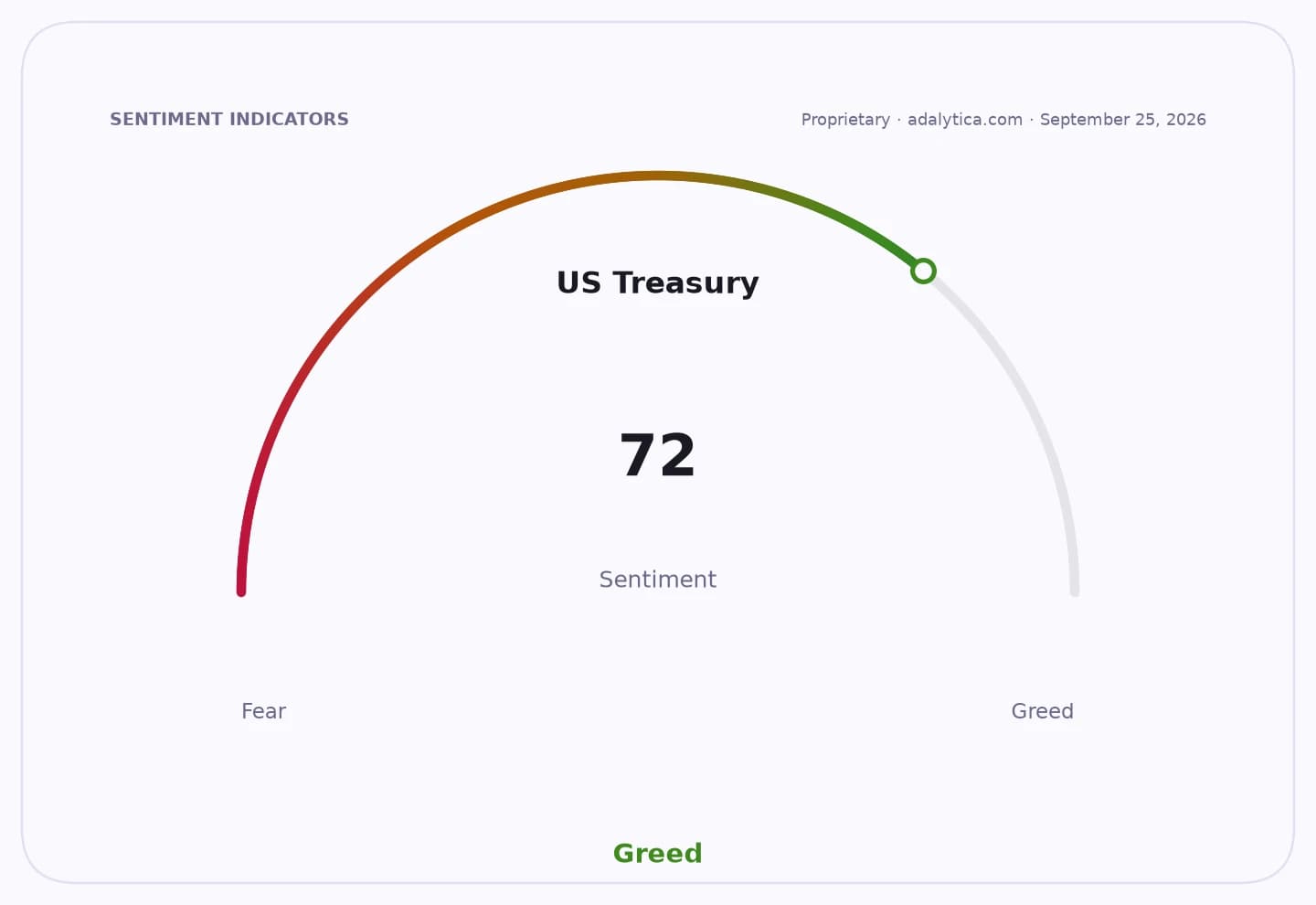
Sentiment IndicatorsⓘProprietary · adalytica.com · September 5, 2026
This is a snapshot — live sentiment, awareness and momentum for 130+ markets update continuously in the dashboard.Open AlphaPulse
The move fits a broader bond-market story: government yields have surged worldwide as investors worry about stubborn inflation and swelling debt loads, forcing policymakers to confront the real cost of financing deficits. In the U.S., the 10-year Treasury yield was around 4.8%, while the Fed funds rate sat near 3.63%, leaving short-dated public debt attractive for investors unwilling to take big interest-rate risk. That backdrop is helping explain why money is still chasing one-year paper even as bond markets remain volatile.
For investors, the message is clear. This is a market still searching for parking places, not one embracing aggressive risk-taking. The demand supports the case for short-duration and high-quality fixed income, while reinforcing pressure on longer-maturity bonds that remain exposed to inflation surprises, heavy issuance and policy uncertainty. U.S. bond proxies such as the iShares 1-3 Year Treasury Bond ETF, or SHY, have held firmer than longer-duration funds, while the iShares 20+ Year Treasury Bond ETF, or TLT, has been more fragile.
The trade also has second-order consequences beyond bond funds. When investors favor one-year debt, governments can finance themselves more cheaply at the short end, but they also lock in the need to roll that debt sooner, leaving future budgets more exposed if rates stay high. For companies and households, the persistence of elevated yields keeps pressure on mortgages, autos, housing and capital spending — exactly where refinancing sensitivity is highest.
Adalytica’s U.S. Treasury Bonds Trade Signals show sentiment for TLT remains only neutral, while awareness has jumped, suggesting investors are watching the space closely even if conviction is not yet broad. That is consistent with a market in transition: cautious, yield-driven and highly selective.
The opportunity now is in duration discipline. The market underestimates how long this “higher for longer” environment can keep short-term public debt in demand, and how much longer bonds can outperform cash once central banks finally pivot. For now, the winners are short-duration bond buyers and issuers who can meet that demand; the losers are long-duration holders waiting for an easy rally that may still be some way off.
| Entity | Gains | Losses |
|---|---|---|
| One-year state bond buyers | ▲Higher yield, low duration risk | ▼Reinvestment risk |
| State issuers | ▲Cheap near-term funding | ▼Future rollover pressure |
| SHY / short-duration funds | ▲Demand for safety and income | ▼Limited upside |
| TLT / long-duration bonds | ▲Lower near-term appeal | ▼Rate and inflation risk |