Nvidia’s support for an open-model letter is more than a social-media debut for Jensen Huang — it is a tell that the AI market is entering a new phase where distribution, compute and developer access may matter more than any single model’s secrecy.
Open Models Boost Nvidia Infrastructure Thesis
That matters because the biggest money in AI is shifting from the headline model race to the infrastructure layer underneath it. If open models continue to spread, the winners are likely to be the companies selling the chips, networking, memory, cloud capacity and data-center power needed to run them at scale. The losers are the businesses trying to defend premium pricing purely through model exclusivity.

The strategic implication is especially important for Nvidia. Huang’s first post on X backing open models aligns the company with the broader ecosystem rather than with any one closed AI franchise, helping keep Nvidia positioned as the indispensable toll road of the AI economy. That is a powerful place to be if the market is underestimating how quickly model competition is commoditizing on one side while compute demand keeps compounding on the other.
The price action still says investors are paying up for that thesis, but not irrationally. Nvidia shares ended Friday at $205.97, down from a recent high above $235 in May, even as the stock remains well above both its 50-day and 200-day moving averages. The pullback has not broken the longer-term trend, and conventional technical indicators such as RSI and MACD suggest the stock has cooled from overbought conditions without losing its primary uptrend. In plain English: the market is still treating Nvidia as the core AI infrastructure name, but it is leaving room for another leg higher if the open-model wave translates into fresh capex.
That is where the asymmetric opportunity sits. Open models lower adoption friction. They invite more developers, more enterprise experimentation and more deployment across private cloud, sovereign cloud and on-premise systems. Each of those paths requires more accelerators, more HBM memory, more servers and more data-center buildout. The market tends to focus on who owns the model, but the more durable cash flows may belong to the companies that power every model.
The rest of the AI stack is confirming that message. TSMC, the leading advanced-chip foundry, has also surged dramatically over the past year, reflecting the same logic: if AI compute expands, the picks-and-shovels providers benefit even when software competition gets fiercer. Microsoft, meanwhile, remains exposed to the tension between AI monetization and the cost of supporting ever-larger workloads. Its stock has been volatile, underscoring how expensive the platform race can become when the underlying technology is moving this fast.
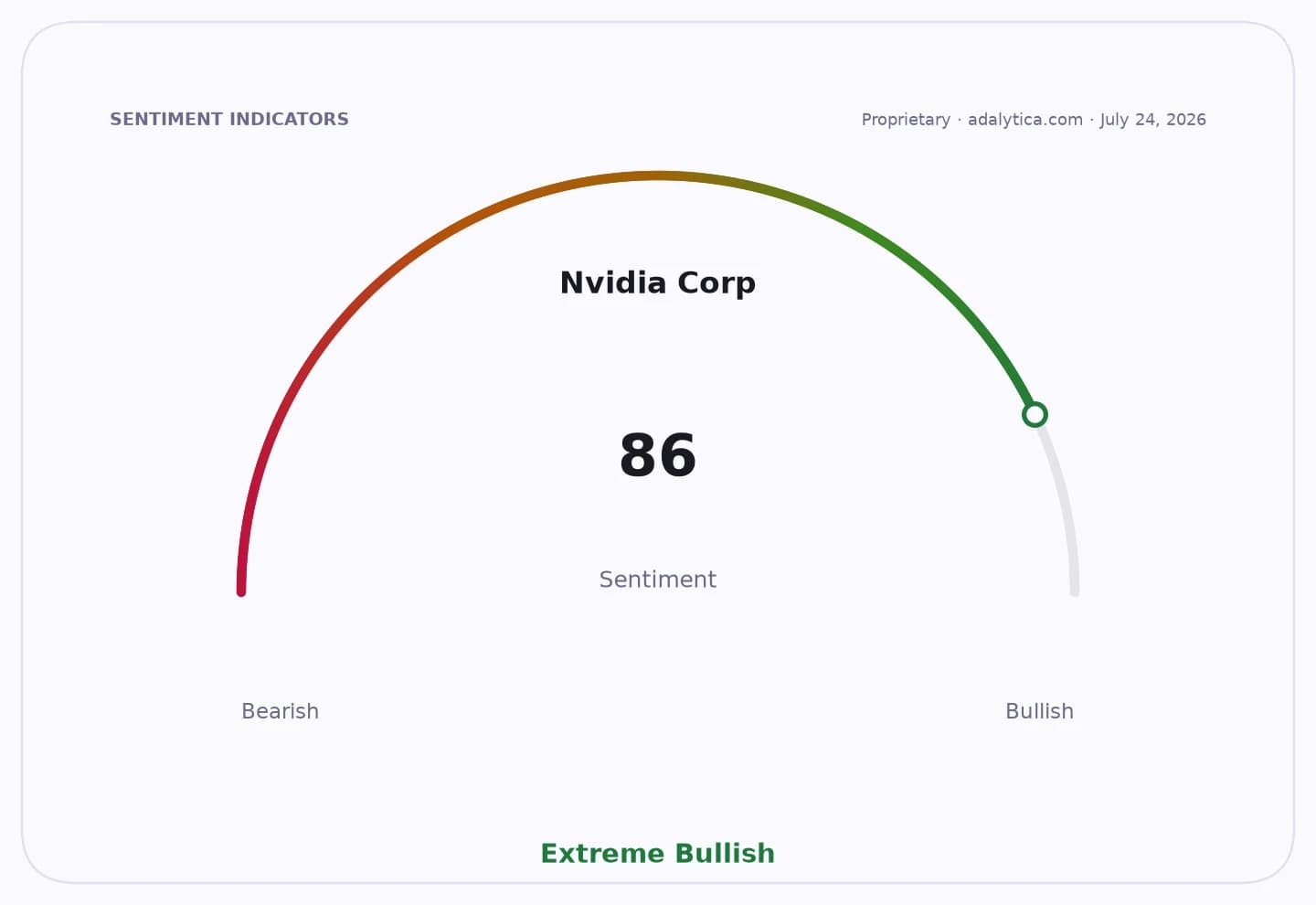
Investor sentiment around Nvidia remains elevated, according to Adalytica.com’s NVIDIA Earnings Sentiment gauge, which is still in “Extreme Greed” territory even after a one-day pullback. That is a warning against chasing weakness blindly, but it does not negate the core thesis. In markets like this, elevated enthusiasm often marks the beginning of a multi-year infrastructure cycle, not its end.
China adds another layer of urgency. The reported rise of free, high-performing models such as Moonshot AI’s Kimi K3 suggests the competitive gap in model quality is narrowing faster than many on Wall Street expected. That increases the odds of open ecosystems winning share globally, especially where cost sensitivity is high. For investors, that is bullish for compute vendors and bearish for any one company claiming a permanent moat at the model layer.
The market is missing one crucial point: open models do not necessarily shrink the AI pie. They can enlarge it. When software gets cheaper and easier to deploy, usage expands, and the bill still lands with the infrastructure providers. That is why Huang’s endorsement matters. It reinforces Nvidia’s role as the neutral platform everyone can build on, regardless of which model wins the latest benchmark war.
My view is straightforward: own the AI infrastructure winners, not the model headlines. Nvidia remains the cleanest expression of that trade, with TSMC as a key second-order beneficiary and Microsoft a more complicated but still central platform exposure. The open-model era is not a threat to the AI capex boom — it is the next catalyst for it.
| Entity | Gains | Losses |
|---|---|---|
| Nvidia | ▲More compute demand | ▼Model exclusivity narratives |
| TSMC | ▲Higher chip orders | ▼Slack in AI capex |
| Open-model developers | ▲Faster adoption | ▼Premium closed-model pricing |
| Closed-model vendors | ▲— | ▼Pricing power |