The Nasdaq-100 is hanging onto support even as the market’s hottest mega-cap names lose momentum, and that matters because the index’s next move will help decide whether investors are looking at a healthy consolidation or the start of a broader de-risking in tech.
QQQ Near 50-Day as Nasdaq Leadership Narrows
The clearest sign of strain is that the QQQ, which tracks the Nasdaq-100, closed at 717.21 on Aug. 19, only a fraction above its 50-day moving average of 712.88, after slipping from a recent high of 729.87. The index is still well above its 200-day moving average of 650.91, so the long-term trend is intact, but the short-term setup is weakening: RSI readings remain elevated at 68.5, yet the move has lost momentum and the MACD is still below its signal line. That is the classic profile of a market that has already priced in a lot of good news and now needs fresh earnings and capex support to keep advancing.
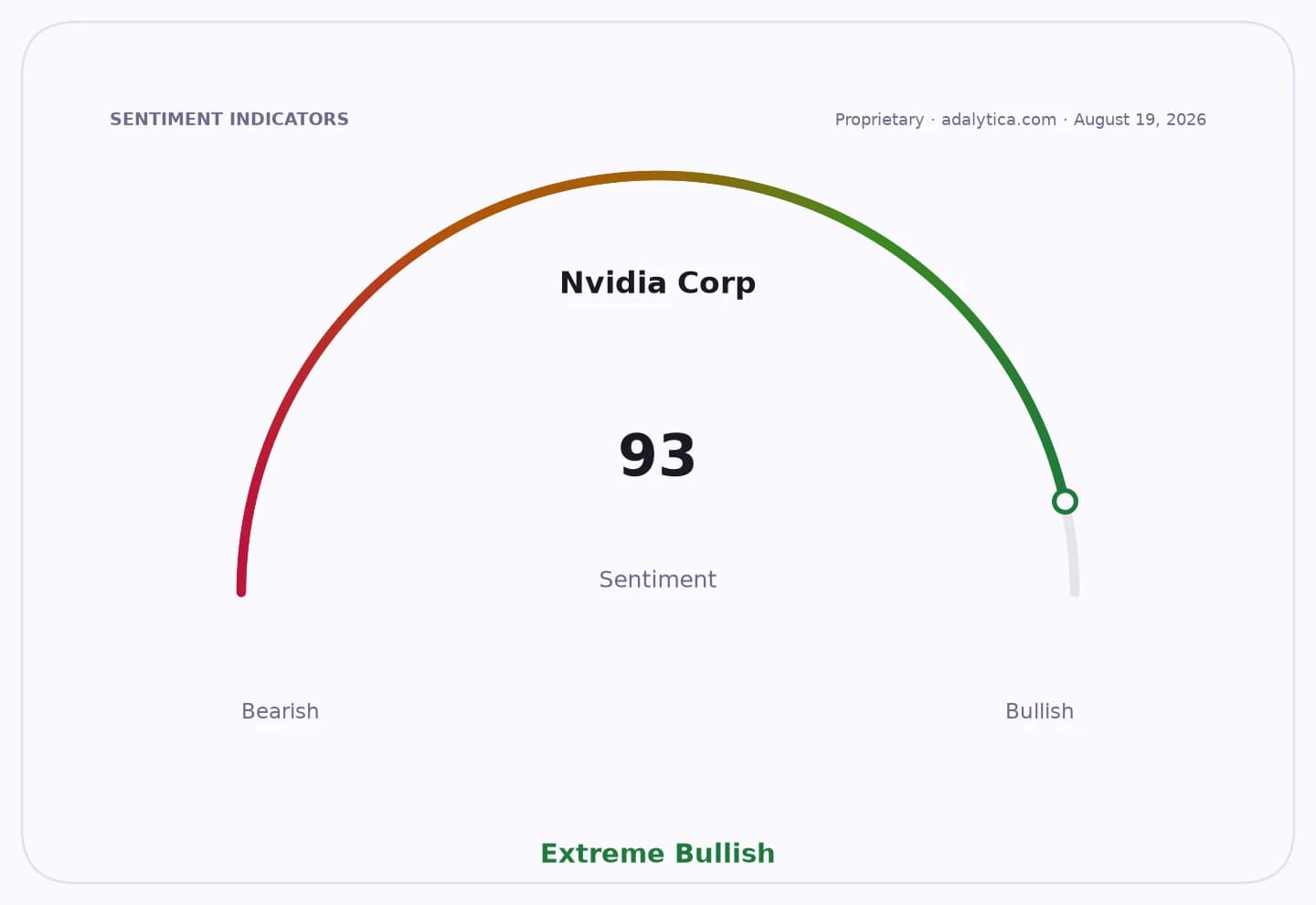
Sentiment IndicatorsⓘProprietary · adalytica.com · August 19, 2026
This is a snapshot — live sentiment, awareness and momentum for 130+ markets update continuously in the dashboard.Open AlphaPulse
For investors, this is where the story gets important. The Nasdaq has not been driven by broad participation; it has been carried by a handful of AI and mega-cap winners, especially Nvidia, Microsoft and the wider semiconductor complex. When leadership narrows this much, the index becomes more fragile. If those names pause, QQQ can slip quickly toward the 50-day line, and if that level gives way, systematic funds and momentum investors are likely to cut exposure rather than buy the dip aggressively.
The AI trade still has fundamental power behind it, but the market is becoming more selective. Adalytica’s Nvidia earnings sentiment sits at 93, or “Extreme Greed,” after jumping 43 points in seven days, while Microsoft’s sentiment has also risen to 82. That tells you enthusiasm is still concentrated in the infrastructure leaders, not the broader index. By contrast, Adalytica’s AI sentiment reading has dropped to 18, a “Fear” level, with awareness near “Extreme Fear,” suggesting investors are wary of paying up for the second-order beneficiaries until the earnings payoff becomes clearer.
That divergence matters because it points to a market transition from pure multiple expansion to proof-of-demand. The latest news that Samsung Electronics and SK Hynix are accelerating North American semiconductor investment is part of the same pattern: AI demand is forcing a real-world capex cycle, but that spending is also a reminder that supply-chain buildout takes time and capital. In other words, the winners are still spending heavily to defend their position, which is good for chip equipment, packaging, power and datacenter infrastructure, but it can also limit near-term margin upside if investors get ahead of themselves.
The bigger market question is whether the Nasdaq can broaden out enough to support itself if the big AI names cool. Right now, the evidence says this is still a leadership market, not a participation market. The QQQ is above its major trendline, but not far enough above the 50-day to look comfortable. If big tech regains lift, the index can push toward its recent highs and keep the bull case alive. If it cannot, investors should expect a rotation into cheaper parts of the market and a sharper repricing of crowded growth positions.
My view: this is not the time to chase the index after a powerful run. The better opportunity is to stay exposed to the AI infrastructure supply chain — semis, packaging, power, networking and datacenter buildout — while respecting that the broad Nasdaq still needs leadership to hold. If the 50-day moving average breaks, the market will tell you the easy money in big tech has already been made for now.
| Entity | Gains | Losses |
|---|---|---|
| Nvidia | ▲AI capex demand | ▼Any pause in momentum |
| Microsoft | ▲Infrastructure spending tailwind | ▼Multiple compression |
| Nasdaq-100 / QQQ | ▲Support if leadership holds | ▼If 50-day support breaks |
| AI infrastructure suppliers | ▲North America fab and buildout cycle | ▼Overowned speculative AI names |