Bucharest’s BET index fell 1% as market turnover dropped to roughly half the levels seen in this year’s strongest sessions, a sign that Romania’s main equity benchmark is losing momentum just as liquidity thins.
Romania BET Index Falls 1% as Turnover Drops
The decline matters less for the size of the move than for what it says about market depth. When trading activity retreats from above 100 million lei on the busiest days to about half that level, price discovery weakens, spreads can widen and large orders move the market more sharply. For investors, that usually means a lower-tolerance environment for risk-taking and a market that is more vulnerable to swings driven by a handful of names.
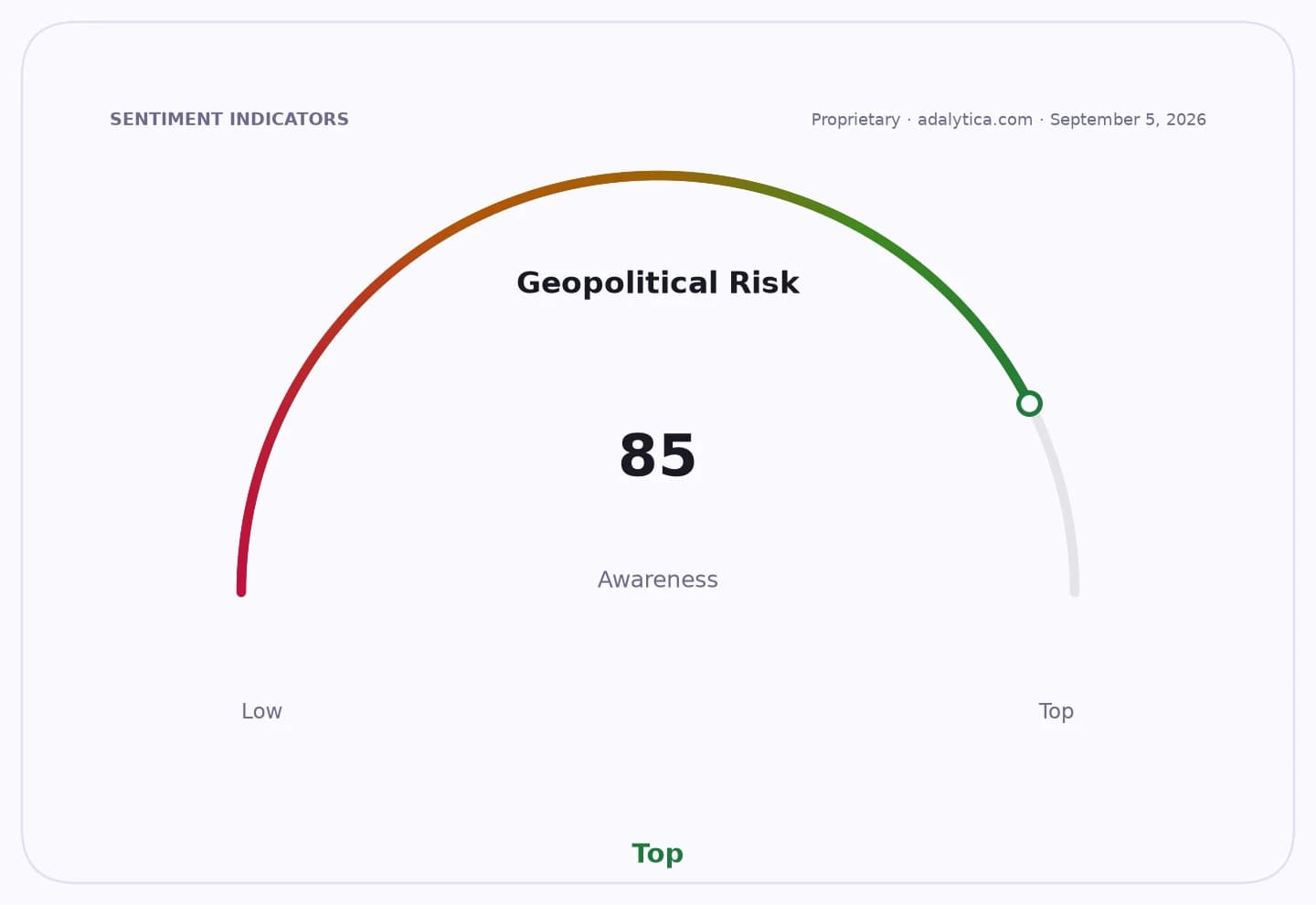
Sentiment IndicatorsⓘProprietary · adalytica.com · September 5, 2026
This is a snapshot — live sentiment, awareness and momentum for 130+ markets update continuously in the dashboard.Open AlphaPulse
The weakening in volumes comes against a broader backdrop of mixed risk appetite. Adalytica’s S&P 500 trade signals were neutral, with sentiment at 47 and awareness at 45, while its global stability gauge showed neutral sentiment but elevated awareness, suggesting investors remain alert to macro and geopolitical risks even if they are not fully de-risked. That combination often leaves smaller markets like Bucharest exposed when domestic participation fades.
For local equities, the immediate implication is that the BET’s recent pullback may reflect not just selling pressure but also a shortage of fresh money. In thin conditions, gains can be harder to sustain and drawdowns can appear sharper than fundamentals alone would justify. That is especially relevant for institutions and active funds that depend on liquidity to enter and exit positions efficiently.
The bigger question is whether this is a temporary pause after stronger sessions or the start of a more durable cooling in appetite for Romanian assets. If turnover stays subdued, the market could struggle to absorb new supply, while any improvement in volumes would likely be read as a sign that investors are willing to re-engage ahead of the next domestic catalyst.
| Entity | Gains | Losses |
|---|---|---|
| Cash holders | ▲Lower entry prices | ▼Less urgent buying pressure |
| Active traders | ▲Wider intraday moves | ▼Thinner liquidity |
| Long-term investors | ▲Potentially better valuations | ▼Harder execution |
| BET-listed issuers | ▲Less immediate volatility | ▼Weaker market support |