Salesforce shares surged after the company showed that AI products are no longer a side story but a real growth engine, turning enterprise adoption into a fresh rerating for the stock.
Salesforce Shares Surge on AI Growth Rerating

That matters because investors have spent the past year asking whether the AI boom would stay concentrated in chipmakers and hyperscale cloud providers or broaden into the software layer that ultimately monetizes the infrastructure buildout. Salesforce is now making the case that the answer is yes. As companies move from experimentation to deployment, the value shifts from model training to workflow automation, customer service, sales productivity and agentic software that can be sold at scale.
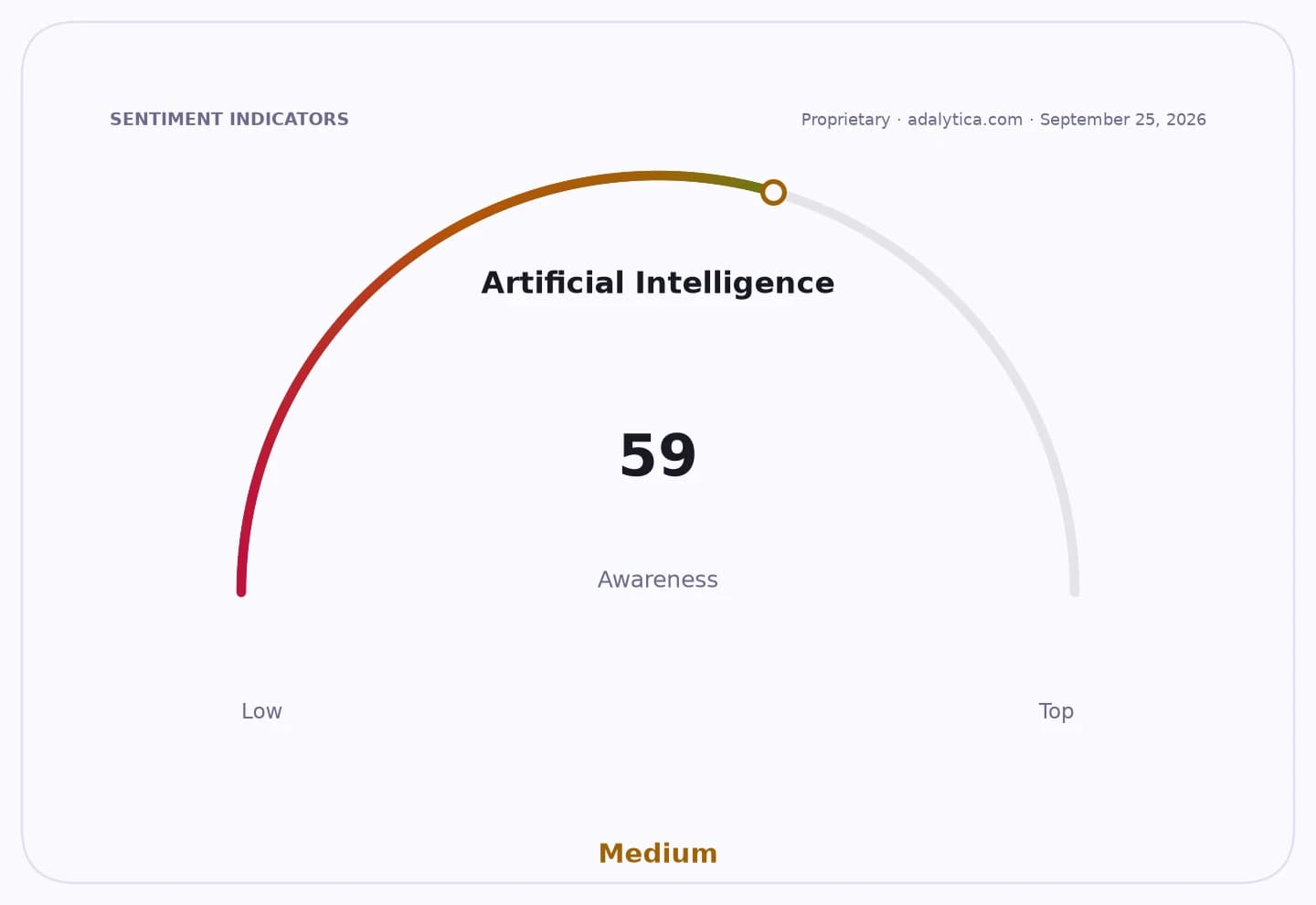
Sentiment IndicatorsⓘProprietary · adalytica.com · August 31, 2026
This is a snapshot — live sentiment, awareness and momentum for 130+ markets update continuously in the dashboard.Open AlphaPulse
The stock action reinforces how quickly sentiment can change when revenue growth becomes visible. CRM has ripped from a recent close of $205.62 on Aug. 26 to $256.00 a day later, a one-day gain of more than 22%, as trading volume exploded to 55.5 million shares. The move pushed the shares well above the 50-day moving average and reflected a sharp break in market expectations rather than a routine earnings bounce.
The bigger economic point is that AI is entering its industrialization phase. Companies are no longer buying AI for headlines; they are buying tools that compress labor costs, improve conversion rates and automate workflows. That is exactly the kind of adoption that supports higher software spending even in a more cautious macro backdrop. Salesforce’s own filings show it intends to keep investing in AI, agentic and cloud services while also using generative AI efficiency gains to accelerate its roadmap, a sign the company sees margin leverage and product expansion as linked.
The move also has spillover effects across the software complex. If Salesforce can prove that AI products drive measurable growth, it strengthens the investment case for other enterprise platforms trying to layer monetizable AI onto existing customer bases. Microsoft and Oracle have already been rewarded at various points for AI-linked cloud momentum, and Salesforce’s breakout suggests the market may be ready to pay up again for software vendors that can show real usage, not just AI branding.
Technically, the stock’s spike left it stretched in the short term — the relative strength index jumped into overbought territory and price ran far above the 50-day average — but that matters less than the broader implication. The market is repricing Salesforce as an AI beneficiary, not an AI bystander.
For investors, the takeaway is straightforward: the next leg of the AI trade may be moving up the stack. The fastest gains are no longer just in compute and semiconductors; they are increasingly in the software platforms that turn AI into recurring enterprise revenue. Salesforce now looks like one of the clearest ways to own that shift, and the market is starting to catch up.
| Entity | Gains | Losses |
|---|---|---|
| Salesforce | ▲AI-driven growth rerating | ▼Skeptics on software monetization |
| Enterprise software peers | ▲Higher multiple potential | ▼Pressure to prove AI revenue |
| Microsoft, Oracle | ▲Validation of AI spending cycle | ▼Slower relative repricing if execution lags |
| Short sellers | ▲Volatility opportunity | ▼Sharp squeeze risk |