Artificial intelligence has injected fresh doubt into the authorship of Leonardo da Vinci’s “Salvator Mundi,” the $450 million painting that remains the most expensive artwork ever sold, and if the new attribution holds it could mean the buyer vastly overpaid for what may have been the work of a student rather than the Renaissance master himself.
Salvator Mundi AI attribution debate
The challenge matters because authorship is the market’s primary pricing anchor in high-end art. A confirmed da Vinci command premium rests on scarcity, provenance and historical significance; remove that attribution and the economic value of the painting collapses to a fraction of the price paid at Christie’s in 2017 by Saudi Crown Prince Mohammed bin Salman. In the bluntest terms, the difference between a masterwork and a workshop piece is not academic — it can be hundreds of millions of dollars.
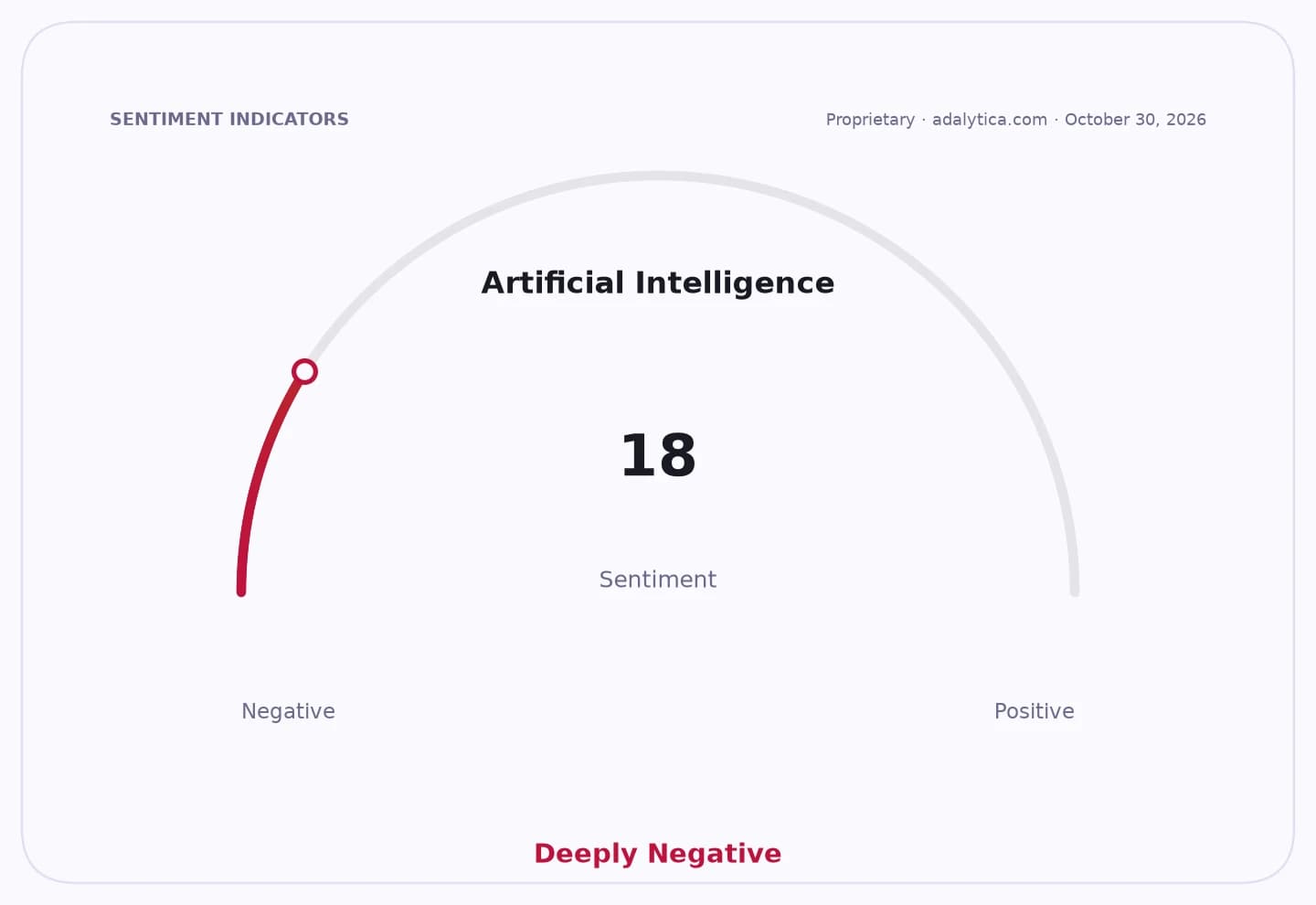
Sentiment Indicators
The latest claim comes from a Brazilian AI system called Luminari, which reportedly gave an 81% probability that the work was painted by Giovanni Antonio Boltraffio, one of da Vinci’s pupils. That is not proof, and experts are right to be skeptical. Art historians have long treated the attribution debate around “Salvator Mundi” as unresolved, and professor Frank Zoellner said AI may be useful as a tool but cannot definitively settle disputes of authorship. Still, the fact that machine analysis is now being used to challenge one of the art market’s most famous attributions shows how technology is beginning to reshape a field that has relied heavily on connoisseurship, provenance and expert opinion.
For investors and collectors, the implications extend beyond one painting. The ultra-high-end art market depends on trust, and trust depends on attribution. If AI-assisted authentication becomes more common, it could improve transparency, pressure inflated valuations and make buyers more cautious about headline-grabbing prices. That may benefit serious collectors and insurers, but it is a risk for sellers, auction houses and anyone holding assets whose value rests on contested authorship.
There is also a geopolitical and institutional layer. The painting has not been shown publicly since the sale and is expected to be displayed at Riyadh’s planned Museum of World Cultures, keeping it tied to Saudi Arabia’s cultural branding strategy. Any renewed controversy over its maker could complicate that narrative, even as it underscores the kingdom’s role in the global art market.
The broader lesson is that AI is not just rewriting how investors assess companies and markets; it is starting to intrude on cultural assets whose values depend on expert judgment. For “Salvator Mundi,” the immediate economic question is whether a record-breaking price was paid for a da Vinci or for something far less valuable — and whether the market will ever be able to agree on the answer.
| Entity | Gains | Losses |
|---|---|---|
| AI authentication tools | ▲Credibility and relevance | ▼Skepticism over limits |
| Collectors and insurers | ▲Better due diligence | ▼Higher doubt on valuations |
| Christie’s / art sellers | ▲None | ▼Reputation risk |
| Saudi owner / MBS | ▲None if attribution weakens | ▼Potential overpayment narrative |