Helene Meisler, the former Goldman Sachs technical analyst who correctly warned in September that stocks were headed lower, now says the selloff has pushed the market into a short-term oversold setup that could spark a rebound this week.
S&P 500 Oversold After Seven-Day Selloff

That matters because the S&P 500 has already fallen more than 10% from its peak and is now in correction territory, with the Nasdaq also under pressure. When a market this widely owned and this heavily levered to momentum gets stretched on the downside, forced selling can exhaust itself quickly and create a tradable bounce even if the bigger debate — whether this is a healthy reset or the start of something worse — is still unresolved.
Sentiment Indicators
S&P 500
Meisler’s call is the kind investors listen to because it comes from the tape, not the narrative. She has spent decades reading market internals, and her point is straightforward: after seven straight down days, the market is short-term oversold. That is exactly the kind of condition that has historically produced sharp countertrend rallies, especially when sentiment has turned one-sided.
The setup is not happening in a vacuum. The market is also digesting post-midterm uncertainty, a pattern that has often created a rough stretch before the presidential-cycle “sweet spot” later in the year. Stock Trader’s Almanac editor Jeffrey Hirsch has pointed to the 2018 analogy, when the S&P 500 struggled through late in the year before the market found its footing and powered higher in 2019. Hirsch argues the current cycle could follow a similar path, with Q4 of the midterm year through Q2 of the pre-election year often delivering strong returns even after a shaky start.
S&P 500 — 30-day sentimentadalytica.com
Explore this data interactively — full history, time series and cross-market comparisons.

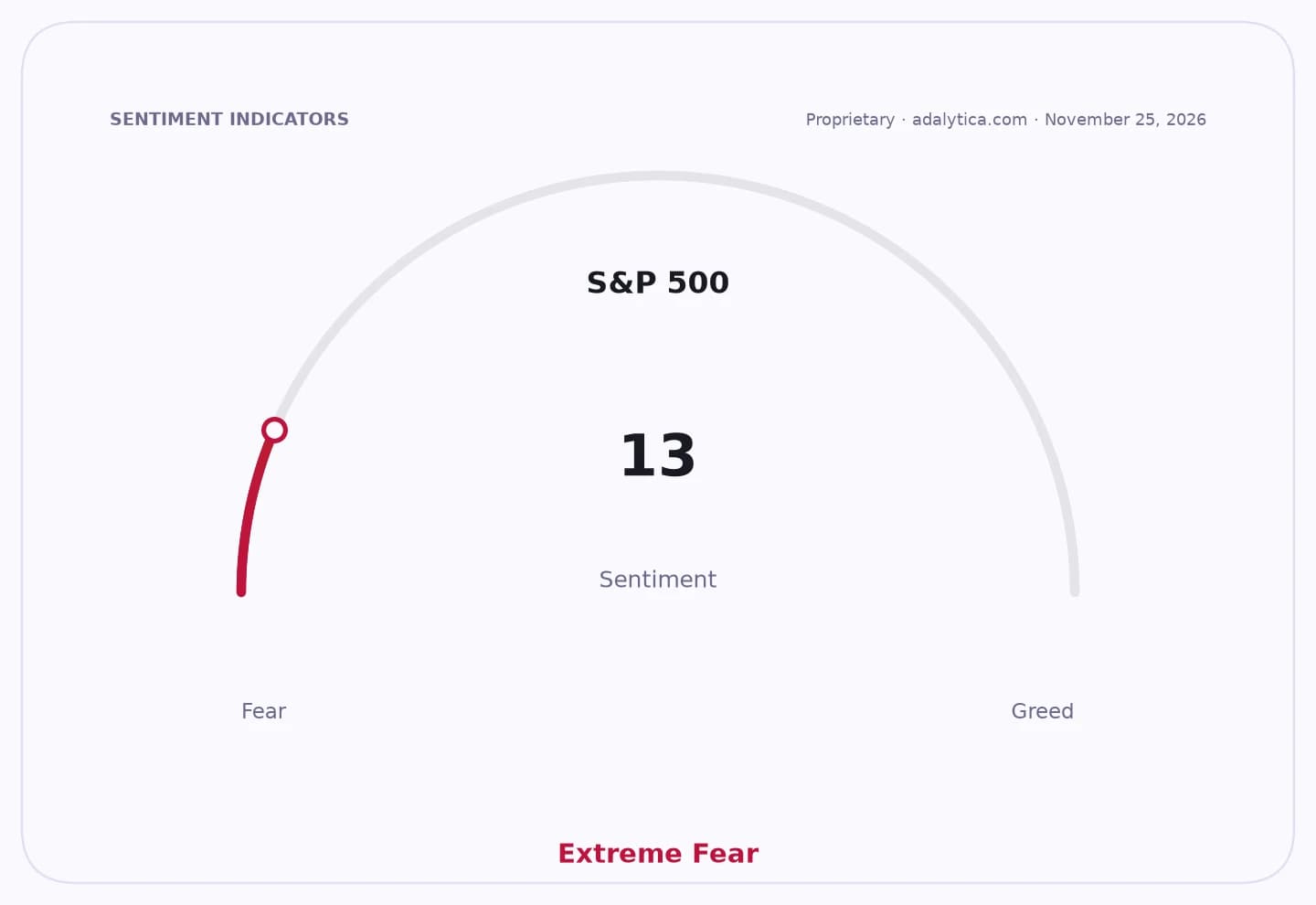
For investors, the immediate issue is not whether every risk has vanished. It is whether the market has already priced in too much bad news too fast. Technical indicators on the SPY show the S&P 500 ETF with a relative strength index around 36 and trading well below its 50-day moving average, while Adalytica’s trade signals show extreme fear even as awareness remains elevated. That combination often marks the kind of capitulation zone where short sellers become vulnerable and cash on the sidelines starts looking for entry points.
The other wrinkle is the AI trade, which has become a major source of both earnings leadership and valuation risk. There is growing concern that spending on artificial intelligence could peak and then cool, especially if the circular flow of investment among chipmakers, cloud providers and customers starts to unwind. That debate is crucial because AI capex has been one of the market’s most powerful support beams. If it slows, the unwind could hit not just megacap tech but the broader growth complex that has carried indexes higher.
Still, the broader investment takeaway is that this is the kind of tape where discipline matters more than fear. Meisler is not calling a new bull market; she is calling a bounce. That distinction matters. For investors with dry powder, the likely opportunity is in quality equities and market leaders that were punished alongside the index, while traders may look for a short-term reversal in broad ETFs like SPY. If Hirsch’s presidential-cycle read proves right, this could be the opening act of a much larger recovery.
The market may not have bottomed for good, but it may already be close enough for a tactical rebound. In volatile regimes like this, the biggest gains often come when consensus is still focused on what went wrong rather than what usually happens next.
| Entity | Gains | Losses |
|---|---|---|
| SPY / S&P 500 buyers | ▲Oversold bounce potential | ▼Late sellers |
| Short sellers | ▲Limited if rebound hits | ▼Mark-to-market losses |
| AI leaders / megacap tech | ▲Relief rally if capex fears fade | ▼Momentum unwinds |
| Cash / tactical dip buyers | ▲Entry at lower levels | ▼Passivity if rebound starts |