Ether’s slide to the $1,500 area has become the market’s most important stress test, because it is where leveraged liquidation risk, whale positioning and fragile sentiment now collide.
Ethereum Holds $1,500 as Whale Buying Emerges
The token dropped to about $1,543 before rebounding toward $1,711, but the bigger story is the amount of forced selling sitting underneath the market. More than $2.4 billion in leveraged crypto bets were wiped out in the latest washout, and a whale with 182,277 ETH on Aave responded by borrowing another $22 million to buy 13,709 ETH at $1,605. That lifted the wallet’s liquidation line to $1,401, just below the zone traders are now defending.
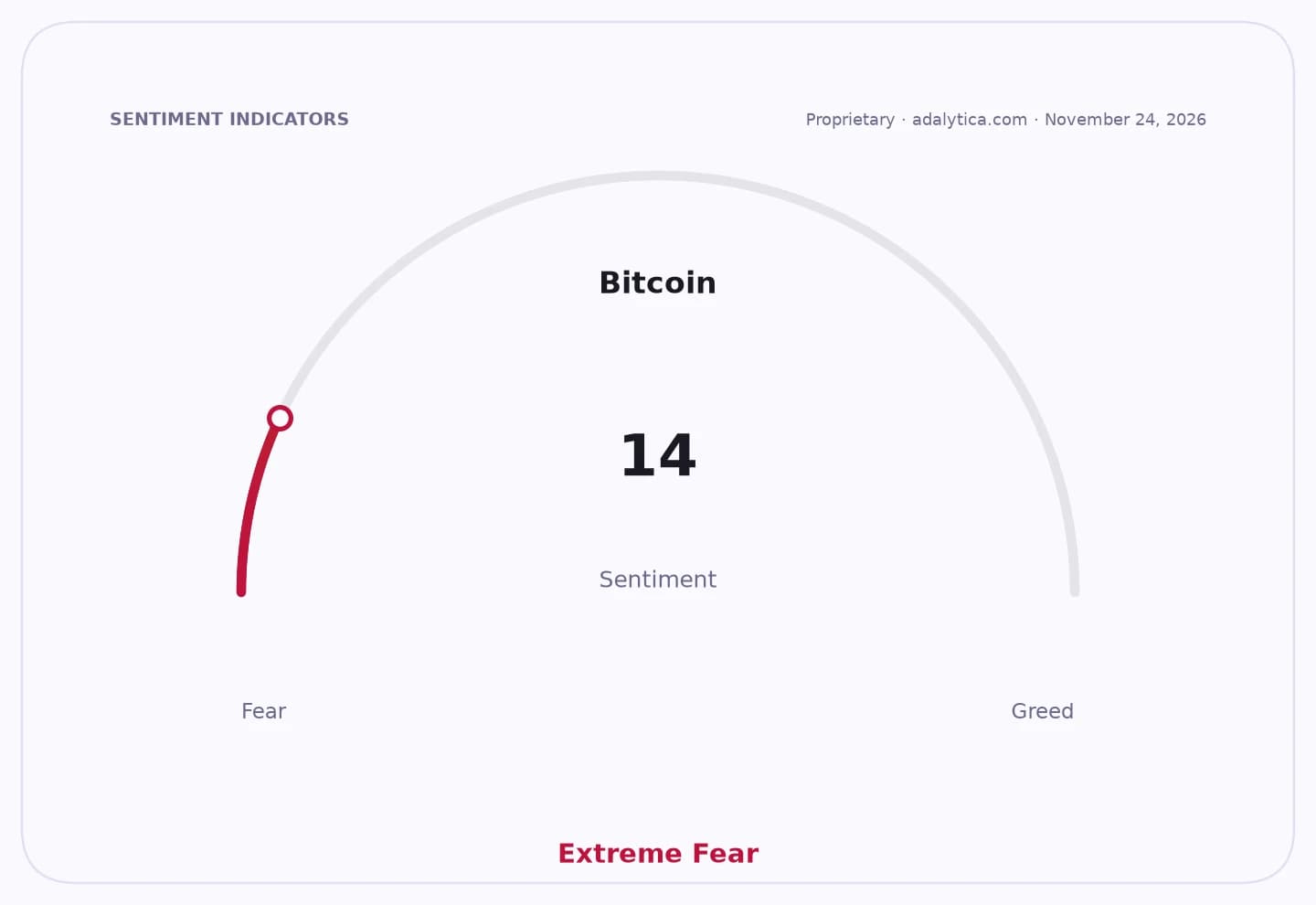
Sentiment Indicators
For investors, that matters because Ethereum is no longer being priced on momentum alone — it is being priced on whether deep-pocketed buyers can absorb panic without triggering a second wave of liquidations. Ether is still a giant asset, worth roughly $190 billion, but the market has become thin enough that a break below $1,500 could force more collateral sales and turn a routine pullback into a cascading deleveraging event. Adalytica’s Ethereum fear gauge now sits at 17, in Fear territory, with awareness in Extreme Fear, underscoring how quickly confidence has been damaged.
The technical picture is equally important. Ether’s rebound has not yet repaired the damage from the selloff: the price remains far below its 50-day and 200-day moving averages, and the recent drop pushed RSI readings deep into oversold territory before a modest bounce. Traders are now watching $1,750 and then the $1,817 to $1,850 band as the first real resistance zone. Until Ethereum can close back above that range, every rally is still a reflex bounce inside a broader risk-off trend.
That is why the whale buy matters beyond one wallet. It tells you sophisticated money still sees asymmetry at these levels, even as leverage is being flushed from the system. If $1,500 holds, the market can begin rebuilding toward $1,850 and possibly higher. If it fails, the next major reference point becomes the whale’s $1,401 liquidation level, where a forced sale could add fuel to the downside.
The market is missing the second-order trade here. When Ethereum gets hammered, the obvious story is fear. The better trade is often in the infrastructure and speculative offshoots that benefit from traders looking for cheaper beta and earlier-stage upside. That is why presale names such as Pepeto are drawing attention: the project says it has raised more than $11.3 million and is pitching a fee-free swap model on Ethereum and Solana, a direct appeal to smaller traders who feel every basis point of cost.
Pepeto is obviously a far more speculative bet than ETH itself, but that is precisely the point. When majors are under liquidation pressure, capital often rotates toward high-upside, low-entry tokens that promise exposure to the next recovery leg. If Ethereum stabilizes and liquidity returns, that risk appetite can quickly reprice the entire altcoin complex.
For now, the actionable signal is clear: Ethereum must hold the $1,500 region or risk a slide toward the low $1,400s and a fresh round of forced selling. If you want exposure, this is the kind of selloff where patient buyers scale in rather than chase strength — but the market will first need proof that the panic is over, not just paused.
| Entity | Gains | Losses |
|---|---|---|
| Ethereum bulls | ▲a defended $1,500 floor | ▼breakdown below support |
| Whale buyer | ▲lower entry on ETH | ▼if liquidation line is hit |
| Leveraged shorts | ▲profit from downside | ▼if ETH rebounds sharply |
| Pepeto presale buyers | ▲speculative upside | ▼if risk appetite stays frozen |