Michael Saylor’s latest Bitcoin purchase is a timely bet that the market is underestimating how quickly risk appetite can snap back in crypto, even as broader sentiment remains washed out.
Strategy Buys More Bitcoin as Fear Stays High

Strategy added another 250 bitcoin between Oct. 5 and Oct. 11, lifting its holdings to 848,250 BTC, while Strive also kept buying, taking its stash to 35,595 BTC after two October purchases. The message is bigger than one company’s treasury trade: institutional buyers are still using weakness to accumulate, and they are doing it while Bitcoin hovers near $80,000 and market mood has turned distinctly defensive.
Sentiment IndicatorsⓘProprietary · adalytica.com · October 24, 2026
This is a snapshot — live sentiment, awareness and momentum for 130+ markets update continuously in the dashboard.Open AlphaPulse
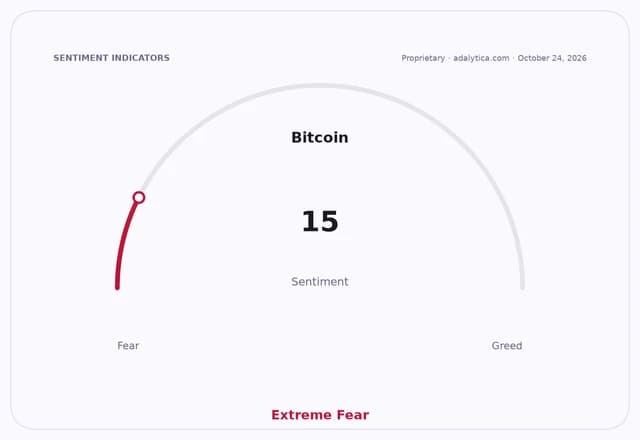
That matters because Bitcoin is now trading against a backdrop that historically has rewarded patient buyers. The Bitcoin-to-silver ratio is bouncing off a multiyear support trendline, a setup that preceded rallies of more than 1,200% in 2021-22 and 412% in 2024-25. At the same time, Adalytica’s Bitcoin Fear & Greed Index sits at 15, deep in extreme fear, while U.S. equity sentiment has also collapsed. In other words, the market is nervous, but the positioning is exactly the kind that can fuel a sharp Q4 reversal if Bitcoin holds.
The technical picture argues the same way. Bitcoin’s relative strength is being tested while the crypto market’s RSI remains in weak territory, usually a sign that selling pressure is still dominating. But for long-term allocators, that is often the moment to build exposure, not flee it. Saylor appears to be leaning into that view, effectively treating the current tape as an accumulation window rather than a warning sign.
Bitcoin — 30-day sentimentadalytica.com
Explore this data interactively — full history, time series and cross-market comparisons.Open AlphaPulse
For investors, the real story is not just Bitcoin itself but the second-order trade. If the coin stabilizes and the silver ratio continues to rebound, the winners are likely to be the most levered institutional proxies: Strategy, Coinbase and Bitcoin ETFs such as IBIT. Strategy has already shown how powerfully its stock can react to BTC conviction, while IBIT remains the cleanest vehicle for institutions that want direct exposure without balance-sheet risk. A turn in Bitcoin would also revive trading volumes and fee generation across the crypto platform stack.
The broader setup is even more interesting because the macro backdrop is turning friendlier for alternative stores of value. U.S. equities are cooling, the dollar has weakened sharply in Adalytica’s trade signals, and Bitcoin increasingly has a chance to act like a hedge if markets keep wobbling into year-end. That creates an asymmetric window: downside is still tied to macro stress, but upside could accelerate quickly if institutional bids keep arriving and the fear trade reverses.
The takeaway is straightforward: Saylor is not buying because he thinks Bitcoin is comfortable here, but because he thinks the market is missing the next move. If Bitcoin’s silver ratio keeps breaking higher from support, Q4 could become the first real inflection point for the next leg of the crypto cycle. For investors, that argues for building exposure now, while fear is still high and the best names are still trading like the rally has not started yet.
| Entity | Gains | Losses |
|---|---|---|
| Strategy (MSTR) | ▲BTC leverage upside | ▼treasury volatility |
| IBIT | ▲fresh inflows | ▼lower trading volumes |
| Coinbase (COIN) | ▲volume rebound | ▼weak crypto prices |
| Short-term bears | ▲lower entry risk | ▼missing a Q4 rebound |