Michael Saylor is signalling that Strategy will keep buying Bitcoin, even as the company’s funding flexibility narrows and a looming MSCI decision threatens to push passive investors out of the stock.
Strategy buys Bitcoin as MSCI decision nears

That is the central tension for Strategy: the world’s biggest corporate Bitcoin holder still wants to add to its 848,250 BTC stash, but it is now being forced to balance that ambition against preferred-share obligations, liquidity management and the possibility that it could be dropped from major benchmarks on Nov. 11. JPMorgan estimates an MSCI exclusion could trigger about $2.8 billion of passive outflows, a hit that would matter far beyond Strategy’s own balance sheet because the stock has become a proxy trade on institutional acceptance of Bitcoin.
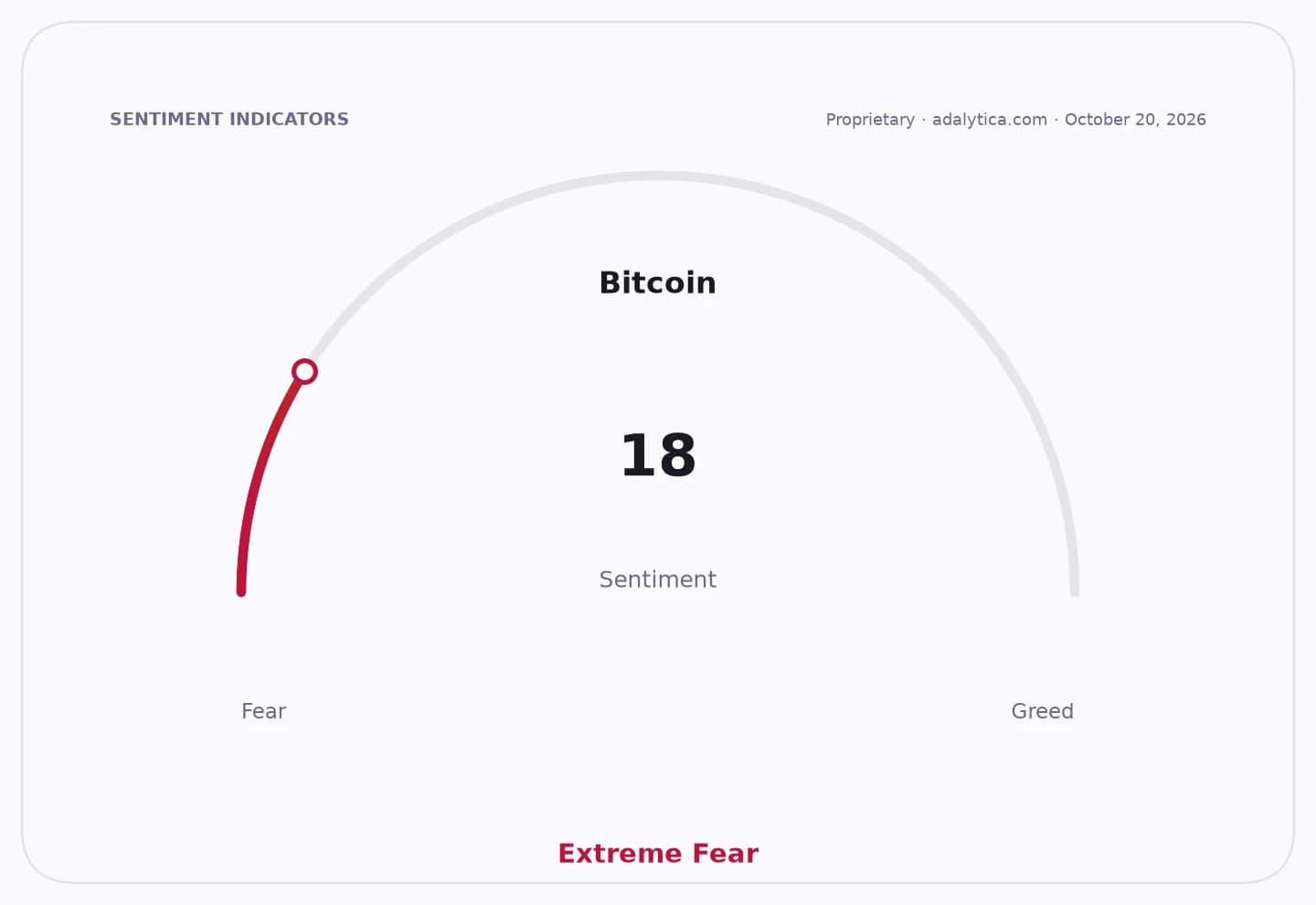
Sentiment IndicatorsⓘProprietary · adalytica.com · October 22, 2026
This is a snapshot — live sentiment, awareness and momentum for 130+ markets update continuously in the dashboard.Open AlphaPulse

Saylor’s latest post on X — “We found room for more orange” — was a familiar signal that Strategy remains committed to accumulation. But the company’s recent activity shows that commitment is no longer unconstrained. In the latest reporting week, Strategy bought just 250 Bitcoin for about $21.5 million, its smallest weekly purchase this year, while allocating $192.4 million to repurchase Series STRC preferred shares. That shift suggests management is prioritizing capital structure repair over outright crypto accumulation, likely because STRC’s 12.31% yield is an increasingly expensive claim on future cash flows.
The market is already treating the trade as higher risk. Strategy shares fell 9.56% to $136.83, dragging the company’s market net asset value ratio to 0.83x, meaning the stock now trades below the estimated value of its underlying assets. That discount matters because it weakens one of the most important pillars of the Strategy equity story: that investors would pay a premium for leveraged Bitcoin exposure wrapped in a public company structure. Once that premium disappears, financing new purchases becomes harder and more dilutive.
At the same time, Strategy’s Bitcoin position remains enormous by any measure. Its holdings are valued at roughly $69.45 billion, with an average acquisition cost of $75,444 per coin. The portfolio is still showing an unrealized gain of 8.15%, and the company says its Bitcoin stack is up 26.1% year to date. But those headline gains are now set against a more demanding funding environment, with about $5.5 billion in dollar reserves intended to support liquidity and dividend obligations rather than aggressive expansion.
The MSCI issue is particularly important because it goes to the heart of whether Strategy is viewed as a software company with a large Bitcoin treasury or as a quasi-crypto fund that no longer fits traditional index rules. If the latter view prevails, the stock could lose benchmark demand from index-tracking funds at a time when the shares are already under pressure. That would not only reduce liquidity and deepen volatility, but could also raise the cost of capital for future Bitcoin purchases.
For investors, the immediate question is whether Saylor can keep the accumulation narrative alive without relying on the market to fund it at a premium. Bullish holders will argue that Strategy still has scale, reserves and operating flexibility, and that any benchmark-related selloff would be temporary if Bitcoin remains strong. The bear case is that MSCI exclusion, a sub-1.0x mNAV and higher preferred obligations together mark the point where the model starts to strain.
Bitcoin itself is not the only driver here, but it remains the backdrop. The token was last trading around $81,521, close to its 50-day moving average, while Strategy’s stock is attempting to stabilize after a sharp break lower. With MSCI due to rule on the company next month, the next catalyst is less about the next Bitcoin purchase and more about whether Strategy can preserve its place in mainstream equity indexes while still behaving like a Bitcoin accumulator.
| Entity | Gains | Losses |
|---|---|---|
| Strategy | ▲Bitcoin appreciation, treasury value | ▼Benchmark inclusion, stock premium |
| Passive index funds | ▲— | ▼Forced selling risk |
| Bitcoin bulls | ▲Corporate accumulation narrative | ▼If Strategy trims buying |
| Preferred shareholders | ▲Higher repayment priority | ▼If cash stays tight |