Tesla’s latest rally matters because the market is re-pricing the company not just as an EV maker, but as a lower-risk borrower with broader access to capital at a moment when its growth story still depends on heavy spending in autonomy, robotics and manufacturing.
Tesla rally shifts focus to financing profile

That shift is economically important. An investment-grade balance sheet can reduce funding costs, widen the buyer base for Tesla’s debt, and give Elon Musk more flexibility to keep investing through the next capex cycle without leaning as hard on equity markets. For a company valued on future optionality — robotaxis, Optimus, energy storage and software margins — that matters more than a quarter of vehicle deliveries.
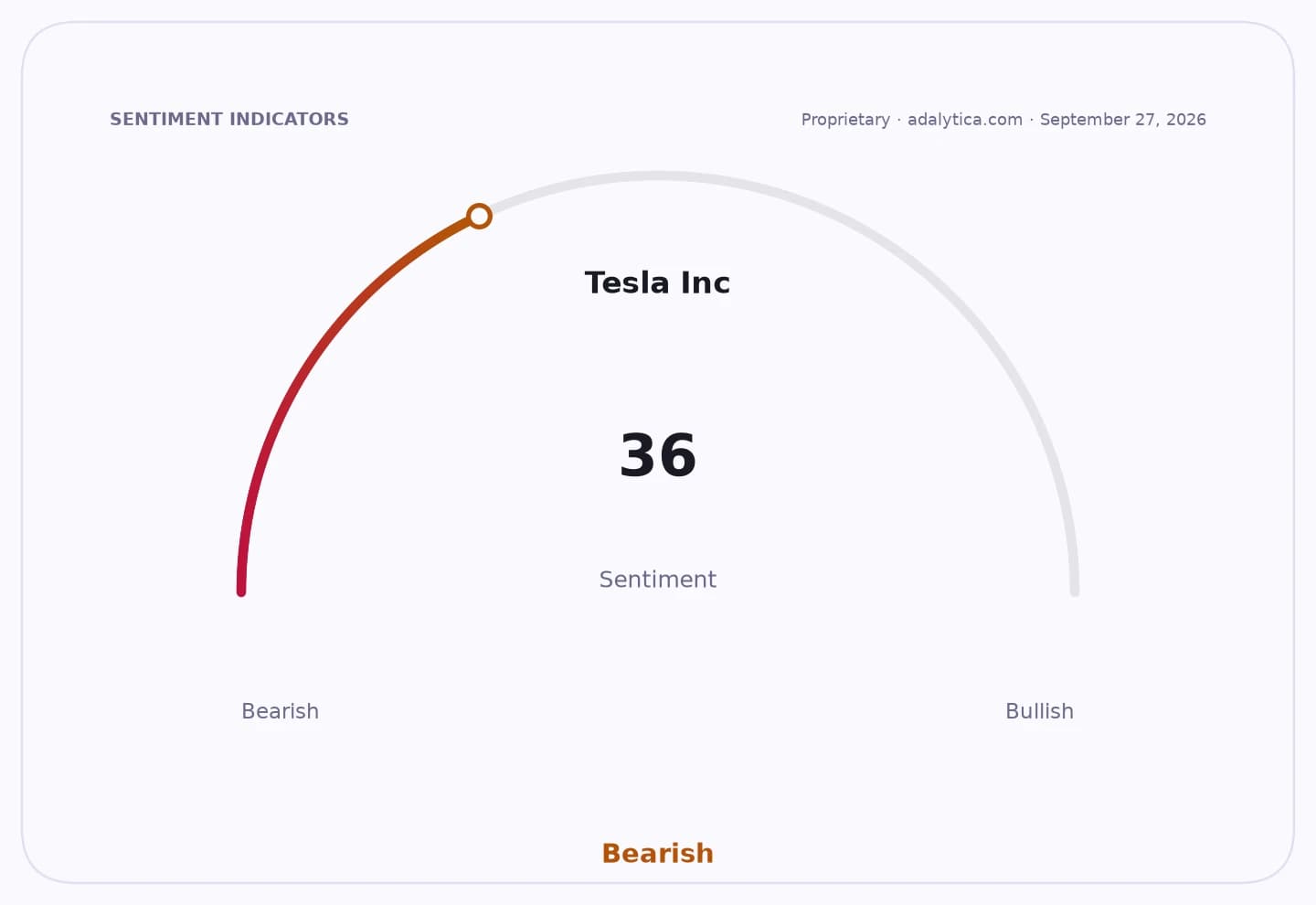
Sentiment IndicatorsⓘProprietary · adalytica.com · September 26, 2026
This is a snapshot — live sentiment, awareness and momentum for 130+ markets update continuously in the dashboard.Open AlphaPulse
The stock has already been acting like investors are beginning to look past the auto cycle. Tesla closed at $372.11 on Sept. 25, after trading as high as $489.88 in December, and the recent technical backdrop still points to a stock that is trying to rebuild momentum even after a sharp pullback. The 50-day moving average remains below the current price, while the RSI has cooled from overbought levels, suggesting the move is being digested rather than abandoned.
What the market is really pricing is a better financing profile for a business that still burns plenty of capital in the race to build the next platform. Tesla’s recent filings underscore that it is simultaneously ramping production, expanding its Supercharger network and investing in autonomy, robotics and new battery technology. That is a classic investment-grade story: a capital-intensive company with enough scale and cash generation to fund its own future, and enough strategic value that lenders are increasingly willing to give it the benefit of the doubt.
That is also why the move matters beyond Tesla itself. In a market that has been rewarding infrastructure, AI and electrification plays, Tesla now looks less like a speculative auto stock and more like a financing platform for multiple secular growth bets. If the credit profile keeps improving, Tesla can keep leaning into the highest-upside parts of its story while competitors face tighter balance-sheet constraints.
The relative losers are easier to spot. Traditional automakers such as Ford and General Motors remain exposed to the old EV economics — thinner margins, heavier legacy costs and more pressure from tariffs, regulation and cyclical demand — while Tesla’s stronger balance-sheet profile gives it more room to outspend them in software, batteries and autonomous systems. That gap is exactly where the next leg of value creation will likely come from.
Investors should watch whether Tesla’s market strength is matched by more favorable credit pricing and continued operating cash flow. If it is, the stock’s next move may not be about cars at all, but about the market finally valuing Tesla like a durable industrial-tech compounder with cheap capital and long-duration optionality.
| Entity | Gains | Losses |
|---|---|---|
| Tesla | ▲Lower funding costs, wider investor base | ▼Less debt-market pressure |
| Tesla shareholders | ▲More optionality, lower balance-sheet risk | ▼Less near-term distress discount |
| Ford | ▲None | ▼Relative capital-cost disadvantage |
| General Motors | ▲None | ▼Slower EV/tech investment flexibility |