Tirana is pulling further ahead of the rest of Albania on pay, with average monthly wages in its best-paid industries now above 120,000 lekë, while many regional workers remain clustered far below that level.
Tirana wage gap widens vs Albania regions
That matters because the wage gap is no longer just a social statistic — it is a map of where the country’s most productive, highest-value jobs are being created, and where they are not. For investors, entrepreneurs and policymakers, the message is straightforward: Albania’s growth is still highly concentrated in the capital, and that concentration is shaping everything from consumer spending to labor supply and regional development.
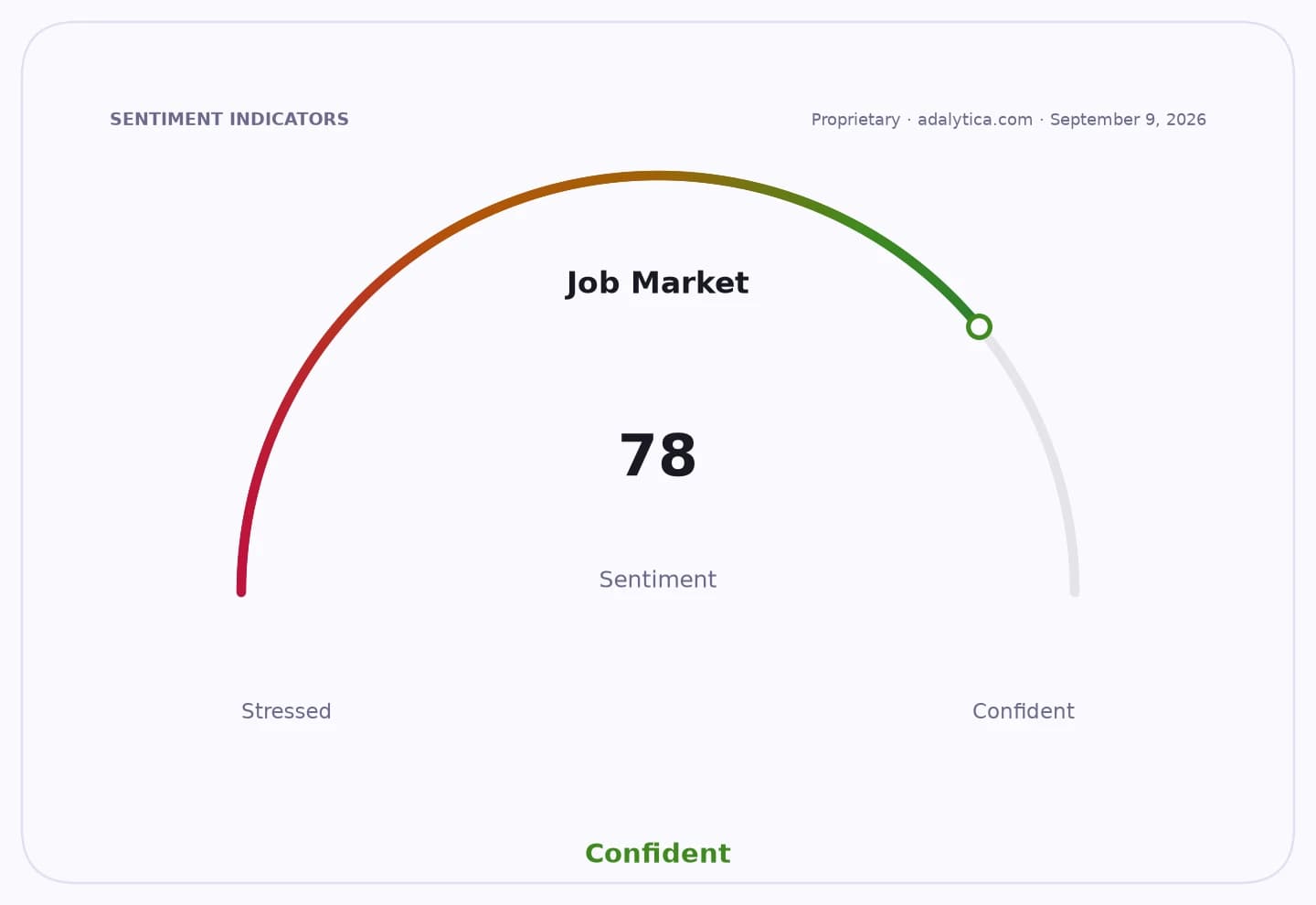
Sentiment IndicatorsⓘProprietary · adalytica.com · September 9, 2026
This is a snapshot — live sentiment, awareness and momentum for 130+ markets update continuously in the dashboard.Open AlphaPulse
INSTAT’s regional data show the biggest premium in Tirana comes from information and communications, finance, insurance, real estate and professional services. In those sectors, average pay exceeds 120,000 lekë a month, more than double the roughly 45,000 to 60,000 lekë typical in most other counties. Even in public administration, education and health — usually among the best-paid areas outside the private sector — regional wages mostly sit between 80,000 and 87,000 lekë, still well below the capital’s private-sector peak.
The pattern points to a deeper economic imbalance. High-skill, high-productivity activities remain concentrated in Tirana, where companies can tap larger labor pools, better infrastructure and denser business networks. Outside the capital, the pay structure is flatter and weaker, with fewer private employers able to bid up wages. In Berat, Elbasan and Korçë, most sectoral pay sits around 45,000 to 60,000 lekë, while in Kukës and Dibër the market is even softer. Kukës is the weakest region in the data, with agricultural wages near 40,000 lekë and only public administration approaching 80,000 lekë.
That is significant for the broader economy because wage inequality often becomes labor-market inequality. Workers follow pay, which means the capital keeps attracting talent, investment and spending power, while smaller regions risk losing both people and enterprise. Over time, that can widen disparities in housing, retail activity, services demand and tax revenues. It can also make it harder for regional firms to scale, since they are competing for workers against public institutions rather than a deeper private economy.
There are still pockets of strength outside Tirana. Durrës benefits from trade, transport and tourism-linked jobs, while Fier stands out in extractive and processing industries, power and water, where average pay reaches about 75,000 lekë. Gjirokastër also shows relatively better pay in trade, transport, accommodation and food services. But these are exceptions that underline the rule: Albania’s better-paid private economy remains heavily centered in Tirana.
For long-term investors, that concentration has two readings. It supports capital-city consumption, office demand and the expansion of modern services. But it also highlights a structural risk for the country: uneven income growth can cap domestic demand in the regions and keep the labor market tight in the capital. Unless more high-value industries spread beyond Tirana, the pay gap is likely to remain a durable feature of Albania’s economy rather than a temporary distortion.
For now, the wage story is clear. Tirana is still the country’s economic engine — but the distance between the engine and the rest of Albania is getting wider, and that is worth watching closely.
| Entity | Gains | Losses |
|---|---|---|
| Tirana’s high-value sectors | ▲Higher wages, talent inflow | ▼— |
| Regional workers | ▲Public-sector stability | ▼Private-sector pay gap |
| Businesses outside the capital | ▲Lower labor costs | ▼Harder to attract skills |
| Albania’s economy | ▲Stronger capital concentration | ▼Wider regional inequality |