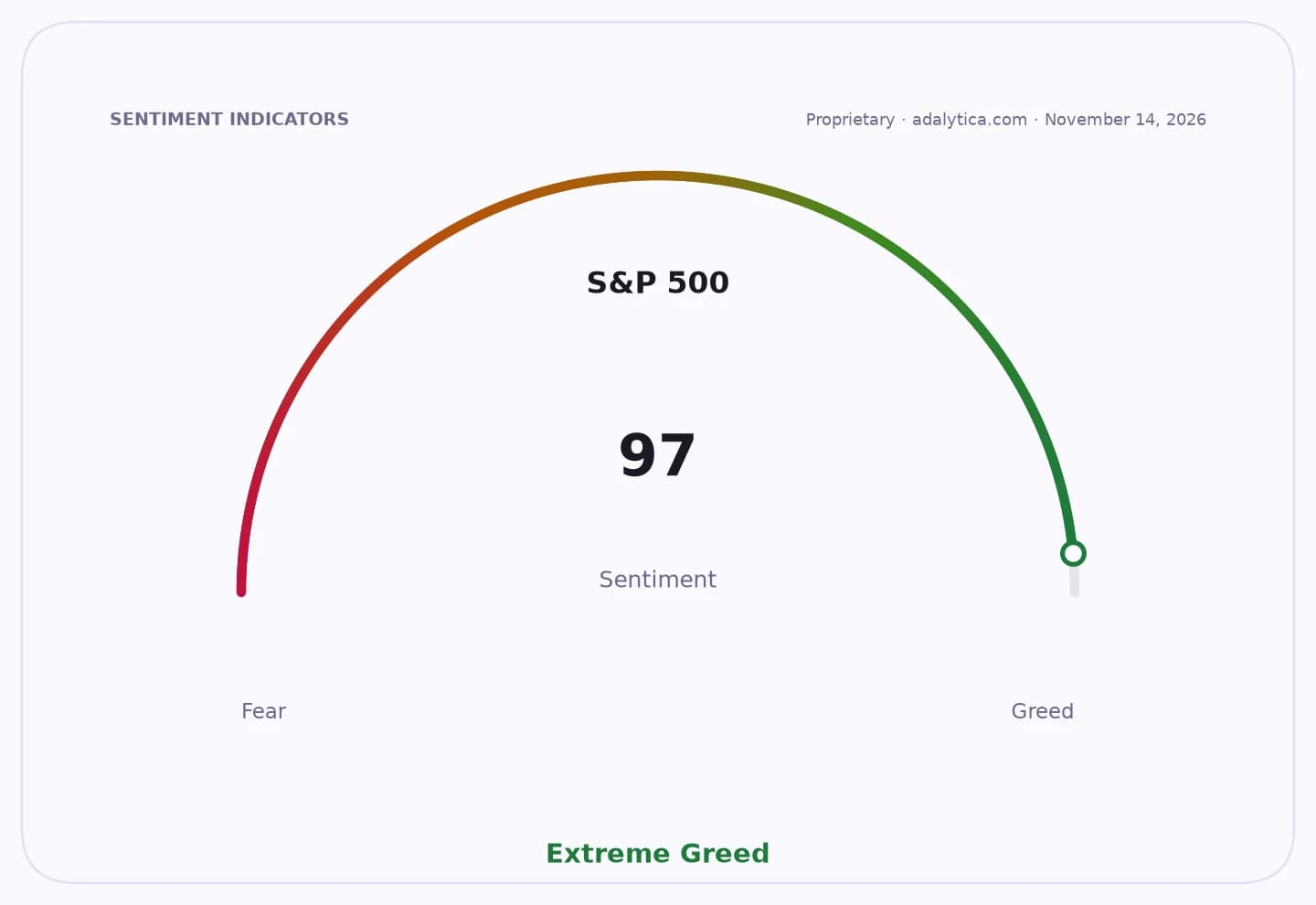
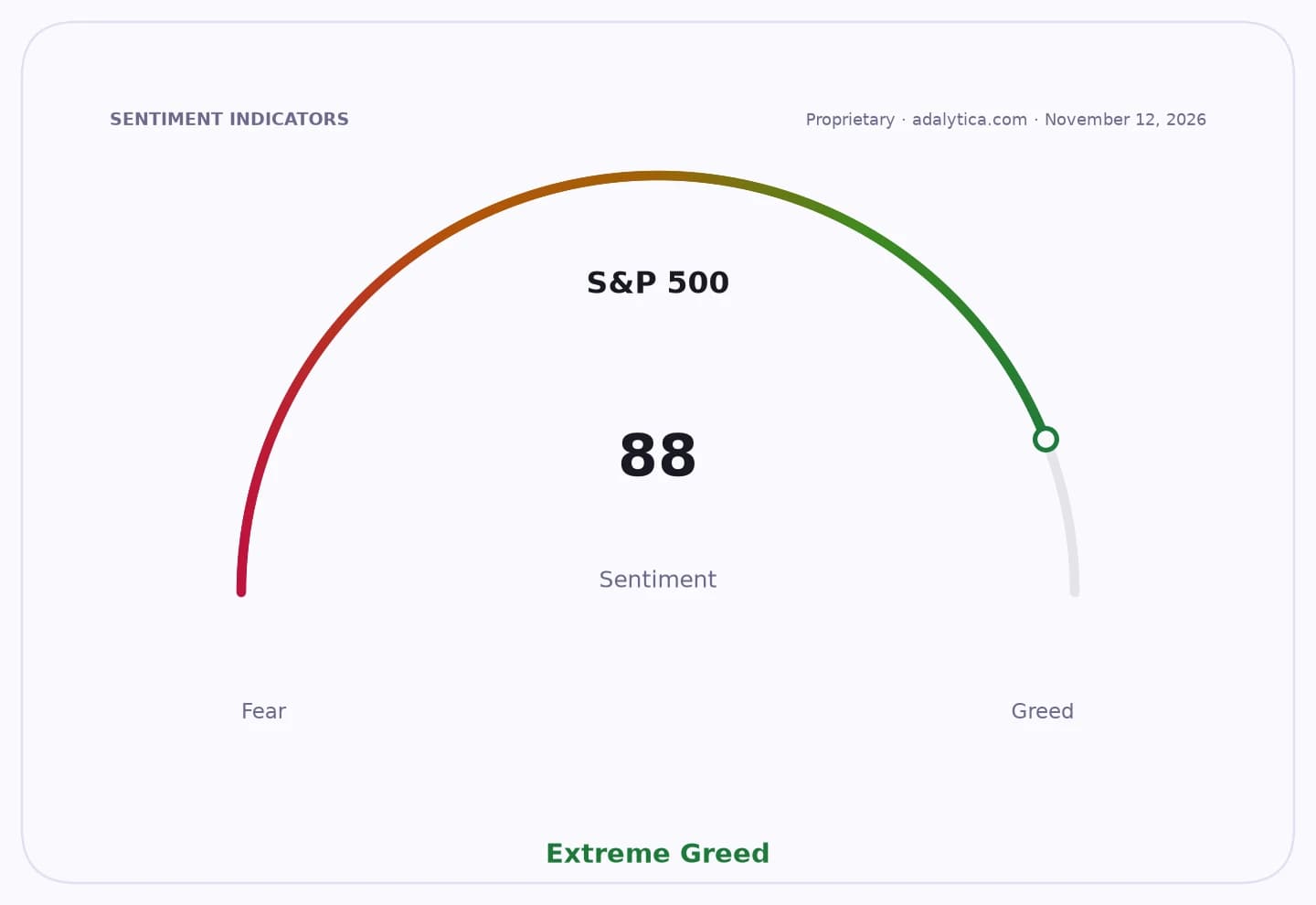
UBS Chief Executive Sergio Ermotti is pressing his warning that investors have become too relaxed about risk just as the artificial-intelligence trade starts to wobble and Wall Street reels from a sharp selloff.
UBS Warns on AI Trade and Market Complacency

That matters because a crowded AI trade has helped drive a big share of this year’s equity gains, leaving banks, fund managers and corporate treasurers exposed if sentiment turns faster than fundamentals.
Sentiment Indicators
S&P 500
Ermotti’s comments land against a backdrop of higher-for-longer rates, with the U.S. 10-year Treasury yield around 5.1% and the federal-funds rate near 3.9%, a combination that keeps financing costs elevated and makes valuations harder to defend. For investors, that raises the risk that stretched pockets of the market can unwind quickly when earnings fail to match the hype.
The UBS chief has also been arguing that turbulence could revive dealmaking, even if it first shakes confidence. When valuations reset and management teams reassess strategy, M&A often follows — and UBS, one of the world’s biggest advisory banks, stands to benefit if a volatility spike pushes companies toward defensive combinations or portfolio reshuffling.
Geopolitical Risk vs UBSadalytica.com
Explore this data interactively — full history, time series and cross-market comparisons.

UBS itself has been navigating the aftershocks of the Credit Suisse rescue while trying to convince markets that the integration is under control. The stock, which closed at $48.31 on Nov. 13, sits just below its 50-day moving average of $49.07 and above its 200-day moving average of $46.85, suggesting the shares are consolidating rather than breaking out.
That mixed technical picture mirrors the broader banking sector, where the Financial Select Sector SPDR Fund has climbed to $58.68 but still shows signs of slowing momentum after a strong run. If the AI-led equity pullback broadens into a wider risk-off move, lenders and capital-markets firms could see trading volumes rise even as underwriting and advisory activity get more selective.
For UBS investors, the key question is whether market volatility becomes a short-lived correction or the start of a more durable repricing. Either way, Ermotti’s message is that complacency is the real risk — and that the next phase of the market may be defined less by AI exuberance than by what happens when that trade loses its shine.
| Entity | Gains | Losses |
|---|---|---|
| UBS | ▲More advisory and trading activity | ▼Risk from market drawdowns |
| AI-heavy megacaps | ▲Still attract capital on dips | ▼Valuation compression |
| Banks and brokers | ▲Volatility-driven client flows | ▼Slower underwriting pipelines |
| Equity investors | ▲Potential buying opportunities | ▼Pain from crowded positioning |