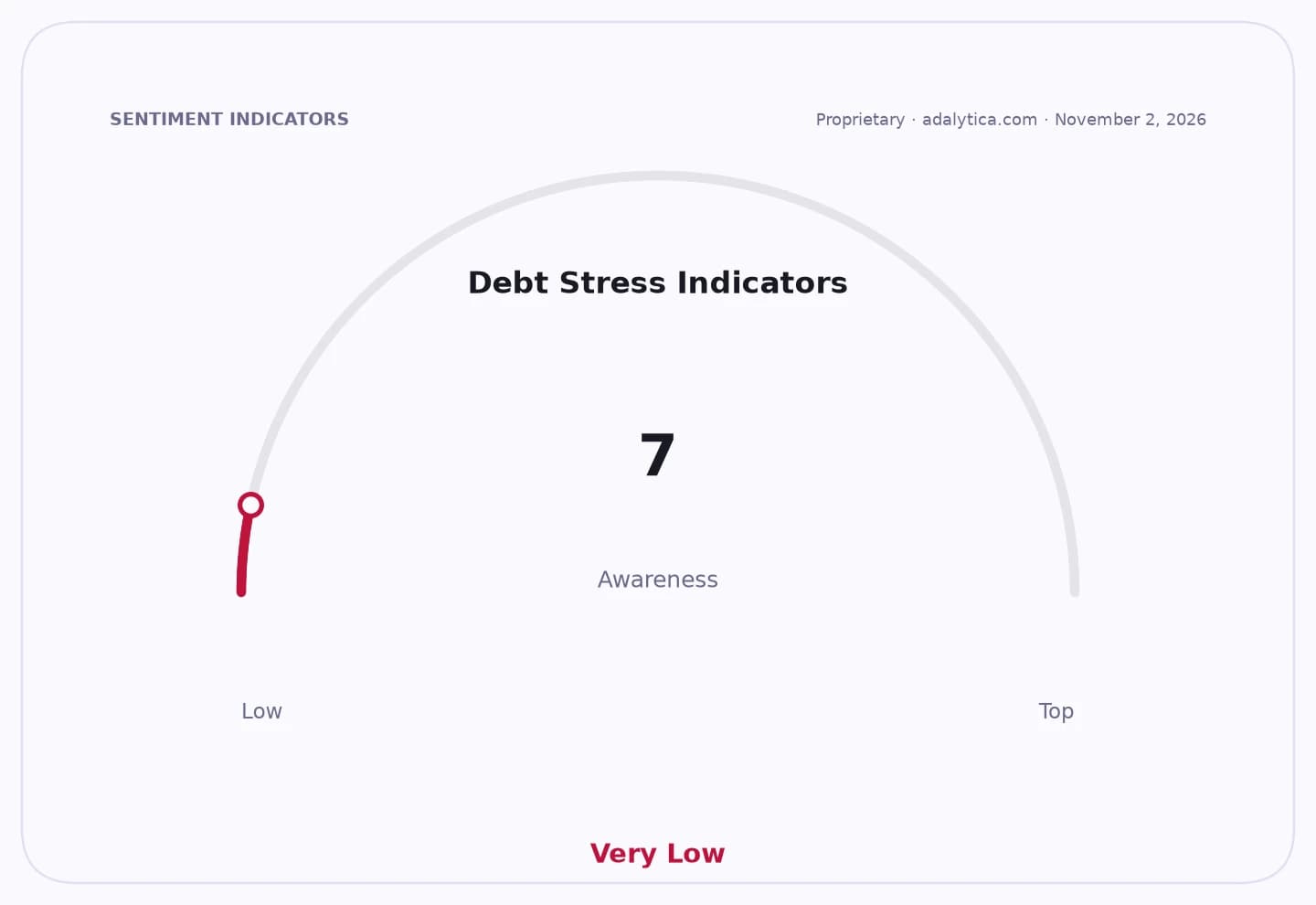
Vietnam’s listed banks are heading into the final quarter with thinner loss-absorbing buffers just as asset quality weakens, a combination that is likely to keep provisioning costs elevated and pressure earnings even as lending growth continues.
Vietnam banks face higher bad debt and lower coverage

According to SHS Research’s third-quarter 2026 review, the bad-debt ratio across 27 listed lenders rose to 2.12% at Sept. 30 from 1.87% at the end of 2025, while the share of loans in the watchlist category also climbed to 1.59% from 1.17%. The deterioration is important because it suggests the problem is not confined to a few legacy loans: new bad debt formation rose to 1.55% in the first nine months of 2026 from 1.32% in 2025, while credit cost edged higher to 1.19% from 1.11%.
Sentiment Indicators

The bigger market issue is that banks are carrying less cushion against further stress. The loan-loss coverage ratio for the group fell to 74% from 83% at the end of last year, meaning provisions now cover a smaller portion of soured loans. In a banking system where loan growth is still expanding, that leaves lenders more exposed if borrowers remain under pressure or if restructured loans fail to heal as quickly as hoped.
That trade-off is already showing up in earnings. Provisioning expenses at the 27 listed banks jumped 42.5% from a year earlier, far outpacing the 27.2% increase in pre-provision profit. While the sector still posted nine-month pretax profit of 311.1 trillion dong, up 20% year on year, the widening gap between operating income and credit costs implies that a larger share of revenue is being absorbed by reserve building rather than flowing through to the bottom line.
The strain is most visible at the state-controlled banks, which remain systemically important and are often the bellwether for the sector’s credit cycle. Vietcombank, VietinBank and BIDV together held 86.1 trillion dong of bad debt at end-September. BIDV accounted for the largest amount at 47.5 trillion dong and also had the weakest coverage ratio among the three at 73%, down from 100% at end-2025. Vietcombank, by contrast, kept coverage at 243%, while VietinBank stood at 160%, underscoring a split between lenders that still have ample buffers and those that have already used up much of their reserve strength.
For investors, the message is straightforward: the sector’s headline profit growth is intact for now, but the quality of that growth is deteriorating. Banks with stronger coverage, such as Vietcombank and VietinBank, retain more room to absorb losses without a sharp hit to capital or dividends. Lenders with thinner buffers, especially those with larger stockpiles of troubled assets, may face a longer period of elevated provisioning and more pressure on return on equity.
The outlook for the fourth quarter will hinge on whether bad debt formation stabilizes and whether banks can rebuild buffers without sacrificing growth. SHS flagged non-performing loans, new bad debt formation, coverage ratios and credit costs as the key indicators to watch. If credit expansion continues while asset quality slips further, Vietnam’s banks may find that profit growth increasingly depends less on lending momentum and more on how quickly they can clean up their balance sheets.
| Entity | Gains | Losses |
|---|---|---|
| Banks with high coverage ratios | ▲Better loss absorption | ▼Slower near-term profit growth |
| Banks with weak coverage, especially BIDV | ▲Loan growth base | ▼Higher provisioning pressure |
| Borrowers under stress | ▲Possible restructuring support | ▼Tighter credit scrutiny |
| Investors in bank equities | ▲Visibility into stronger lenders | ▼Lower earnings quality at weaker lenders |