Vietnam’s real estate developers are leaning harder on bonds just as refinancing gets more expensive and a 167 trillion dong maturity wall looms over 2026-2027, raising the odds of further stress in a sector that still relies heavily on bank credit.
Vietnam property developers face 2026-2027 bond wall

The immediate issue is not just the size of the debt due, but the mismatch between short-term funding needs and the industry’s ability to generate cash. After bank lending slowed and equity markets weakened, property firms sold about 149.5 trillion dong of bonds in the first nine months of 2026, up 126% from a year earlier. Yet the average coupon on those deals climbed to about 11.4% a year, 110 basis points higher than the same period last year, making every refinancing round more expensive.
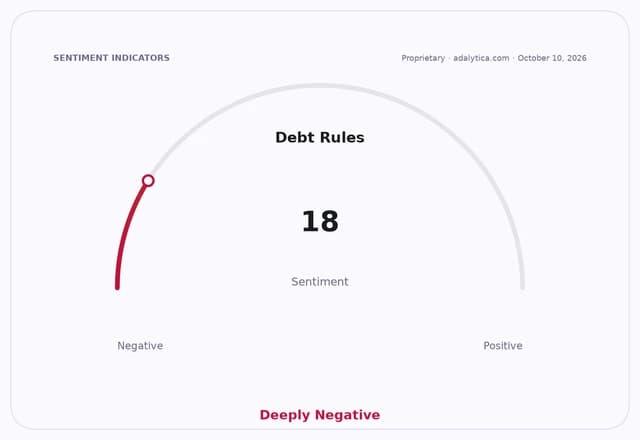
Sentiment IndicatorsⓘProprietary · adalytica.com · October 10, 2026
This is a snapshot — live sentiment, awareness and momentum for 130+ markets update continuously in the dashboard.Open AlphaPulse
That creates a delicate backdrop for a sector whose leverage is already rising. Listed developers’ debt-to-equity ratio reached 74% in the first half, up from an average of 54% in 2022-2025, even as net revenue and EBITDA rose 89% and 100%, respectively. The problem is that operating cash flow has not kept pace. Outside Vinhomes, which reported about 90 trillion dong of positive operating cash flow over the past 12 months, many developers remain in the red on cash generation.
The refinancing burden will intensify as roughly 167 trillion dong of property bonds come due from the fourth quarter of 2026 through the end of 2027. VIS Rating said the sector’s credit profile could weaken in the second half of 2026, with the greatest risk concentrated among smaller developers, firms dependent on the secondary market or projects still tangled in legal disputes.
For investors, that means the sector’s recovery is likely to be uneven. Large developers with stronger sales pipelines, land banks and bank access can still roll debt and fund completions, while weaker names may be forced into asset sales, equity injections or maturity extensions. The market is already signaling that debt quality matters more than headline yields: higher coupons offer little comfort if cash flow cannot support repayment.
Local economists say the solution is to stop using new borrowing simply to repay old debt. BIDV chief economist Cấn Văn Lực said developers need to prioritize cash generation from operations, dispose of non-core assets and accelerate projects with cleaner legal status so units can be launched and sold sooner. VARS vice chairman Nguyễn Văn Đính said bond extensions only help if they are paired with stronger cash flow; otherwise debt just accumulates further.
The bullish case is that the pressure is still manageable. Cấn said the current burden is about one-third below the August 2023 peak, while property sales, a recovering market and faster public investment are helping liquidity. He also said property-sector credit growth could reach about 15% in 2026, adding roughly 675 trillion dong of financing capacity.
The bearish case is that financing conditions are still fragile. Credit growth in property was only 8.6% in the first half of 2026, down from 15% a year earlier, equity issuance almost disappeared at about 350 billion dong, and investors are being asked to absorb more debt at higher rates. If legal bottlenecks delay projects or sales soften, the refinancing window could close quickly for smaller players.
For investors, the next phase will hinge on which developers can convert assets into cash before the maturity wall arrives. Those with strong presales, low legal risk and access to diversified funding should outperform. Those that remain dependent on bond rollovers will face rising funding costs, weaker credit metrics and a greater chance of restructuring.
| Entity | Gains | Losses |
|---|---|---|
| Large developers | ▲Access to refinancing | ▼Higher coupons |
| Smaller developers | ▲— | ▼Maturity wall pressure |
| Bondholders | ▲Higher yields | ▼Greater default risk |
| Banks | ▲More lending demand | ▼Concentration risk |