The number of 401(k) millionaires has fallen as violent swings in U.S. equities have chipped away at the paper wealth of retirement savers who had been riding a years-long market rally.
401(k) Millionaires Fall as U.S. Stocks Swing

That matters because the drop is not just a headline about wealthy households; it is a reminder that retirement security in the U.S. remains tightly tied to market direction. When stocks rise, millions of defined-contribution savers quietly move closer to or above the $1 million mark. When markets lurch lower, those gains can evaporate quickly, especially for workers nearing retirement who have less time to recover losses.
Sentiment Indicators
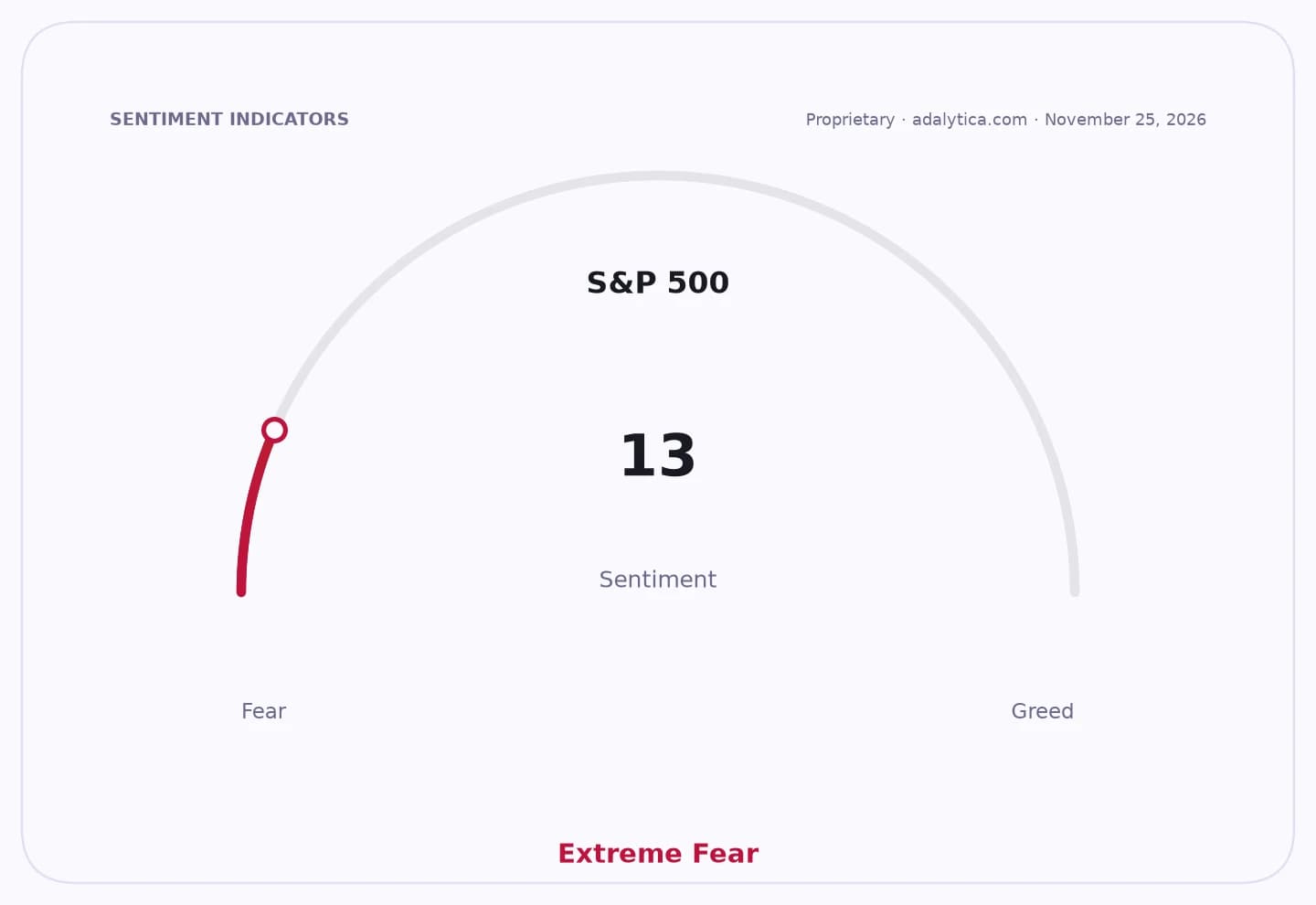
The latest market backdrop has been harsh for that group. The S&P 500, tracked by SPY, has swung sharply over the past year, with the fund falling to $689.81 on Nov. 20 from $766.81 on Nov. 4 before recovering only part of that loss to $716.70 on Nov. 25. The tech-heavy Nasdaq 100, tracked by QQQ, has been even more volatile, dropping from $709.80 on Oct. 16 to $608.45 on Nov. 20 and closing at $633.93 on Nov. 25. Such drawdowns can be especially damaging to account balances that are heavily weighted to equities and have been built up through automatic payroll contributions rather than new windfalls.
Technical indicators underline how unsettled the tape has been. SPY’s 14-day RSI slipped to 29.4 on Nov. 20, a reading that typically reflects oversold conditions, while QQQ’s RSI was 31.4 that same day. Even after the rebound, both funds remained well below recent highs and their MACD readings stayed negative, suggesting momentum had not fully reset. VTI, a broad U.S. equity proxy, fell to 340.02 on Nov. 20 from 376.92 on Nov. 4 before recovering to 353.20 on Nov. 25, reinforcing that the pressure was not confined to a single sector.
The macro backdrop has not provided much comfort. Treasury yields remain elevated by recent standards, with the 10-year note at 4.91% on Nov. 24 and a forecast at 4.84% for Nov. 25, keeping bond competition for retirement portfolios strong and discount rates high. Inflation, while no longer in crisis mode, is still running above the Federal Reserve’s comfort zone, with the CPI at 337.476 in October and a forecast of 338.6475 for November. Unemployment, at 4.1% in October and forecast at 4.11% for November, points to a labor market that is stable but not strong enough to offset market turbulence through wage gains alone.
For investors, the decline in 401(k) millionaires is a sign that household balance sheets remain vulnerable to equity-market corrections after a long stretch of gains. It is also relevant for asset managers, because retirement flows are a major source of sticky capital for firms such as BlackRock and T. Rowe Price, both of which explicitly note in filings that market moves affect assets under management and income. If volatility persists, contribution rates may stay intact, but account growth will slow, and more savers may delay retirement or reduce risk exposure, which can weigh on equity demand at the margin.
The policy response is moving in the opposite direction, with regulators trying to widen access to retirement savings even as markets punish existing balances. The Treasury Department and IRS have finalized automatic enrollment rules for some workplace plans, a step meant to lift participation over time. That may help future savers, but it does little for current workers whose account values are hostage to the next selloff. The immediate lesson for investors is that the 401(k) millionaire club is not a durable status in choppy markets; it is a function of duration, contribution discipline and, above all, where equities go next.
| Entity | Gains | Losses |
|---|---|---|
| 401(k) savers | ▲Lower entry barrier for newer contributions | ▼Paper wealth erodes in selloffs |
| Equity markets | ▲Relief if volatility fades | ▼Retirement demand weakens during drawdowns |
| Bondholders | ▲Higher yields improve income appeal | ▼Less upside if rates fall later |
| Asset managers | ▲Automatic enrollment can lift future flows | ▼AUM and fee growth slow when markets fall |