The Alternative for Germany’s best-ever result in Saxony-Anhalt has turned a protest vote into a governing question, raising the stakes far beyond one eastern state and forcing Germany’s political establishment to confront whether its long-held refusal to work with the far-right can still hold.
AfD Wins Saxony-Anhalt Vote, BSW Holds Balance
With 43.8% of the vote and 39 of 83 seats, the AfD fell just short of an outright majority, but the margin was narrow enough to make coalition arithmetic the central market for power in the coming days. The CDU collapsed to 17.2%, while the SPD and Greens together with the CDU can only reach 31 seats, leaving the five lawmakers of Sahra Wagenknecht’s BSW as potential kingmakers. That gives the BSW leverage not only over who governs Saxony-Anhalt, but over whether the state becomes the first in modern Germany where a far-right party can plausibly translate an election win into executive office.
For investors, the economic significance is less about one regional parliament than about what an AfD-led administration would mean for policy continuity in a country that remains Europe’s largest economy. Saxony-Anhalt under the AfD would likely pursue tougher immigration rules, more pressure on refugees, less support for wind power and climate mandates, and a more nationalist cultural agenda. Some of those changes would be constrained by federal law or courts, but even partial implementation could affect labor supply, public investment, renewable-energy development and the tone of business policy in an already fragile German industrial landscape.
The result also speaks to the fragility of Germany’s traditional parties in the east, where the CDU has now been dislodged after 24 years as the strongest force in the state. That erosion matters for Berlin because state elections are increasingly serving as a barometer of frustration over migration, living standards and the pace of change. If the AfD can force its way into government despite the so-called firewall, it would normalize a party that federal authorities classify as far-right and could embolden it ahead of future regional contests.
The BSW now holds the immediate balance of power, but its options are limited. Its leadership has ruled out backing CDU candidate Sven Schulze for minister-president, while its founder Sahra Wagenknecht has previously rejected a coalition with the AfD even as she left the door open to cooperation. That ambiguity leaves the state in a political gray zone and increases the odds of prolonged negotiations, minority arrangements or another attempt by established parties to keep the AfD isolated.
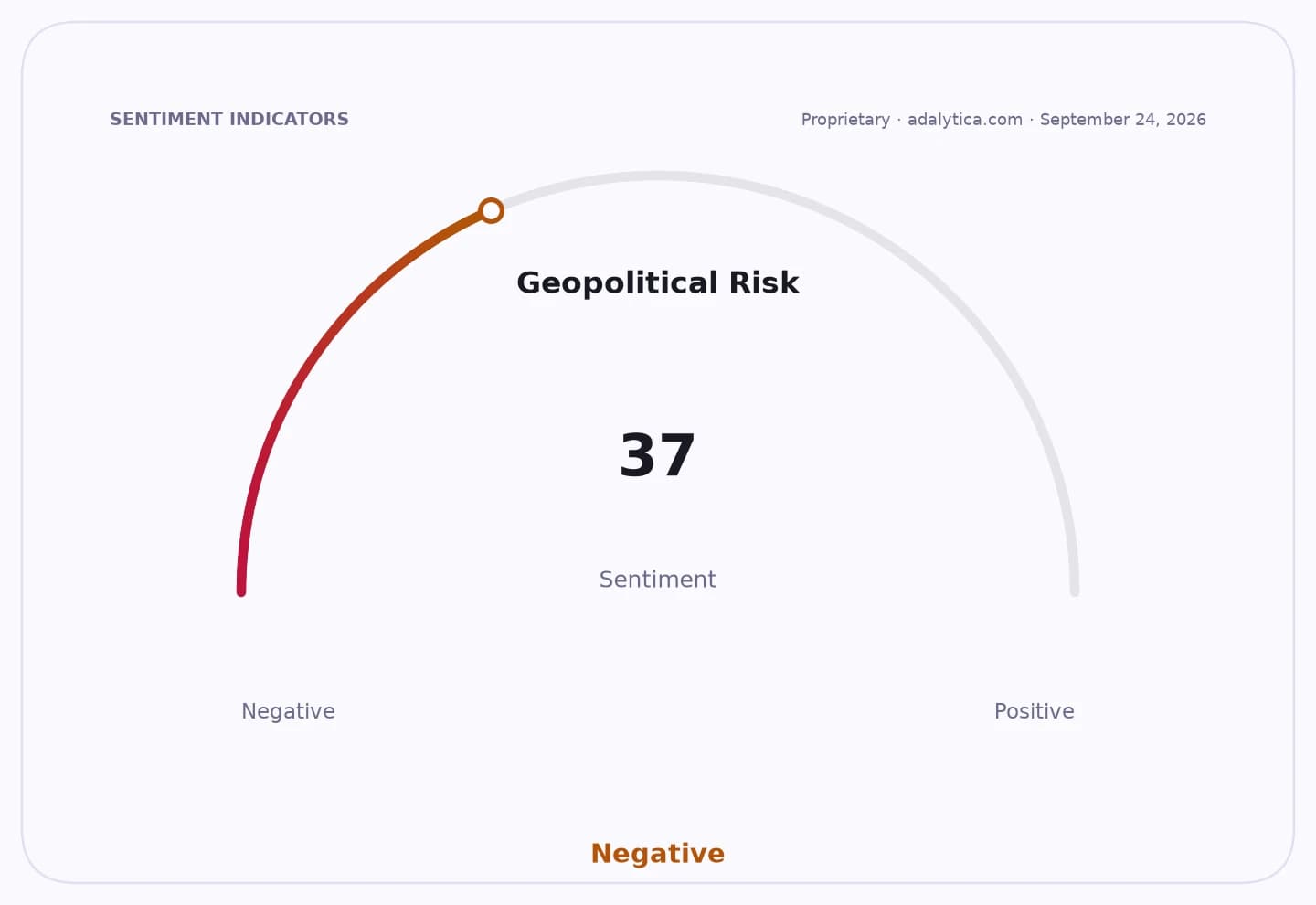
Markets are unlikely to react directly to a Saxony-Anhalt vote, but the broader message is material. Adalytica’s Global Stability Sentiment gauge has weakened sharply, underscoring rising political risk, while its euro trade signals have improved only recently after months of volatility. A deeper normalization of far-right governance in Germany would matter for the euro, for domestic confidence and for sectors exposed to regulation, construction, energy transition spending and public procurement.
For now, the key question is not whether the AfD can keep winning votes — it can — but whether Germany’s institutional defenses can still keep those votes from becoming executive power. The answer will shape the country’s political risk premium, and investors will be watching whether Saxony-Anhalt becomes a local anomaly or a precedent.
| Entity | Gains | Losses |
|---|---|---|
| AfD | ▲Governing leverage | ▼Firewall opposition |
| CDU/SPD/Greens | ▲Coalition legitimacy if united | ▼Control of Saxony-Anhalt |
| BSW | ▲Kingmaker status | ▼Political flexibility |
| German businesses | ▲Clarity if coalition is stable | ▼Policy uncertainty if AfD governs |