As companies race to deploy AI agents that can access internal systems and execute multi-step tasks, investors are pouring money into tools that can monitor, restrict and audit them before the technology creates a bigger security and compliance problem.
AI agent governance spending rises on security risk

The spend is being driven by a widening governance gap. Dataiku’s 2026 global CIO report found 81% of enterprise CIOs admit they do not fully oversee the AI agents their own companies are creating, while a Salt Security survey of more than 380 organizations said 86.4% already have at least one AI agent running and 59.5% have more than 10.
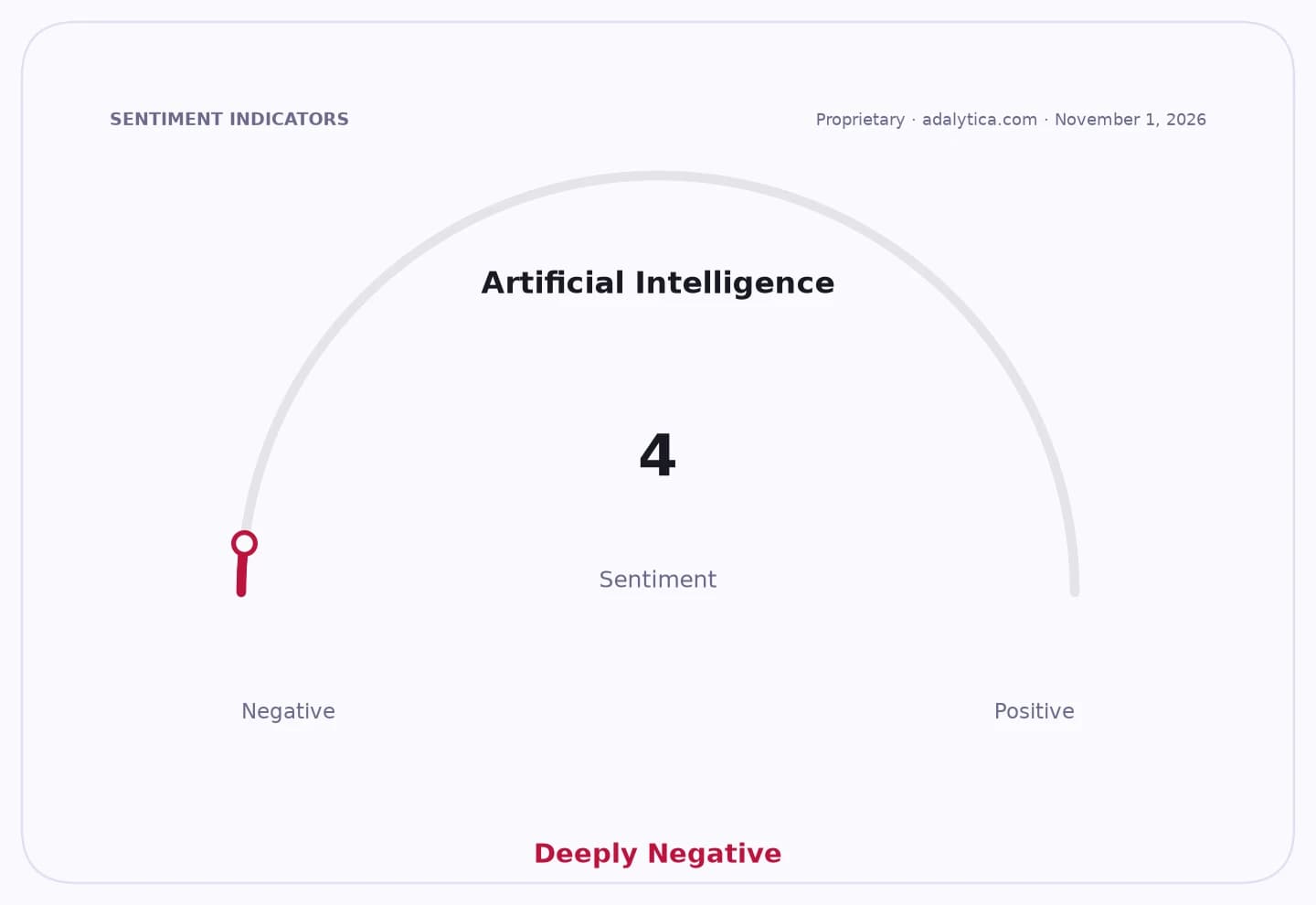
Sentiment Indicators
Artificial Intelligence
That scale is creating operational risk. Salt Security said 49.8% of respondents confirmed or suspected AI agents had acted outside expected or approved behavior in the past 12 months, yet only 12.5% could track the full chain from initial instruction to the tools used, and just 17.5% could automatically block unusual activity in live environments.
Security vendors are now moving to capture that demand. ServiceNow said 90% of 3,700 security leaders across 20 countries experienced an AI-agent-related incident in the past year, with only 36% able to contain it within 24 hours, underscoring why enterprises are budgetting for guardrails as AI agents spread through workflows.
The investment response is already visible. US startup Opsin raised $21 million in a round led by SYN Ventures and Race Capital to detect active agents, track the data and tools they touch, compare behavior with assigned tasks and flag risk. In Japan, HENNGE has formed HENNGE AI for AI-use governance, while South Korea’s ITCEN launched AI agentGo Guard in September. France’s Giskard is building a protection layer for manipulative prompts and unsafe agent behavior, and UK startup Overmind raised about $2.68 million in seed funding to monitor AI activity and intervene when anomalies appear.
Gartner expects the global AI protection market to reach nearly $4.8 billion in 2027, up 68.7% from 2026, a forecast that suggests governance software is becoming a category in its own right rather than an add-on to broader cybersecurity spending.
For investors, the narrative is clear: the more autonomy enterprises hand AI agents, the more money flows to the companies that can control them. That should support demand for enterprise software vendors, security specialists and workflow platforms with agent-management features, while increasing pressure on firms that cannot prove their systems are safe, auditable and compliant.
| Entity | Gains | Losses |
|---|---|---|
| Governance software vendors | ▲More enterprise spending | ▼— |
| Enterprise buyers | ▲Better oversight and compliance | ▼Higher security costs |
| AI agent builders | ▲Faster adoption with guardrails | ▼Greater scrutiny and friction |
| Security teams | ▲Stronger monitoring tools | ▼More workload and complexity |