AI is moving from recommending what consumers might buy to helping decide how they pay, and that shift could reshape the economics of online commerce for card networks, payment processors and retailers.
AI checkout could reshape Visa, Mastercard, PayPal

The core change is not that machines can now search faster, but that they are starting to sit between the shopper and the checkout button. That matters because the payments layer captures fees, data and control over transaction flow — all highly valuable in a digital commerce stack already under pressure from competition and fraud risk.
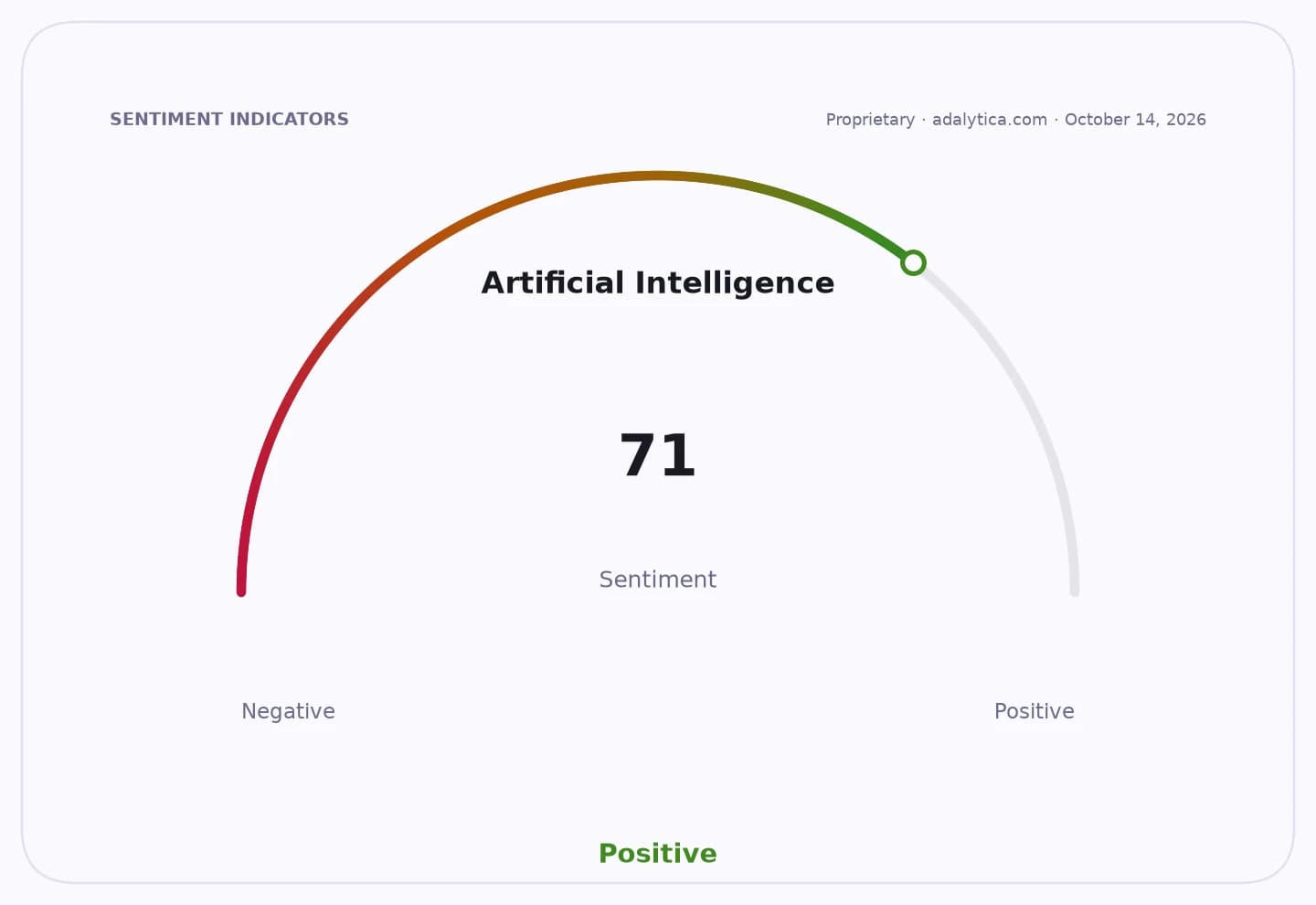
Sentiment IndicatorsⓘProprietary · adalytica.com · October 12, 2026
This is a snapshot — live sentiment, awareness and momentum for 130+ markets update continuously in the dashboard.Open AlphaPulse
The emerging model, often called agentic commerce, lets an AI agent compare products, fill baskets and, in some cases, complete purchases with user approval. OpenAI has pushed the concept through its Instant Checkout work with Stripe, while Meta’s Muse can search websites and prepare forms before asking for permission to pay. In South Korea, Naver said it plans to pilot in-agent payment this year after rolling out a shopping AI beta in February and adding recommendation tools in June.
Naver’s early traction shows why retailers are racing ahead. It said monthly active users and daily conversations for its shopping AI agent were about five times higher in August than in March, while average daily transaction value through the agent rose about fourfold over the same period. Digital and electronics accounted for 40% of the agent’s transaction value, a sign that consumers are most willing to hand AI the heavier lifting in categories where products require comparison and specification checks.
The bigger market question is where the economic value lands. If AI agents become the front end for shopping, they could redirect traffic away from brand websites and search engines and toward whichever platform controls the agent. That would pressure margins at merchants that pay for customer acquisition, but it could also create new distribution advantages for big tech firms and payments intermediaries that are first to integrate secure agent-to-merchant checkout.
For Visa, Mastercard and PayPal, the opportunity is obvious but so is the risk. A successful agentic checkout could generate more payment volume and lock in card usage for online purchases. But it also raises the stakes around authentication, chargebacks, disputed transactions and liability if an agent buys the wrong item or exceeds the user’s intent. PayPal has already warned in filings that fraud prevention becomes more difficult as it expands product offerings, while Visa and Mastercard face the same challenge of preserving trust as the payment flow becomes more automated.
The economics hinge on consumer behavior, and that is where the story remains unresolved. Surveys cited in the Korean report suggest shoppers are willing to let AI narrow choices and even assist in payment, but they remain reluctant to hand over final authority. In a Gartner survey of 322 U.S. consumers, willingness to let AI make purchase decisions did not exceed 11% even for low-stakes items. A Worldpay survey of 8,000 consumers found 80% of AI-shopping enthusiasts were open to giving AI some role in payment, but 59% still wanted to approve each purchase themselves.
That split is important for investors because it suggests adoption may be slower than the hype around autonomous shopping implies. The near-term winner is likely to be the “copilot” model — AI that searches, filters and prepares payment, but leaves the last click to the user. That favors payment networks and wallet providers that can embed strong identity checks, tokenization and fraud controls without surrendering the customer relationship.
Regulators are likely to decide how far the industry can go. New rules in multiple markets are pushing banks to closely supervise high-risk AI systems that handle payments and credit decisions, a response to concerns that autonomous tools could amplify fraud, misrouting of funds or discriminatory outcomes. The unresolved question is liability: if an AI misreads a request, if a merchant’s ad spend skews the recommendation, or if a fraudster abuses an agent’s credentials, who pays — the AI developer, the merchant, the payment processor or the card issuer?
For investors, that means the first phase of AI payments may reward the companies that make machine-driven checkout safe rather than fully autonomous. Visa and Mastercard appear better positioned if AI raises transaction volume without displacing cards, while PayPal’s path depends on whether it can turn its wallet and checkout footprint into a trusted layer for agentic shopping. Retailers and ad-dependent commerce platforms, meanwhile, risk losing control of the customer journey unless they build their own agent interfaces or secure preferred placement inside the new AI gatekeepers.
| Entity | Gains | Losses |
|---|---|---|
| Visa, Mastercard | ▲More digital payment volume | ▼Greater fraud/liability exposure |
| PayPal | ▲Wallet relevance in AI checkout | ▼Margin pressure from new fraud controls |
| Retailers | ▲Higher conversion from assisted shopping | ▼Less control over customer journey |
| AI platforms | ▲New commerce distribution power | ▼Regulatory scrutiny and trust risk |