The most important shift in the AI story is no longer whether machines can replace people, but how quickly companies, workers and regulators are being forced to reprice labor around them. That matters because the winners from AI are increasingly the firms that can turn software into productivity, while the losers are likely to be workers whose roles are redefined, compressed or eliminated, and investors are already starting to sort those outcomes across tech and the broader economy.
AI Shifts Labor Power and Market Winners

A facilities management company’s decision to spend $200,000 on AI tools to squeeze more output from skilled trades workers captures the new reality: AI is being deployed less as a blunt replacement engine than as a force multiplier in a tight labor market. With shortages still biting in trades and services, employers are willing to pay for AI skills and software that can help each worker do more, which supports margins even when headcount stays flat.
Sentiment IndicatorsⓘProprietary · adalytica.com · July 28, 2026
This is a snapshot — live sentiment, awareness and momentum for 130+ markets update continuously in the dashboard.Open AlphaPulse
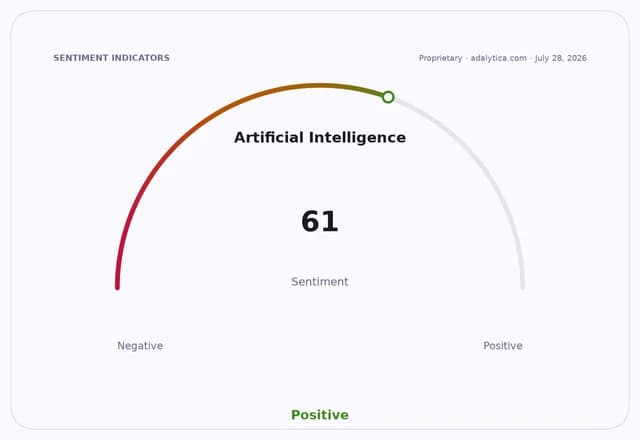
That shift is showing up in the market’s biggest AI names as well. Nvidia remains the clearest beneficiary of the buildout, with the stock up sharply from last year’s lows and still trading well above its 200-day moving average even after recent pullbacks, a sign investors continue to treat AI infrastructure as a long-cycle capital-spending theme. Microsoft and Alphabet, meanwhile, are both deeply exposed to the same trend through cloud, software and AI products, but their shares have been more volatile as investors weigh monetization against the costs, risks and regulation tied to embedding AI across their businesses.
The labor angle is what makes this story economically broader than a technology trade. Government and labor groups are already moving to extend protections, regulate AI in hiring and employment decisions and even consider new benefits tied to productivity gains, a sign that AI is beginning to alter bargaining power, wage structures and workplace rules. If AI boosts output without proportionate hiring, it can cool labor demand at the margin even as it raises output per worker, a combination that may help companies but complicates the outlook for wage growth and employment.
Artificial Intelligence — 30-day sentimentadalytica.com
Explore this data interactively — full history, time series and cross-market comparisons.Open AlphaPulse
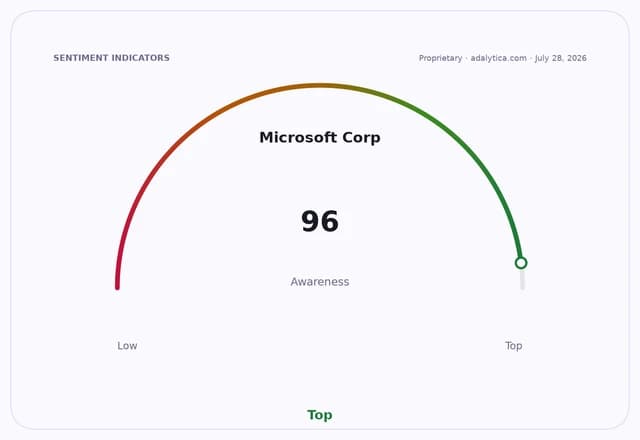
For investors, that means AI exposure is becoming more differentiated. Hardware suppliers still stand to benefit from data-center spending, but software and platform companies face a tougher test: proving that AI features drive real revenue while not triggering higher compliance costs, legal liability or customer pushback. Adalytica’s AI sentiment gauge sits in neutral territory even as awareness remains elevated, underscoring a market that still believes in the theme but is less willing to buy the simplest version of the labor-replacement narrative.
The next catalyst is whether AI productivity gains show up in earnings without a matching rise in labor pain. Upcoming results, guidance and any fresh policy moves on AI in hiring or workplace protections will determine whether this becomes a margin story, a regulation story or a broader revaluation of work itself.
| Entity | Gains | Losses |
|---|---|---|
| AI infrastructure providers | ▲Higher enterprise spending | ▼Slower capex if ROI disappoints |
| Employers using AI | ▲Lower labor costs, higher output | ▼Upfront software and training spend |
| Workers in routine roles | ▲Better tools, higher pay for AI skills | ▼Job displacement, weaker bargaining power |
| Regulators and labor groups | ▲More leverage to shape rules | ▼Slower adoption if restrictions tighten |