An emerging wave of AI litigation is becoming a market issue, with courts now being asked to decide who owns training data, who pays for it and whether companies can automate consequential decisions without clear accountability.
AI litigation adds risk to megacap rally
That matters because the legal outcome could raise the cost of building frontier models, force changes in how AI systems are trained and expose companies using AI in hiring, content creation and other regulated areas to more lawsuits and tighter rules. Investors are watching closely because the winners in AI may be determined not only by chip supply and model quality, but also by the durability of their data pipelines and their legal defenses.
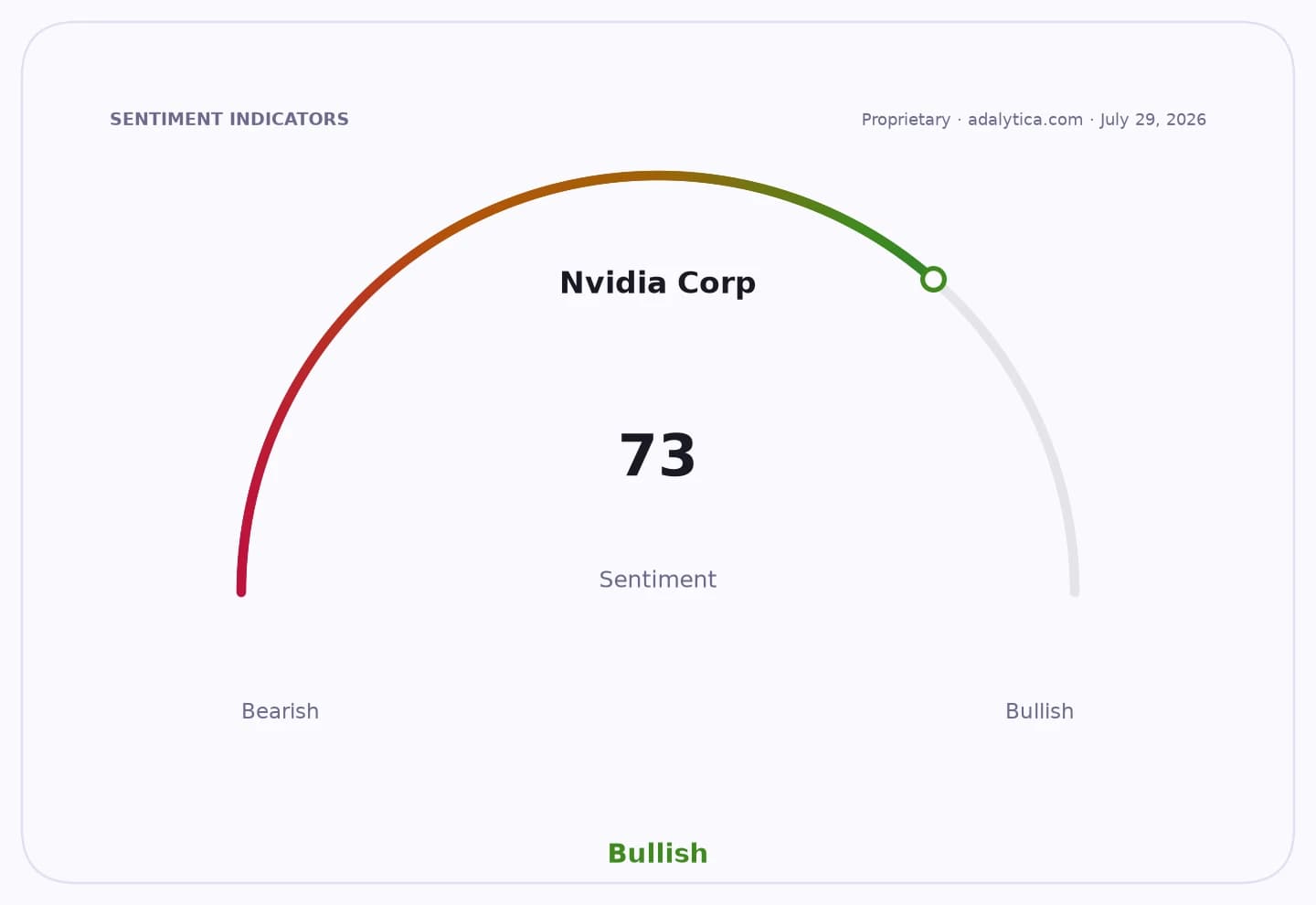
Sentiment IndicatorsⓘProprietary · adalytica.com · July 29, 2026
This is a snapshot — live sentiment, awareness and momentum for 130+ markets update continuously in the dashboard.Open AlphaPulse
The backdrop is a wider push to define the boundaries of AI in court. The U.S. Supreme Court’s approval of Anthropic’s $1.5 billion copyright settlement underscored how expensive model-training disputes can become, while lawsuits over algorithmic layoffs have highlighted how hard it can be to prove AI-driven accountability in employment cases.
At the same time, governments are moving to embed AI more deeply into legal systems. The United Arab Emirates has launched the first comprehensive judicial system integrated with AI, a sign that regulators are not just policing the technology but also adopting it — a split-screen development that increases demand for legal clarity around transparency, fairness and automated decision-making.
For investors, the stakes extend well beyond the courtroom. Nvidia, Microsoft and Alphabet all sit at the center of the AI buildout and face different exposures to regulatory and litigation risk, from model training and cloud deployment to enterprise software and data use. Nvidia shares have remained volatile around $197, while Microsoft is near $393 and Alphabet is at $334, showing that even dominant AI names are trading with elevated sensitivity to legal and policy headlines.
Technical indicators suggest the recent pullback in AI-linked stocks has eased some near-term froth. Nvidia’s 14-day RSI is 44.2, while Microsoft’s is 56.4 and Alphabet’s is 36.9, pointing to mixed momentum after sharp swings in the group. Adalytica’s AI sentiment gauge is at 61, with awareness still elevated at 71, suggesting investors remain engaged even as conviction cools.
The broader narrative is shifting from “how fast can AI scale” to “how safely and legally can it scale.” If courts impose heavier liability or stricter disclosure standards, the industry could face higher compliance costs, slower deployment and more pressure on margins. If companies win more legal clarity, the AI rally could regain momentum as investors price in a cleaner path for training, licensing and monetization.
The next catalysts are likely to come from court rulings, copyright negotiations, employment disputes and new regulatory actions in the U.S. and abroad.
| Entity | Gains | Losses |
|---|---|---|
| AI developers | ▲clearer rules if they win cases | ▼higher training and licensing costs |
| Courts/regulators | ▲stronger oversight tools | ▼slower adoption if rules tighten |
| Nvidia, Microsoft, Alphabet | ▲less legal uncertainty if precedents favor AI | ▼margin pressure from compliance risk |
| Content owners and plaintiffs | ▲potential settlements and royalties | ▼weaker leverage if courts favor fair use |