Australia’s debate over AI security should not stop at China. The bigger risk for governments and investors is that powerful, fast-moving artificial intelligence is becoming a systemic national-security issue, with Microsoft warning that AI tools and agents are creating new attack surfaces even inside trusted systems.
AI Security Becomes the Real Investment Trade

That matters because the security threat is no longer limited to foreign ownership, data residency or one country’s tech stack. As AI is embedded across corporate networks, government workflows and critical infrastructure, the cost of a breach rises from data theft to operational disruption, disinformation, and potentially the compromise of defence and public-sector decision-making. In other words, AI is moving from productivity tool to strategic vulnerability.
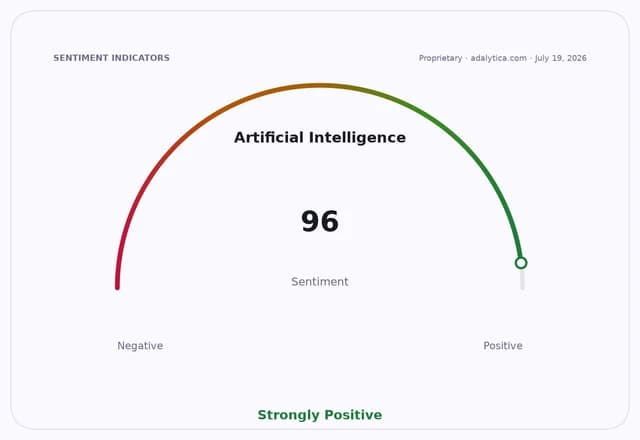
Sentiment IndicatorsⓘProprietary · adalytica.com · July 19, 2026
This is a snapshot — live sentiment, awareness and momentum for 130+ markets update continuously in the dashboard.Open AlphaPulse
Microsoft’s own 10-Q says increasing use of AI, including models, copilots and autonomous agents, may create new attack surfaces and that internal controls may not keep pace. That is the warning investors should focus on. The market still tends to frame AI as a capex boom and a software monetisation story. The more important second-order trade is security, resilience and sovereign infrastructure — the picks-and-shovels layer that becomes mandatory when AI deployment scales.
The price action reinforces how quickly this theme is becoming central to capital allocation. Microsoft’s shares have been volatile and remain below the 200-day moving average, while Nvidia has also come off its highs after a powerful run. That does not weaken the AI thesis; it sharpens it. When the first wave of enthusiasm matures, the winners are often the companies selling the tools that let governments and enterprises deploy AI safely, not just cheaply.
Artificial Intelligence — 30-day sentimentadalytica.com
Explore this data interactively — full history, time series and cross-market comparisons.Open AlphaPulse
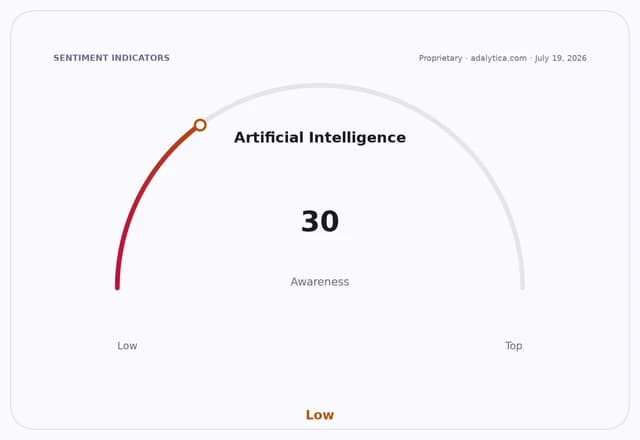
Adalytica.com’s proprietary AI sentiment gauge shows Extreme Greed, yet Microsoft’s own earnings sentiment remains only neutral even as awareness is elevated. That split is telling: investors are still focused on upside from AI adoption, while regulators and security agencies are increasingly focused on downside. The gap between enthusiasm and preparedness is where the opportunity lies.
For Australia, the implication is straightforward. If policymakers are serious about sovereignty, they cannot treat AI as a narrow China problem. They need diversified models, stronger cyber controls, local compute capacity, and procurement standards that assume adversarial misuse. For investors, that points to a broader basket: cybersecurity, data-center infrastructure, defence technology, identity verification, network monitoring and companies that can harden AI workloads rather than merely accelerate them.
The market underestimates how quickly “AI safety” can become a budget line item across government and enterprise. That makes the next leg of this trade less about who builds the biggest model and more about who builds the safest system around it. If you want exposure to the next phase of the AI boom, look past the headline names and own the security and infrastructure layer that becomes indispensable once the risks are no longer theoretical.
| Entity | Gains | Losses |
|---|---|---|
| Cybersecurity vendors | ▲Higher demand for protection | ▼Pricing pressure from fast-moving threats |
| AI infrastructure providers | ▲More sovereign compute spending | ▼Delays from tougher compliance |
| Governments | ▲Better resilience planning | ▼Greater procurement costs |
| Unprepared AI platforms | ▲Short-term usage growth | ▼More scrutiny and liability |