AI is forcing investors to ask a deceptively simple question: if software can now write code, generate images and automate workflows, how many expensive seats will companies still need to buy?
AI Repricing Hits Enterprise Software Valuations
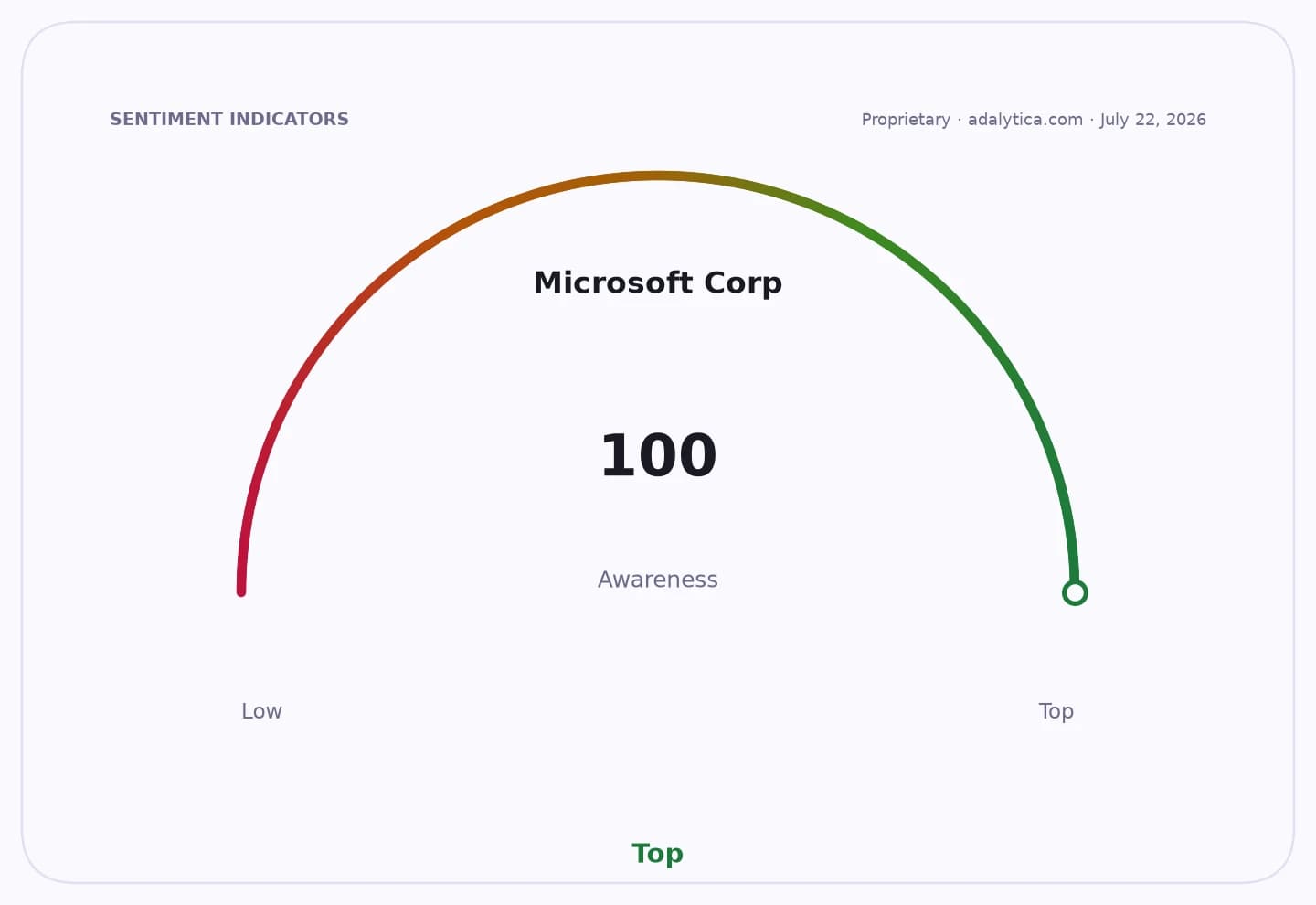
That question is driving one of the most important valuation resets in technology. Microsoft, Adobe and Salesforce have all seen sharp swings as the market rethinks the economics of enterprise software in an AI-first world. The fear is not that these businesses disappear overnight. It’s that the old model of selling more licenses to more users, at ever-higher prices, may not be as durable as it looked a year ago.
Sentiment IndicatorsⓘProprietary · adalytica.com · July 22, 2026
This is a snapshot — live sentiment, awareness and momentum for 130+ markets update continuously in the dashboard.Open AlphaPulse
For investors, that matters because software had long been prized for recurring revenue, high margins and predictable cash flow. If AI lowers the cost of creating software-like output, the bargaining power shifts. Buyers may need fewer seats, demand more usage-based pricing or pressure vendors to bundle AI features at no extra cost. That can slow revenue growth even if customers keep using the products.
The market has already started to price in that risk. Microsoft shares were last around $397.75, well below their 200-day moving average near $436.70, after falling from a 2026 peak above $525. Adobe ended near $227.16, versus a 200-day average around $280.77, while Salesforce traded around $170.06, below its 200-day average of roughly $206.85. Those are not just chart signals; they reflect a broad rerating of software names as investors weigh whether AI will strengthen these companies’ moats or erode them.
The technical picture underscores how violent the repricing has been. Microsoft’s RSI, a standard momentum indicator, had plunged into deeply oversold territory before recovering, while Adobe and Salesforce also spent stretches in oversold conditions. In plain English, the market sold first and asked questions later. That kind of move often happens when investors fear a structural change rather than a one-quarter disappointment.
There is good reason for the anxiety. Adobe’s creative tools sit directly in the crosshairs of AI-generated content, where text-to-image and text-to-video tools can do in seconds what once required skilled design work. Salesforce faces a similar test as AI agents promise to automate customer service, sales outreach and reporting. Microsoft is better positioned, because it owns the cloud, the developer stack and the AI infrastructure layer, but even it has told investors in filings that building and supporting AI models and infrastructure carries significant costs.
That does not mean software is broken. It means the winners will be the companies that control the workflow, own proprietary data, or can make AI an indispensable productivity layer rather than a cheaper substitute. Microsoft still has that kind of leverage through Azure, Office, GitHub and its broad enterprise relationships. Adobe still has a strong brand and deep creative workflow integration. Salesforce still has one of the largest customer data footprints in enterprise software. But each has to prove AI will expand the market faster than it compresses pricing.
The bigger macro story is that AI is shifting profit pools. A Reuters-style takeaway from the latest market action and corporate disclosures is that software is no longer being valued purely on subscription growth. Investors now want to know whether AI will add net new demand or merely cannibalize legacy seats. That is why some names tied to the AI buildout, including infrastructure and chip suppliers, have remained more resilient than application-layer software.
For long-term investors, this is exactly the kind of disruption that creates both danger and opportunity. The danger is paying premium multiples for businesses whose pricing power may be less secure than it once was. The opportunity is buying the strongest franchises after the market has spent months discounting a worst-case scenario. In a decade, the software winners will likely be the firms that turned AI into a source of higher productivity, deeper lock-in and stronger cash flow, not just a feature.
Until then, investors should focus less on the hype around AI and more on which companies can preserve their economic moat. Microsoft looks like the most durable name in this group, while Adobe and Salesforce must prove their products remain essential in an AI-assisted workflow. For buy-and-hold investors, this is a time to be selective, patient and diversified — and to keep the strongest software leaders on the watchlist, not the sidelines.
| Entity | Gains | Losses |
|---|---|---|
| Microsoft | ▲AI platform leverage | ▼Legacy seat growth fears |
| Adobe | ▲Creative workflow integration | ▼Generative AI substitution pressure |
| Salesforce | ▲Automation upside if AI sticks | ▼Pricing power compression |
| Software buyers | ▲Lower costs, more output | ▼None if vendors discount deeply |