Nvidia’s reported plan to lock in SK Hynix memory supply for a $500 billion AI deal matters because it shows the AI boom is no longer just about faster chips — it is becoming a battle for the scarce components that keep those chips fed. That shifts pricing power deeper into the supply chain and raises the stakes for anyone trying to build out AI infrastructure at scale.
AI Supply Chain Tightens Beyond Nvidia
The market has spent two years rewarding Nvidia as the central toll road in artificial intelligence, but this deal suggests the real bottleneck is moving into high-bandwidth memory, where capacity, yield and long-term supply agreements are becoming strategic assets. If Nvidia is effectively reserving future memory output, the implication is clear: AI capex is still accelerating, demand visibility remains unusually strong, and the winners are increasingly the suppliers that can guarantee volume rather than just design the best silicon.
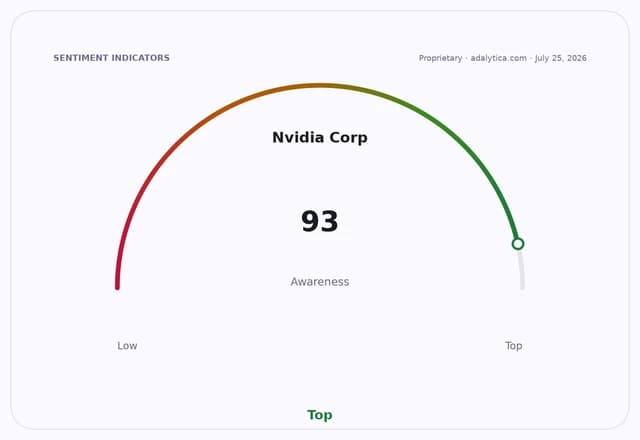
Sentiment IndicatorsⓘProprietary · adalytica.com · July 25, 2026
This is a snapshot — live sentiment, awareness and momentum for 130+ markets update continuously in the dashboard.Open AlphaPulse

For investors, that is a powerful setup. Nvidia remains the demand engine, but SK Hynix and, by extension, the broader memory ecosystem could see a much longer period of pricing discipline and order-book strength than the market once assumed. Micron and other memory suppliers stand to benefit as the industry’s “pick-and-shovel” layer gets repriced, while TSMC remains essential to the foundry side of the AI buildout even as its shares have been punished by a sharp pullback and weak technical momentum. The contrast is telling: sentiment on Nvidia is still in “Extreme Greed,” while TSMC’s reading is in “Extreme Fear,” even as both remain indispensable to the AI hardware stack.
The message from the tape is just as important as the headline. Nvidia shares have held above their 50-day and 200-day moving averages, and recent technical indicators have stabilized after a volatile summer, suggesting investors are still willing to buy dips in the AI leader. SK Hynix has not been part of the supplied price data, but the news flow around memory supply is enough to reinforce the idea that the next phase of the AI trade will be about supply-chain scarcity, not just model breakthroughs. Alphabet’s increased AI investment only adds to that demand picture.
Our thesis is simple: the market is still underestimating how much of the AI value chain will be governed by long-duration supply commitments, not spot demand. That favors Nvidia as the demand orchestrator, SK Hynix as a constrained beneficiary, Micron as a levered second-order play, and TSMC as the indispensable manufacturing backbone. The next leg of the trade belongs to investors who position early for the infrastructure layers that become more valuable as AI compute gets bigger, hungrier and harder to supply.
| Entity | Gains | Losses |
|---|---|---|
| Nvidia | ▲Secured memory supply | ▼Less flexibility on sourcing |
| SK Hynix | ▲Pricing power, guaranteed demand | ▼Capacity tightness risk |
| Micron | ▲Memory tailwind, repricing potential | ▼Shares in supply battles |
| TSMC | ▲AI fab demand remains strong | ▼Relative underperformance if ignored |