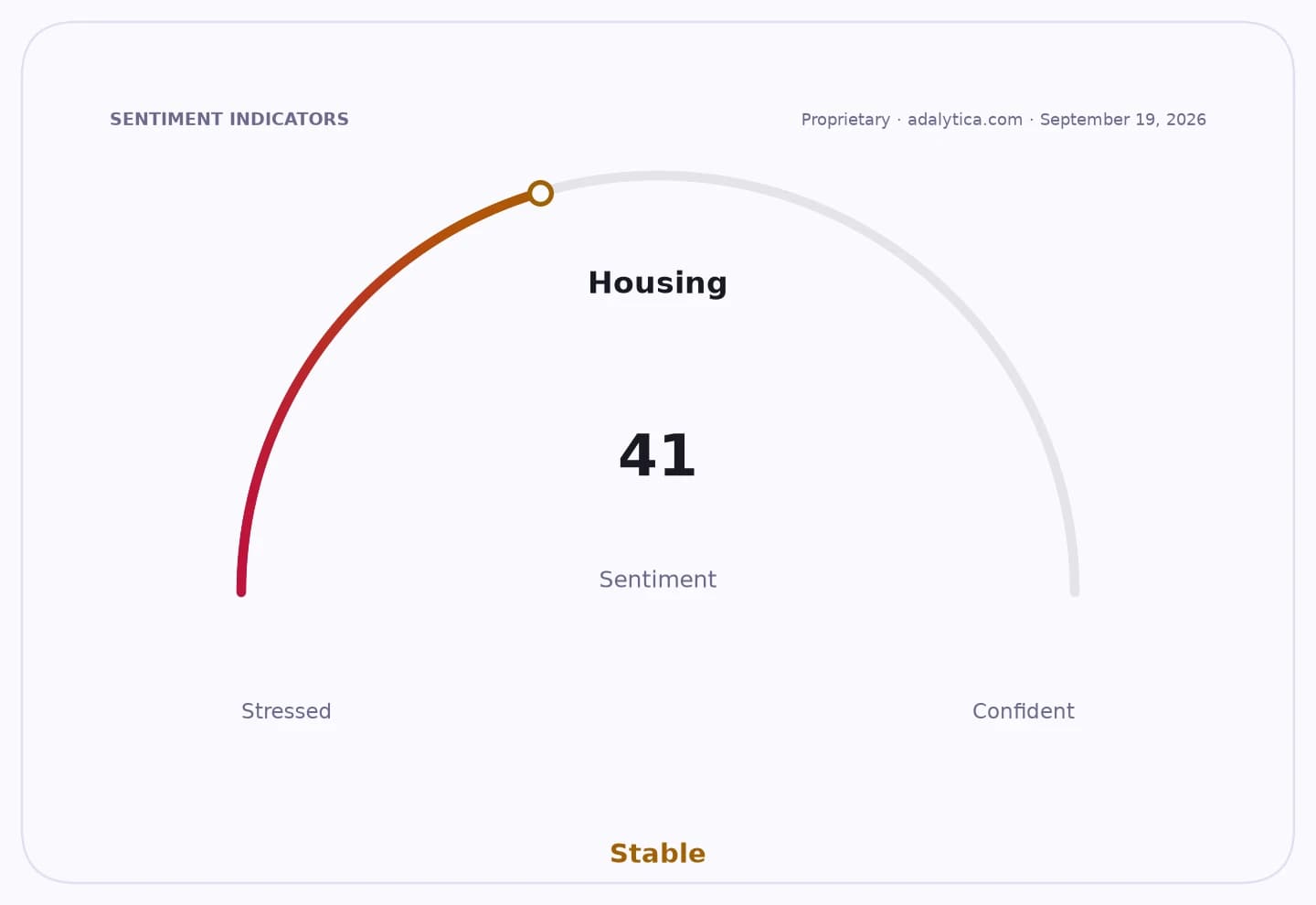
House price growth in Albania slowed sharply in the first half of 2026, a sign that the country’s property market is cooling after two years of overheating and that affordability pressures are beginning to bite.
Albania house price growth slows in first half of 2026
The Bank of Albania said its Fisher housing price index was unchanged from the previous six months and up 10% from a year earlier, a marked slowdown from annual gains of 28% in the second half of 2025 and 41.7% in the first half of that year. For investors and policymakers, the shift matters because housing has been one of the clearest channels through which stronger demand, foreign buying and easy credit have fed into the wider economy.
The cooling is most visible in Tirana, where prices still rose 10% from the second half of 2025 but were up only 9% year on year, underscoring how much of the earlier price surge was concentrated in the capital. Agents surveyed by the central bank were still more upbeat overall, with the net balance on market conditions at +15%, and even stronger at about +35% among those that reported sales. Coastal areas stood out as the most optimistic segment, suggesting demand remains resilient in tourism-linked locations even as the broader market loses momentum.
The data point to a market that is no longer moving only in one direction. Most sales were still being completed at prices equal to or within 5% of asking, and the gap between achieved and listed prices remained broadly stable. But the stock of unsold homes and commercial properties has been falling for several six-month periods, while the average time to sell a home edged up to 9.9 months from 9.1 months nationally. In Tirana, the sales period lengthened to 9.7 months from 8.1 months, even as coastal properties sold faster at 8.2 months, down from 9.9 months.
Credit remains central to the market’s functioning, which is why the slowdown matters beyond real estate. About 58% of residential and commercial properties sold by agents were financed with bank loans, and in roughly a third of those cases the loan covered up to 60% of the value. That leaves the sector sensitive to any tightening in lending conditions, and suggests household balance sheets, bank underwriting and construction activity could all feel the effects if price growth keeps easing.
The composition of demand is also changing. Around 20% of homes sold in the first half of 2026 were bought by non-residents, the vast majority from EU countries, extending a five-year upward trend in foreign participation. That supports demand at the top end of the market and in coastal areas, but it also means Albania’s housing cycle is becoming more exposed to cross-border capital flows and external sentiment.
For investors, the message is less about a collapse than about normalization. A slower pace of price growth may ease pressure on affordability and reduce the risk of a destabilizing bubble, but it also points to less upside for developers, brokers and landowners that benefited from the prior surge. If borrowing costs stay high or demand softens further, transaction times could lengthen again and margins could come under pressure, even as the market remains liquid by regional standards.
What happens next will depend on whether demand from residents, banks and foreign buyers can absorb a market that is still expensive but no longer accelerating at the pace seen in 2025. The Bank of Albania’s next readings will show whether this is a pause after a boom or the beginning of a broader cooling in a sector that has become important to growth, credit and confidence.
| Entity | Gains | Losses |
|---|---|---|
| Homebuyers | ▲Better affordability | ▼Less urgency in hot market |
| Banks | ▲Continued mortgage demand | ▼Greater credit sensitivity |
| Developers/sellers | ▲Still stable transactions | ▼Slower price gains |
| Foreign buyers | ▲More negotiating power | ▼Less rapid capital appreciation |