Alibaba is moving to sell more than e-commerce and cloud computing: it is positioning itself as a maker of generative media tools, a shift that matters because video generation is one of the most commercially valuable and compute-intensive corners of artificial intelligence.
Alibaba launches AI video generation tool

The launch of Alibaba’s AI video generation tool adds another front in the race to own the software layer that powers advertising, entertainment and digital content production. For investors, the significance is twofold. First, it strengthens the case that Alibaba’s cloud and AI businesses can become a real growth engine rather than a strategic option. Second, it highlights how Chinese internet groups are trying to turn model development into revenue at a time when capital spending on AI infrastructure is still rising across the sector.
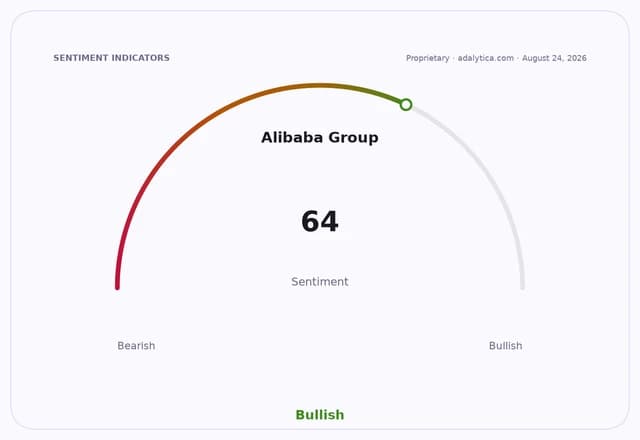
Sentiment IndicatorsⓘProprietary · adalytica.com · August 24, 2026
This is a snapshot — live sentiment, awareness and momentum for 130+ markets update continuously in the dashboard.Open AlphaPulse
Alibaba’s push comes as the broader AI stack continues to widen. Media production tools have become a proving ground for frontier models because they combine technical complexity with clear enterprise demand. The ability to generate video at scale can lower production costs for marketers, studios and merchants, while creating new usage-based revenue streams for cloud providers and model developers. That is economically important in China, where companies are looking for AI products that can translate into fee income more quickly than consumer chatbots.
The market backdrop has also turned more selective. Alibaba shares last closed at $119.34, far below their 200-day moving average of $136.77, even after a sharp rebound from earlier weakness. The stock has been volatile, with the relative strength index falling from overbought levels to 39.8 in the latest reading, suggesting investors are no longer paying up purely for AI exposure. That leaves room for a durable product announcement to matter more than another vague AI promise.
The launch also fits into a wider Chinese competition story. Domestic players are racing to integrate advanced video generation into creative platforms, and the news flow around AI media tools has accelerated. Yuna Media Partner recently said it integrated MiniMax H3 into its PopPixs animation platform, underscoring how fast the market is becoming crowded. The strategic question for Alibaba is whether it can leverage its cloud footprint, distribution and enterprise relationships to turn model access into sticky usage before rivals lock in creators and advertisers.
There is a bull case and a bear case. Bulls will argue that AI video tools expand Alibaba’s addressable market beyond retail and can help re-rate the stock if investors begin to assign more value to its cloud and AI optionality. Bears will say the launch is still a feature, not a business, and that monetization will be slow in a market where many AI services are still being bundled or subsidized.
What matters next is execution: whether Alibaba can show developer adoption, commercial partnerships and measurable cloud demand from AI workloads. If it can, the company’s latest product move will look less like a novelty and more like evidence that China’s largest platforms are trying to convert generative AI into a new profit pool.
| Entity | Gains | Losses |
|---|---|---|
| Alibaba | ▲Higher AI relevance | ▼Pressure to monetize |
| Cloud rivals | ▲Faster market expansion | ▼Share of enterprise demand |
| Creators/advertisers | ▲Lower production costs | ▼More model dependence |
| Traditional video vendors | ▲New tools and workflows | ▼Pricing power and margins |