Alphabet is telling investors it wants more control over the next phase of AI by pushing harder into hardware, a move that could broaden revenue beyond search and cloud while sharpening the battle with Apple and other device makers.
Alphabet Pushes Deeper Into AI Hardware
That matters because hardware is where AI software, consumer adoption and ecosystem lock-in intersect. If Alphabet can turn its AI stack into must-have devices, it could reduce dependence on advertising, deepen user engagement and create a new avenue for monetization at a time when investors are demanding clearer proof that AI spending translates into durable growth.
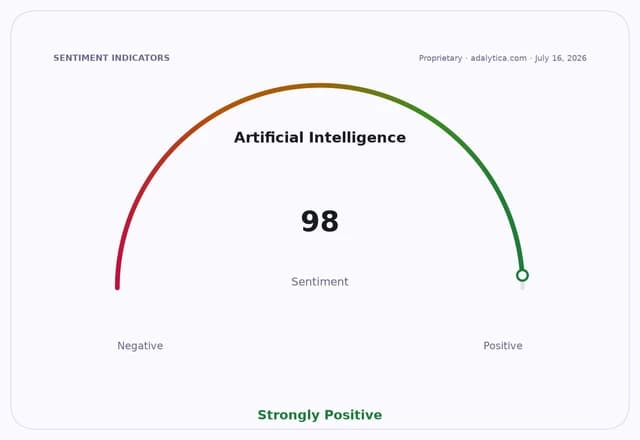
Sentiment IndicatorsⓘProprietary · adalytica.com · July 16, 2026
This is a snapshot — live sentiment, awareness and momentum for 130+ markets update continuously in the dashboard.Open AlphaPulse
The market is already treating Alphabet like a winner in the AI trade. GOOGL closed at $370.92 on July 15, up sharply from $337.39 on June 26, while GOOG finished at $370.21. Both share classes are trading well above their 200-day moving averages, with GOOGL’s 50-day average at $371.89 and GOOG’s at $369.14, showing the stock has been re-rated into a high-expectation name.
The latest move also comes with momentum indicators stretched but still constructive. GOOGL’s RSI14 was 67.5, while GOOG’s was 66.2, just below the overbought line and consistent with a stock that has already priced in strong AI enthusiasm but may still have room if the hardware strategy gains traction. Both shares are hovering near the upper end of their recent Bollinger Bands, underscoring how much optimism is already embedded.
For investors, the setup is a balance between upside optionality and execution risk. A successful hardware push could give Alphabet a more direct path into the consumer AI market, where OpenAI is also pressing ahead and Apple is moving to defend its turf, including through litigation tied to AI hardware ambitions. That raises the stakes for all three companies, but it also highlights Alphabet’s advantage: it already controls search, Android, YouTube and a large cloud platform that can distribute new devices and services at scale.
The question now is whether Alphabet can convert that strategic ambition into something that moves numbers. A hardware expansion can strengthen the ecosystem, but it can also bring margin pressure, supply-chain complexity and longer payback periods than software. Investors will be watching for product details, developer support and whether Alphabet uses hardware to pull more users into Gemini and its broader AI services without sacrificing profitability.
For now, the stock remains a momentum trade with a strategic backstop: if Alphabet’s hardware push is more than a side project, it could become one of the clearest ways to monetize AI beyond search ads. The next catalyst is whether the company can show concrete product timing, demand signals and any early signs that the new devices can expand its addressable market rather than just add cost.
| Entity | Gains | Losses |
|---|---|---|
| Alphabet | ▲New AI hardware optionality | ▼Margin pressure, execution risk |
| GOOGL/GOOG longs | ▲Ecosystem expansion upside | ▼Valuation disappointment |
| Apple | ▲Competitive urgency in devices | ▼More AI hardware pressure |
| OpenAI | ▲Consumer hardware validation | ▼Slower rollout, legal scrutiny |