AI-made stories are increasingly being received better than human-made ones, and that shift matters because attention is becoming one of the most valuable assets in digital media, advertising and search. If machines can produce content that audiences prefer — or at least consume more readily — the economic advantage moves toward companies that can scale creation, distribution and personalization at near-zero marginal cost.
Alphabet, Meta, Netflix benefit from AI content shift

That is the real investment story hiding behind the latest AI headlines. The market is still treating AI as mostly a productivity tool for back-office tasks and enterprise software. I believe that misses the bigger opportunity: AI is starting to reshape the front end of the internet, where the dollars are. Whoever controls the AI stack, the cloud infrastructure and the recommendation engines stands to capture a larger share of ad spend, subscriber growth and engagement time.
Sentiment IndicatorsⓘProprietary · adalytica.com · August 7, 2026
This is a snapshot — live sentiment, awareness and momentum for 130+ markets update continuously in the dashboard.Open AlphaPulse

Alphabet is the cleanest beneficiary. The stock has pushed to $354.97, roughly in line with its 50-day moving average at $356.49 and well above its 200-day moving average at $328.83, while the recent technical rebound shows investors are again willing to pay for AI-enabled distribution. That matters because Alphabet sits at the intersection of search, video, cloud and AI model development, giving it multiple ways to monetize synthetic content without surrendering the traffic.
Meta is even more compelling as a second-order winner. Its shares at $593.43 remain below the 50-day average of $599.65 and far under the 200-day average of $630.45, but that weakness is exactly why the setup is interesting. Meta’s business is built on maximizing time spent, and if AI-generated content proves more engaging than human-created material, the company can feed its recommendation system with an endless stream of cheaper, more personalized inventory. The market underestimates how quickly that can improve ad yield once the cycle turns.
Netflix sits on the other side of the same theme. The stock at $74.19 is still below its 200-day moving average of $90.13, but it has stabilized near the 50-day average of $75.67. For streaming, AI-generated storytelling is not just a novelty; it is a margin story. If audiences accept AI-made content, Netflix and other platforms can lower production costs, test more formats and iterate faster on what keeps viewers hooked.
The broader implication is that AI is moving from creation aid to content engine. That changes the economics of media, marketing and distribution. It also raises the stakes in AI security, governance and moderation, which is why tools such as Netskope’s new AI Command Center fit into the same trade: the more AI content spreads, the more enterprises will need to detect, control and secure it.
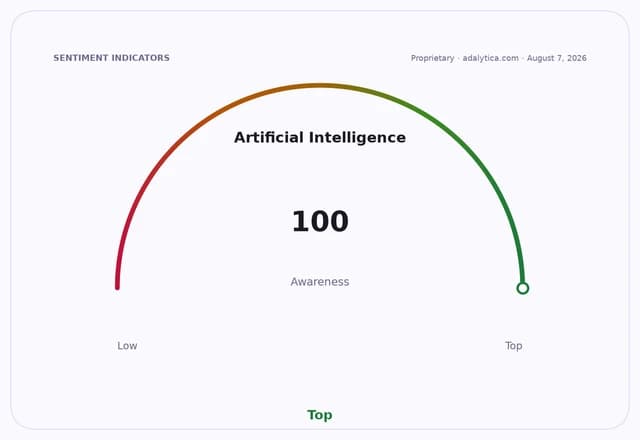
Adalytica’s AI sentiment gauge shows fear at 18 with awareness at 100, a combination that suggests the story is highly visible but not yet embraced. That is usually where the best opportunities begin. The market is focused on the risks of synthetic media, but investors should be focused on the platforms that monetize the shift. My view is simple: own the AI infrastructure and the engagement winners before consensus catches up.
| Entity | Gains | Losses |
|---|---|---|
| Alphabet (GOOGL) | ▲AI search and video monetization | ▼Human-only content creators |
| Meta (META) | ▲Cheaper engagement, higher ad efficiency | ▼Legacy publishers |
| Netflix (NFLX) | ▲Lower production costs, faster content testing | ▼Traditional studios |
| AI security vendors | ▲More demand for controls | ▼Unsecured enterprises |