Altcoin traders are still piling into borrowed bets even after last week’s $850 million liquidation event, leaving the market exposed to another forced-selling spiral if prices slip further.
Altcoin leverage stays high after $850M liquidation
That is the key risk now: leverage in more than 40% of large-cap altcoins remains near this year’s highs, according to Glassnode, while mid-cap leverage has reached a yearly peak. In practical terms, the market has not de-risked after the first shakeout. Instead, many liquidated positions appear to have been replaced by fresh leveraged longs, a setup that can amplify volatility rather than absorb it.
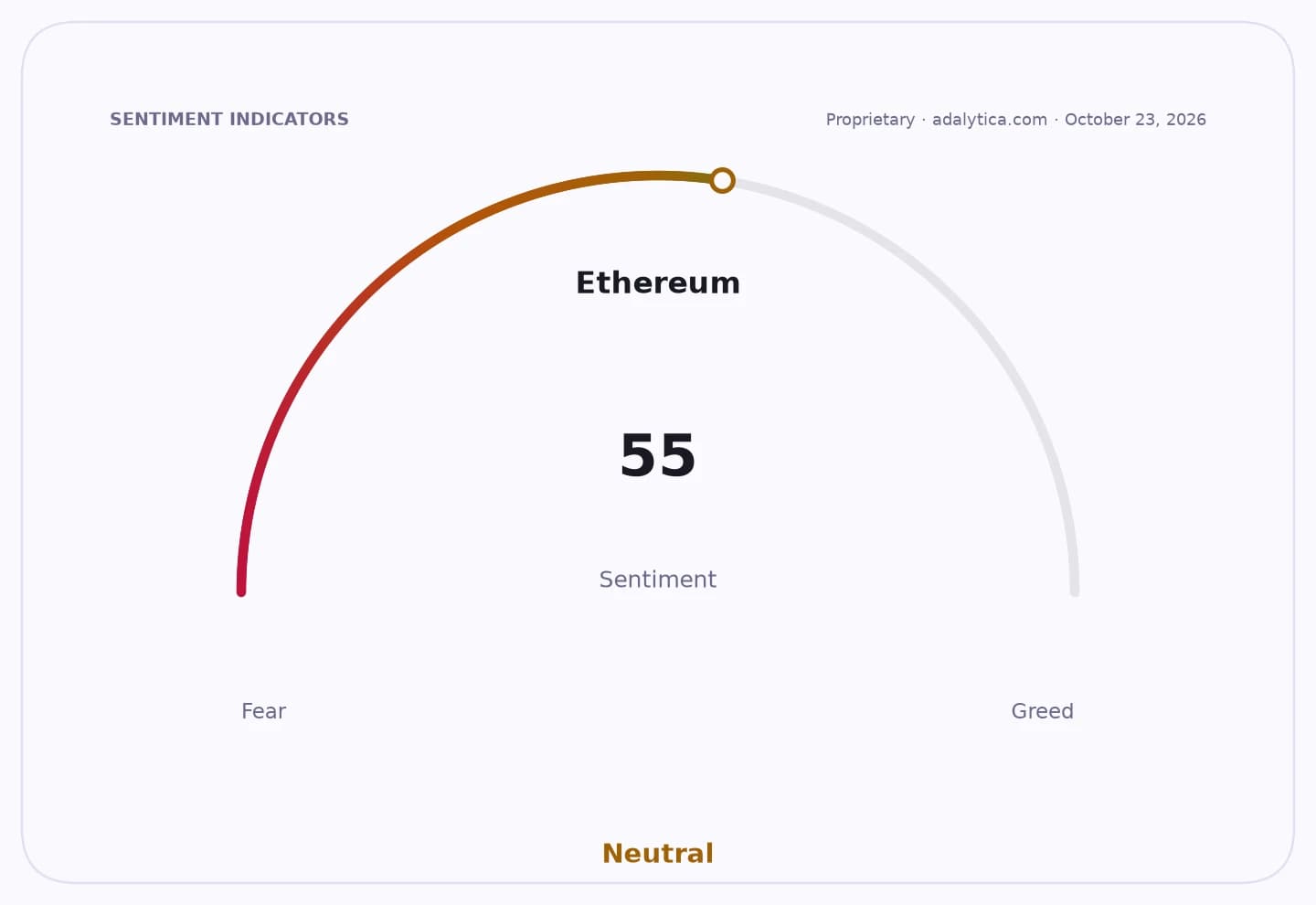
Sentiment IndicatorsⓘProprietary · adalytica.com · October 25, 2026
This is a snapshot — live sentiment, awareness and momentum for 130+ markets update continuously in the dashboard.Open AlphaPulse
The danger is greatest in smaller altcoins, where thin order books mean there is little depth to cushion another round of selling. If prices fall enough to trip more margin calls, exchanges would be forced to liquidate positions into an already weak market, pushing prices lower and potentially triggering a cascade. That feedback loop is especially relevant in crypto, where leverage is often the marginal source of liquidity during selloffs.
The latest price action shows how fragile that support has become. Over the seven days to Oct. 20, Ethena fell 10.9%, Pump.fun dropped 9.6% and Quant lost 4.9%, while Bitcoin fell 2% and Ethereum 4.2%. Even the two largest tokens have not been immune, but they still tend to attract fresh capital first. That matters because Bitcoin and Ethereum ETFs can channel money into those assets before it reaches the broader altcoin complex, leaving most leveraged altcoins without the same buying cushion if risk aversion deepens.
The market backdrop is therefore less about one liquidation event than about whether the unwind has truly begun. Bitcoin traded at about $80,535 on Oct. 25, below its 50-day moving average of $81,815 and with a 14-day RSI of 37.5, a sign of weakening momentum rather than capitulation. Ethereum sat near $2,341, also below its 50-day average of $2,544, with RSI at 30.3. Solana was softer still at $101.47, versus a 50-day average of $109.59, and RSI at 27.4. Those are conventional technical indicators, but taken together they point to an asset class still under pressure and not yet showing a durable rebound.
For investors, the issue is not just short-term price damage. High leverage can turn a routine pullback into a broad liquidity event, especially when speculative altcoins are already fragile and spot demand is concentrated in Bitcoin and Ethereum. That creates a relative-value dynamic: large caps may hold up better than smaller tokens, but the broader altcoin market remains vulnerable to another air pocket.
Bullish traders may argue that the market has already absorbed a major shock and that leverage can stay elevated while prices stabilize. The bear case is more compelling for now: if the next leg lower hits thinly traded altcoins first, the remaining leveraged longs may be the ones that get wiped out, not the ones providing a floor.
For now, the question is whether October’s liquidation was a reset or merely a pause. If leverage remains elevated while prices keep sliding, the market could still be one sharp move away from a deeper unwind.
| Entity | Gains | Losses |
|---|---|---|
| Short sellers | ▲Volatility and forced selling | ▼Squeezed if prices rebound |
| Bitcoin and Ethereum | ▲ETF-driven capital inflows | ▼Spillover from altcoin stress |
| Altcoin longs | ▲Temporary rebounds | ▼Liquidation risk |
| Smaller altcoins | ▲Speculative trading activity | ▼Thin liquidity and deeper drawdowns |