Amazon’s blowout cloud numbers are reviving the market’s willingness to pay for AI infrastructure, and that matters far beyond one quarter of earnings. Amazon.com shares jumped to $267.48 on Friday after the company said AWS sales rose 37% in the second quarter, a pace that signals enterprise demand for cloud and compute is still accelerating even as investors fret about the cost of building out data centers.
Amazon AWS revenue rose 37% in Q2
That is the key economic message: the AI spending cycle is not just alive, it is still broadening. Amazon said AWS operating income climbed to $16.6 billion from $10.2 billion a year earlier, showing that faster growth is still translating into real profit power despite heavy spending on technology infrastructure. For the broader economy, that means the biggest hyperscalers are continuing to funnel billions into chips, servers, networking gear, power and real estate — a capital-intensity wave that is supporting suppliers across the AI stack.
For investors, Amazon’s move is a reminder that the market underestimates the earnings leverage in cloud once usage inflects. The stock’s rally came after a long stretch of weakness that had left it trading below its 50-day moving average for much of the summer; Friday’s surge pushed it well above both the 50-day and 200-day moving averages and lifted momentum indicators sharply. In plain English, buyers are once again rewarding proof that cloud demand can justify the capex.
The comparison with Microsoft and Alphabet only strengthens the case. Microsoft’s latest results showed Azure and other cloud services revenue up 41%, while Google Cloud also continues to lean into AI capacity. That is not just competition; it is confirmation that the entire hyperscale complex is in an arms race for compute. When all three of the major platforms are still seeing robust demand, the takeaway is that the AI buildout is still in an early monetization phase, not a late-cycle one.
That has direct investment implications. Amazon is the obvious beneficiary, but the bigger opportunity may be in the picks-and-shovels names that sell power equipment, networking, semiconductors, and data-center infrastructure. The market keeps looking for the “winner” in AI, but the more durable trade may be the toll roads around it — the companies that get paid every time hyperscalers expand capacity.
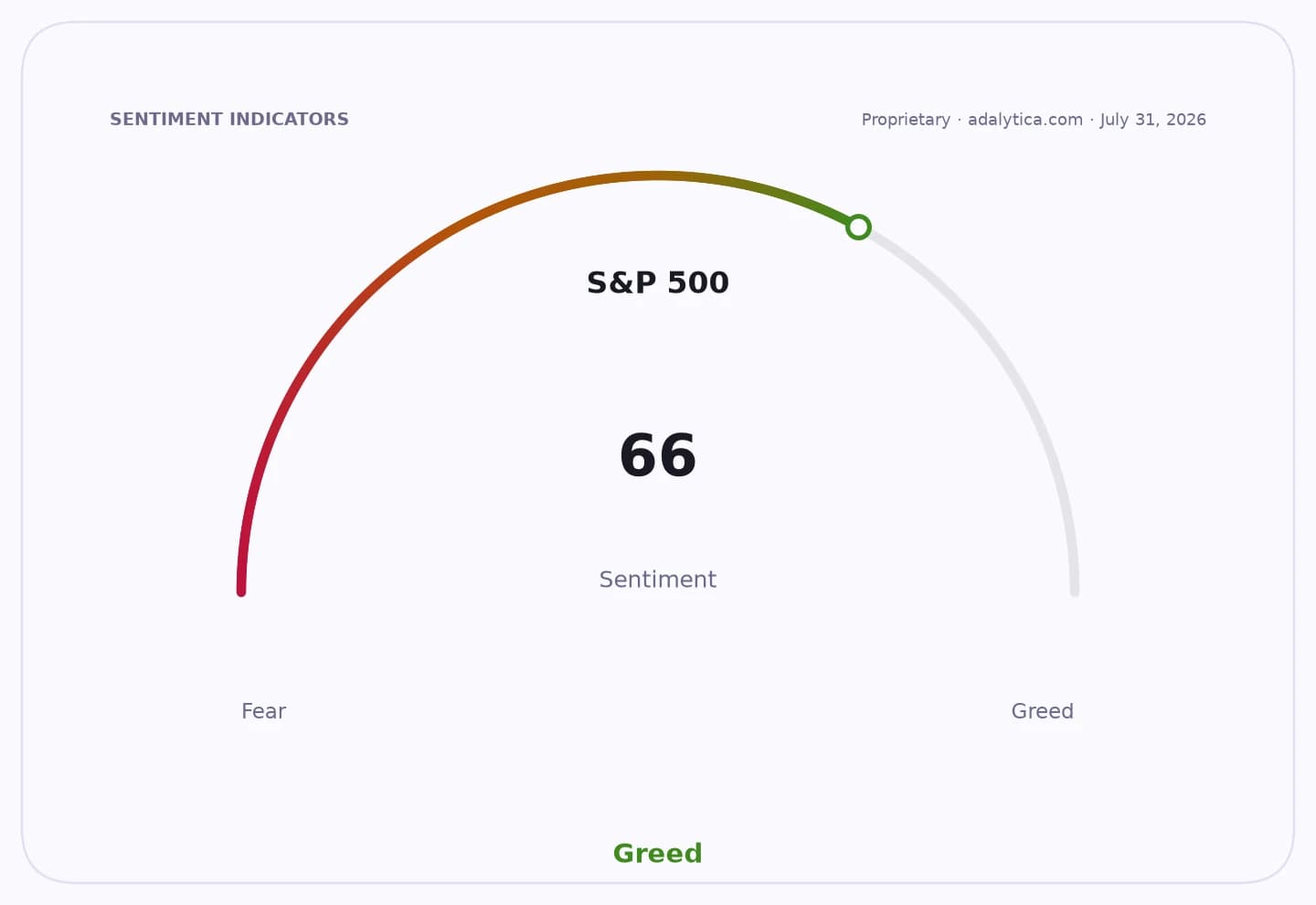
Adalytica.com’s S&P 500 trade signals also show awareness at extreme greed, which is a reminder that the market is crowded into the theme. Crowding does not kill a secular trend, but it does mean investors should favor pullbacks and leaders with visible operating leverage rather than chasing every headline. Amazon fits that bill better than most because cloud growth is still compounding into profits, not just revenue.
The next catalyst is whether AWS can keep growth in the mid-30% range while margins hold up under the weight of AI infrastructure spending. If it can, Amazon is not just a retail and advertising story anymore — it is one of the clearest public-market ways to own the global compute buildout. For long-term investors, that is where the asymmetric upside still sits.
| Entity | Gains | Losses |
|---|---|---|
| Amazon | ▲AWS reacceleration | ▼Skeptics of cloud monetization |
| Microsoft | ▲Azure demand validation | ▼Investors betting on slower cloud growth |
| Alphabet | ▲AI/cloud capex tailwind | ▼Short-term margin hawks |
| AI suppliers | ▲More infrastructure orders | ▼Late entrants to the trade |