A stubbornly elevated 10-year Treasury yield is sharpening the case for one kind of REIT and weakening another, forcing income investors to decide whether they want balance-sheet insulation or steady monthly cash flow.
American Tower vs. Realty Income as 10-year yield stays 4.69%

The latest bond data show the US 10-year yield at 4.69%, only slightly below this week’s recent peak, while the unemployment rate remains near 4.1% and consumer prices are still rising from a much higher base than in the pre-pandemic era. That combination keeps real estate valuations tethered to financing costs, making duration and leverage more important than ever for REIT holders.
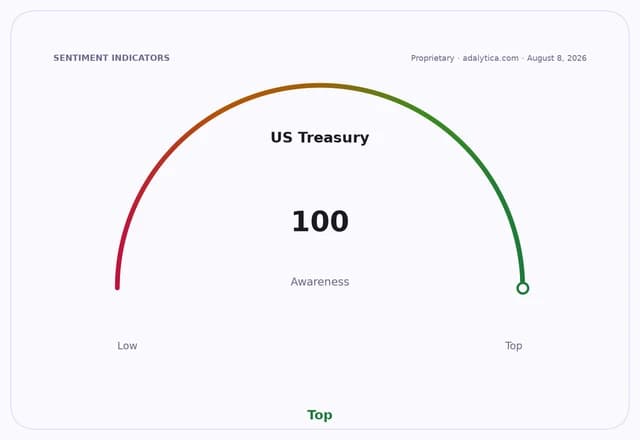
Sentiment IndicatorsⓘProprietary · adalytica.com · August 8, 2026
This is a snapshot — live sentiment, awareness and momentum for 130+ markets update continuously in the dashboard.Open AlphaPulse

In that environment, American Tower looks better positioned than Realty Income. The tower landlord’s shares have recovered to $172.54 after a summer selloff, and the stock is now sitting close to its 50-day moving average, with RSI back above 56 and MACD turning positive. By contrast, Realty Income’s stock has been pinned near $62.51, barely above its 200-day average, with RSI down to 26 and its MACD flat to weak — a technical profile that reflects investor caution even as the company’s scale and dividend appeal remain intact.
The divergence is not just about charts. American Tower’s model is tied to wireless infrastructure, where long-term contracts and recurring rent growth can offset higher rates better than traditional brick-and-mortar property cash flows. Realty Income, the archetypal net-lease REIT, offers defensive tenancy and predictable payouts, but it is also more exposed to the market’s current sensitivity to funding costs and to the spread between property yields and government bonds.
That spread matters. A 10-year Treasury near 4.7% raises the hurdle for REITs whose dividend yields and growth prospects must compete with risk-free income. It also hits the present value of future cash flows, which is why investors have been quicker to reward assets with inflation-linked contracts or structural growth drivers and slower to pay up for slower-moving portfolios.
Proprietary trade signals from Adalytica also point to a market still inclined to chase risk elsewhere even as rates remain restrictive. S&P 500 sentiment is in “Extreme Greed,” the US dollar is flashing “Extreme Greed,” and Treasury-bond sentiment has improved. That mix suggests capital is not broadly seeking safety; instead, it is discriminating between REITs that can grow through higher-rate pressure and those that depend mainly on yield support.
For investors, the choice is becoming more tactical. American Tower offers a cleaner play on secular demand and better relative momentum if rates stay high. Realty Income may appeal to long-duration income buyers, but its near-term upside looks more constrained unless bond yields fall enough to revive the sector’s valuation multiple.
If the 10-year stays anchored above 4.5%, the market is likely to keep rewarding REITs with pricing power, contract visibility and lower refinancing risk while pressuring those whose main attraction is a dividend that competes directly with Treasuries. The real portfolio stabilizer, for now, is the property type with the better spread to rates — not necessarily the one with the biggest yield.
| Entity | Gains | Losses |
|---|---|---|
| American Tower | ▲Relative valuation support | ▼Rate-sensitive income buyers |
| Realty Income | ▲Defensive dividend demand | ▼Multiple expansion |
| Treasury yields | ▲Income competitiveness | ▼REIT valuations |
| REIT investors | ▲Clearer selection discipline | ▼Broad sector complacency |