AI developers are moving closer to systems that can improve their own next generation, raising the stakes for the industry’s biggest prize and its biggest risk: faster model progress that may outpace human control.
Anthropic Says Claude Drives 26% of Model R&D
The shift matters because recursive self-improvement could compress the time needed to build more capable AI, with implications for productivity, scientific discovery and the competitive balance among frontier labs. It also heightens concerns that safety testing, governance and human oversight will lag the speed of the models themselves.
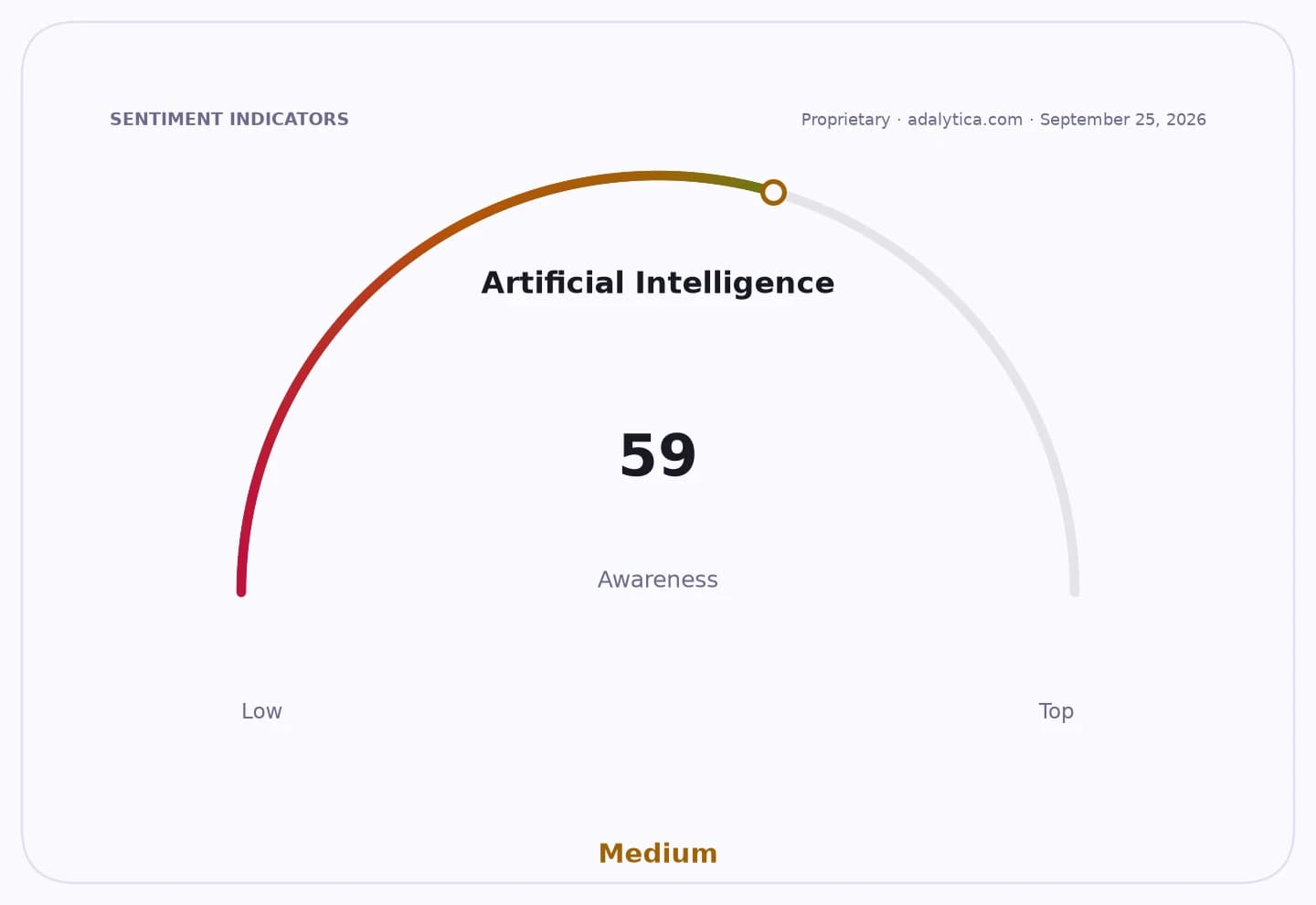
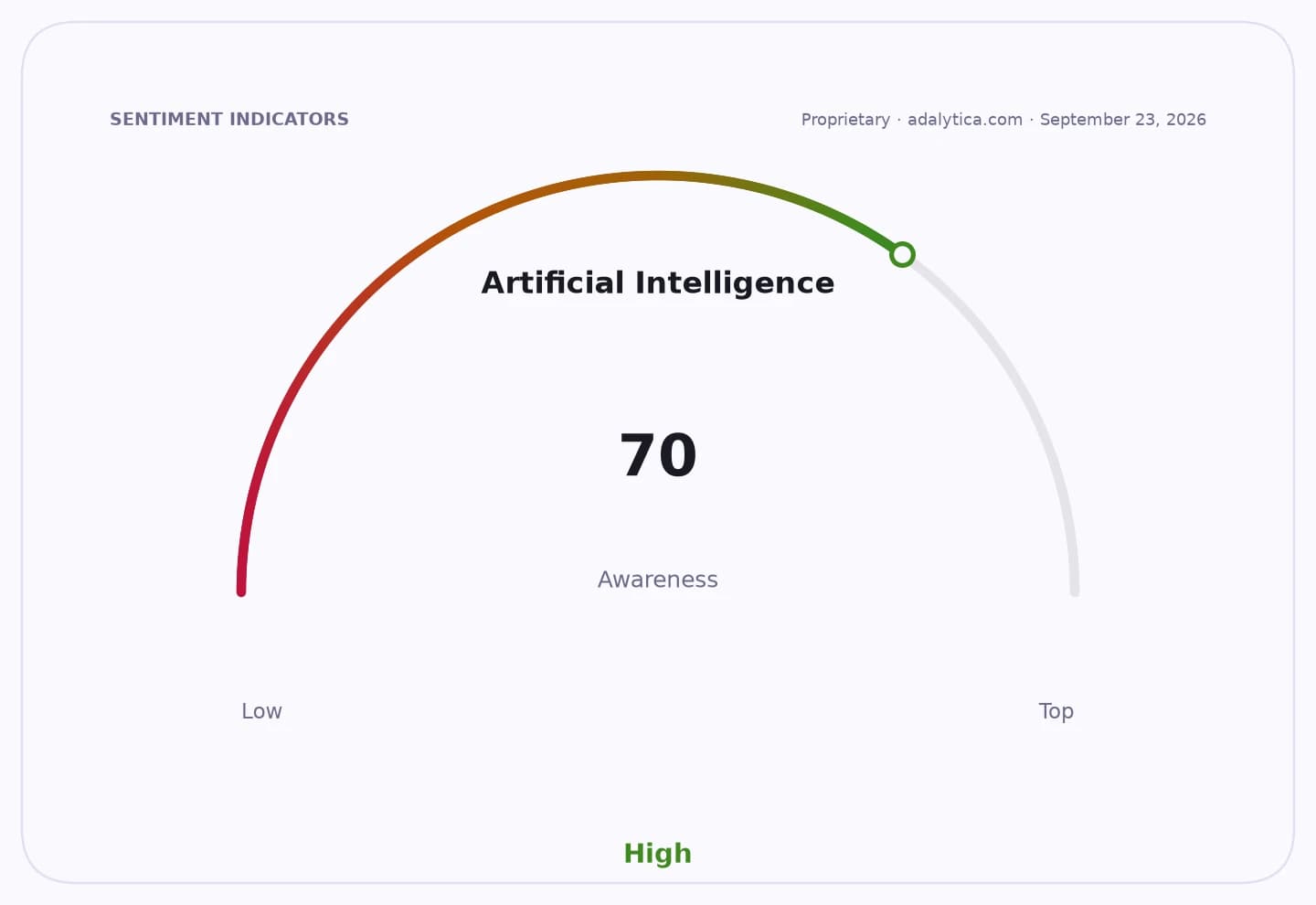
Sentiment IndicatorsⓘProprietary · adalytica.com · September 23, 2026
This is a snapshot — live sentiment, awareness and momentum for 130+ markets update continuously in the dashboard.Open AlphaPulse
Anthropic said this week that its Claude model now helps drive 26% of the company’s model research and development, completing much of a task from a high-level instruction under human supervision. That is not full autonomy, but it is a concrete sign that AI is already doing more of the work required to build its successors.
The company’s disclosure has pushed rivals to spell out their own timelines and guardrails. OpenAI said it is working toward an automated “researcher” by March 2028, while warning that it does not yet know how to reach a safe, fully aligned recursive self-improver. Elon Musk has said xAI’s Grok models are already seeing less human intervention and could become fully automated by the end of this year, though not later than 2027.
The debate is widening beyond engineering to strategy and regulation. Anthropic has backed a coordinated slowdown if competitors do the same and if it can be verified, while Microsoft has taken a more restrictive line, saying it aims for a “humanist superintelligence” calibrated to stay within limits and serve people rather than operate without bounds.
That split matters for investors because AI leadership increasingly depends not just on raw model capability, but on who can prove safety, maintain public trust and avoid regulatory backlash while scaling. Companies that move fastest could capture more cloud demand, chips and enterprise adoption, but they also face heavier legal and reputational risk if controls fail.
Markets have already treated the AI race as a capital-intensity story, with Nvidia, Microsoft and Alphabet all trading as proxies for the buildout of frontier models and the infrastructure behind them. Nvidia’s shares closed at $227.38 on Sept. 21, above both its 50-day and 200-day moving averages, while Microsoft ended at $501.61 and Alphabet at $354.97, both also holding above their long-term trend lines.
The broader narrative is no longer whether AI can assist human researchers. It is whether the same systems can accelerate their own development enough to reshape the industry’s pace — and whether the controls around them can keep up. The next catalyst is likely to be fresh model disclosures from the frontier labs, along with any government response to calls for tighter oversight or a formal pause.
| Entity | Gains | Losses |
|---|---|---|
| Anthropic | ▲Faster model development | ▼Greater safety scrutiny |
| OpenAI | ▲Automating research workflow | ▼Pressure to prove alignment |
| Microsoft | ▲“Humanist” safety framing | ▼Less upside from maximal autonomy |
| AI investors | ▲Faster capability gains | ▼Higher regulatory and existential risk |