AI is beginning to deliver measurable business value in Indian healthcare, with hospitals and diagnostics firms moving beyond pilots and into production use in imaging, documentation and risk detection, even as high deployment costs and tight governance requirements limit a broad rollout.
Apollo Hospitals AI use expands in India healthcare
That matters because healthcare has long been the sector where AI’s commercial promise was hardest to prove. In finance or retail, automation can be scaled quickly. In medicine, every use case has to clear the higher bars of clinical utility, patient safety, regulatory scrutiny and physician adoption. The latest evidence from India suggests the technology is now crossing that threshold in a few narrow but economically important areas, particularly diagnostics and administrative workflows.
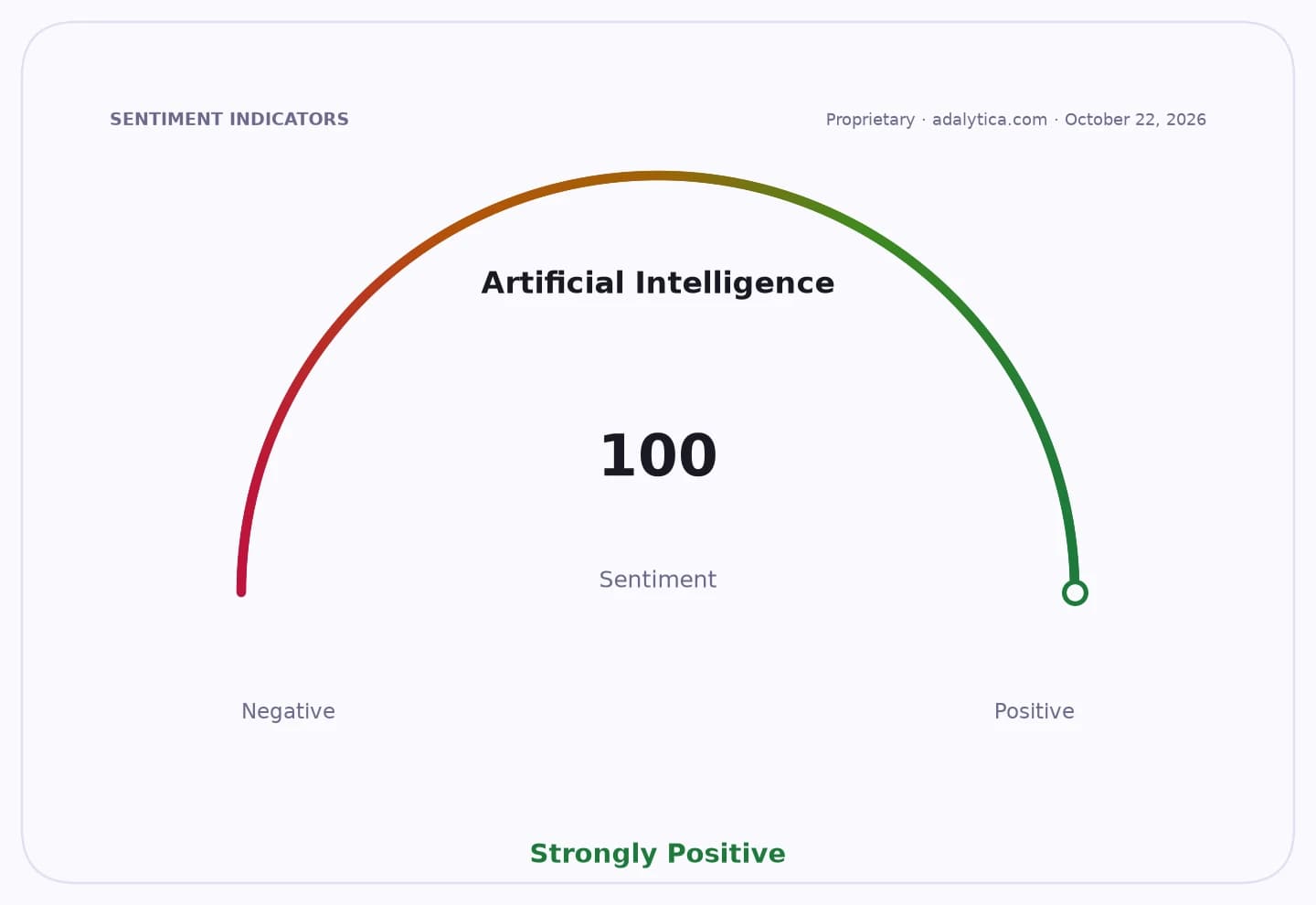
Sentiment IndicatorsⓘProprietary · adalytica.com · October 22, 2026
This is a snapshot — live sentiment, awareness and momentum for 130+ markets update continuously in the dashboard.Open AlphaPulse
Apollo Hospitals, one of the country’s largest private healthcare groups, said it has developed 20 certified AI algorithms, with 12 already in production and eight being integrated or deployed. The company is using AI in imaging, nursing workflows, discharge summaries, medical coding and remote patient monitoring. Management says investment has shifted away from the algorithm alone toward electronic medical-record integration, secure infrastructure, governance and clinician adoption — a sign the commercial bottleneck is no longer model quality, but implementation.
That shift is the real story for investors. AI is most valuable where there is abundant structured data, specialist shortages and a clear efficiency gain. Radiology, pathology, cardiology and neurology fit that profile, which is why diagnostics has emerged as the first large-scale adoption area. AI can flag undetected cardiac risk, vet CT images before radiologists sign off and reduce time spent on routine documentation. Those are not abstract productivity claims: they are direct levers on throughput, turnaround times and capacity utilisation.
But the economics are not straightforward. In India, where labour costs are comparatively low, some back-office automation still struggles to justify itself against hiring more staff. Several healthcare executives say that means hospitals will only adopt AI where the return is visible in outcomes, speed or reduced clinical variation, rather than in simple headcount reduction. For providers, that makes AI less of a wholesale operating model reset and more of a targeted capital-allocation decision.
The pricing issue is also critical. One senior healthcare executive said investors often assume AI is cheap because model access is token-based, but infrastructure, integration and governance can make it expensive. Even in radiology, one of the most mature AI use cases, AI-assisted reporting can cost more than conventional human-led reporting. That is a warning that adoption will likely be concentrated among larger systems with the balance sheet, data architecture and scale to absorb upfront costs.
The market opportunity is still substantial. NITI Aayog has said AI could contribute to a threefold increase in India’s GDP by 2035, while EY has estimated generative AI applications in health and life sciences could add $64 billion to India’s economy by 2030. Those figures are broad policy estimates rather than company guidance, but they underline why healthcare has become a strategic test case for India’s AI ecosystem: if the sector can prove value here, it strengthens the investment case across other regulated industries.
Yet the biggest constraint may be trust rather than technology. Healthcare leaders say AI cannot scale without secure data-sharing frameworks, cybersecurity, regulatory standards and compliance with India’s Digital Personal Data Protection Act. Smaller providers in particular may lack the systems to support responsible deployment. In practical terms, that means the next phase of growth depends less on launching more tools and more on embedding a smaller number of them into everyday care.
For investors, the implication is clear. AI in healthcare is no longer just a promise story; it is becoming a workflow story. Winners are likely to be hospital chains, diagnostics platforms and vendors that can integrate models into clinical systems and demonstrate hard evidence on outcomes, safety and throughput. The losers are likely to be those chasing broad-based automation without a clear return on capital. The commercial value of AI in healthcare is now being proven — but only where the economics, governance and clinical use case line up.
| Entity | Gains | Losses |
|---|---|---|
| Apollo Hospitals and large hospital chains | ▲Workflow efficiency and clinical capacity | ▼Upfront integration costs |
| Diagnostics AI vendors | ▲Faster adoption in structured-data specialties | ▼Broad, low-ROI automation plays |
| Patients and clinicians | ▲Earlier detection and less admin burden | ▼Overreliance risk without governance |
| Small providers | ▲Limited direct gains from scale economics | ▼Compliance and infrastructure costs |