Apple’s valuation premium now rests on a narrower set of assumptions: that Tim Cook’s handoff, whenever it comes, will not break the company’s earnings machine the way Amazon’s shares lagged after Jeff Bezos stepped aside.
Apple succession risk vs Amazon after Bezos
That is why the market is likely to treat any succession timetable at Apple as more than a governance footnote. Amazon remains the cautionary example. Since Bezos ceded the CEO role, the stock has badly underperformed the S&P 500 and the Nasdaq-100, even as the company kept expanding its cloud and retail franchises. For investors, the lesson is not that founder transitions automatically destroy value, but that a chief executive who has been deeply associated with a company’s operating discipline and capital allocation can be hard to replace without a period of multiple compression or strategic drift.
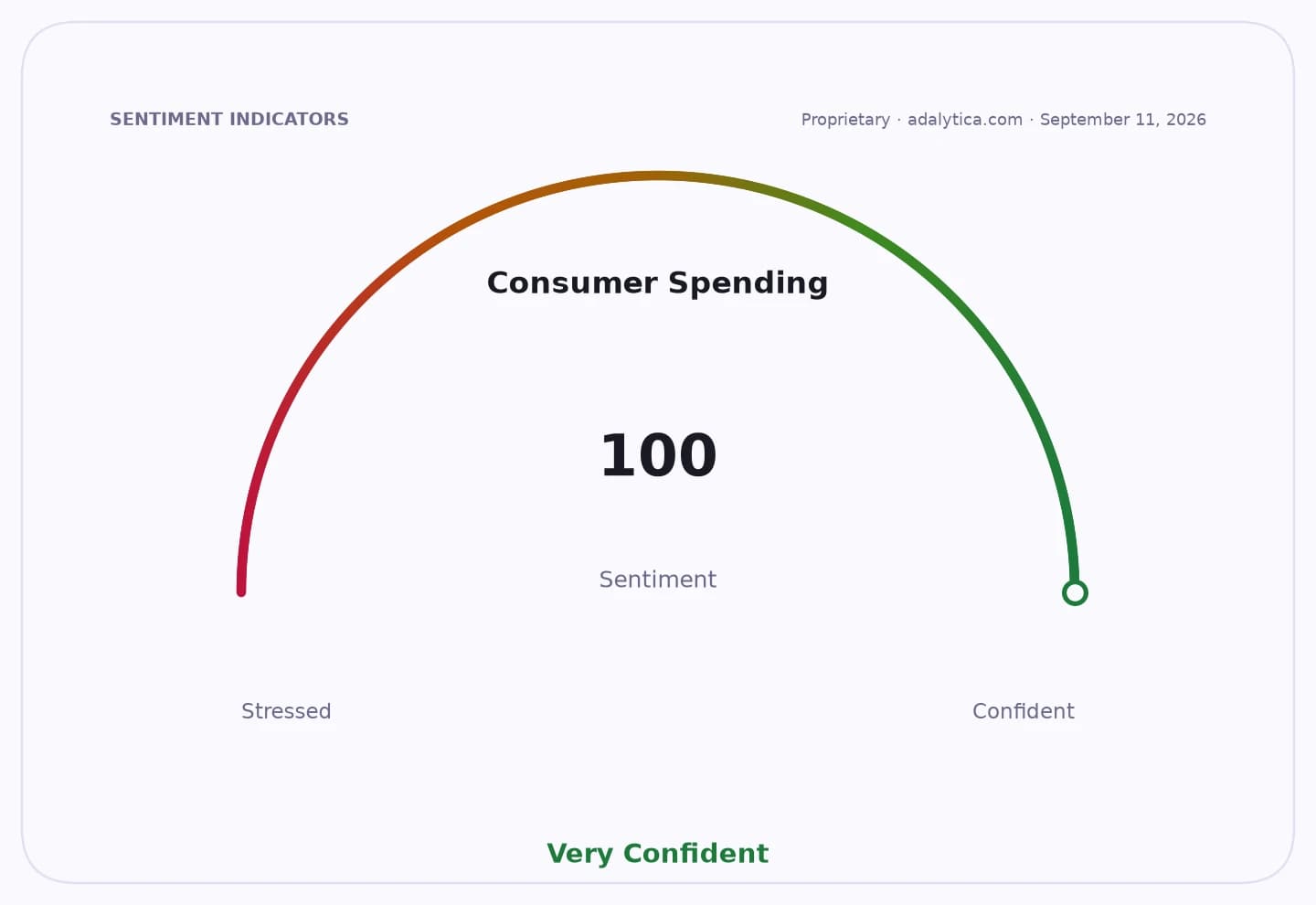
Sentiment IndicatorsⓘProprietary · adalytica.com · August 30, 2026
This is a snapshot — live sentiment, awareness and momentum for 130+ markets update continuously in the dashboard.Open AlphaPulse
Apple enters that same conversation with a far more mature business and a different set of risks. The company is not trying to invent a new retail format or scale a cloud platform from scratch; it is defending a hardware ecosystem, a services margin base and an enormous installed customer network. But that makes the leadership question more consequential, not less. Apple trades as one of the market’s premier quality franchises, and that premium is tied to predictable execution, product cadence and the perception that management can preserve pricing power even in a slower-growth environment.
Recent trading shows how sensitive the stock remains to that confidence. Apple has climbed back above its 50-day and 200-day moving averages and was last near $319.70, after a sharp rebound from early-summer weakness. The 50-day average at about $311.81 and the 200-day near $282.15 show a stock that has reasserted its uptrend, while RSI readings around 64 suggest momentum is firm but not yet stretched. That backdrop matters because any leadership uncertainty would hit a market that is already paying for stability.
By contrast, Amazon’s own shares have been more volatile despite a strong run in 2026 and a business that still has AWS growth as a key support. The stock was last around $266.43, below a recent peak near $284, after oscillating sharply around its 50-day average. The market is rewarding the franchise, but not with the same consistency it gives Apple. That divergence is part of the cautionary tale: even very large, strategically sound companies can see the market re-rate them lower if investors start to doubt the continuity of the leadership model.
The comparison matters economically because CEO succession is not just a boardroom event. It can affect capital spending, supply-chain priorities, buyback pace, product strategy and the willingness to take long-duration bets. In Apple’s case, investors will ask whether a successor can preserve the company’s ability to extract high margins from mature hardware while still financing new categories and artificial-intelligence ambitions. In Amazon’s case, the post-Bezos period showed that a company can remain operationally strong while the market still discounts it for lack of the founder’s strategic imprint.
The broader market context raises the stakes. The Nasdaq-100 has been driven by a concentrated group of mega-cap technology names, and Apple is a central pillar of that index. With U.S. equity sentiment in Bloomberg-style terms sitting at a very elevated “Extreme Greed” reading on the S&P 500 gauge, the market is pricing in continued perfection from the biggest names. That leaves little room for a succession narrative to be dismissed as irrelevant.
There is also a bear case investors cannot ignore. Apple has historically benefited from a leadership style that emphasizes operational discipline over disruption. A successor who is less adept at preserving that balance could face pressure from multiple directions: regulators, China exposure, slowing handset cycles and the challenge of turning artificial intelligence into a meaningful driver of revenue rather than just an engineering expense. If the transition is poorly handled, the stock could lose some of the scarcity premium attached to Cook’s record of steady execution.
The bull case is that Apple’s institutional strengths are bigger than any one executive. Its hardware-software integration, services economics and buyback capacity create a self-reinforcing investment case that does not rely on a founder. If the transition is staged well and the board gives the market a long runway, Apple may avoid the Amazon pattern entirely.
For now, the market is likely to judge the question less on the date of any exit than on whether Apple can demonstrate succession depth without interrupting its financial formula. That is what investors should watch: not just who replaces Cook, but whether the company can keep compounding through the handoff.
| Entity | Gains | Losses |
|---|---|---|
| Apple long-term holders | ▲continuity if transition is orderly | ▼multiple risk if succession is messy |
| Tim Cook | ▲legacy gets benchmarked against Bezos | ▼increased scrutiny on endgame |
| Apple board | ▲time to frame succession | ▼pressure to prove depth |
| Amazon shareholders | ▲cautionary reference point | ▼reminder of post-founder underperformance |