Argentina’s latest debt rollover handed the economy ministry $6.6 trillion pesos, but the bigger market question is whether the operation drains too much liquidity and pushes short-term rates, inflation expectations and the dollar higher.
Argentina debt rollover lifts peso liquidity debate
The auction covered 136% of the week’s roughly $4.85 trillion in maturities, leaving a net absorption of about $1.7 trillion at first glance. That is meaningful in a market where the government has been trying to manage every peso in circulation to avoid amplifying price pressures and exchange-rate stress, but several desks said the effective drain could prove smaller if official support operations in the secondary market are confirmed.
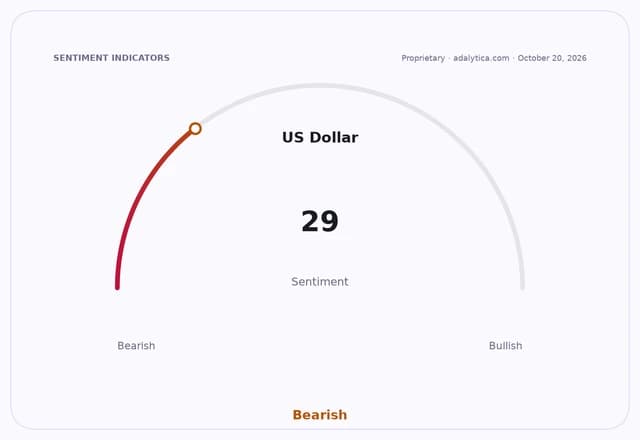
Sentiment IndicatorsⓘProprietary · adalytica.com · October 20, 2026
This is a snapshot — live sentiment, awareness and momentum for 130+ markets update continuously in the dashboard.Open AlphaPulse

Daniel Chodos, head of research at Dhalmore Capital, said the tender was relatively small and that the liquidity impact should be limited, though short rates need to be watched in coming days. Other market participants pointed to reports that the central bank bought around $1 trillion of Lecap bills in the same session, potentially offsetting a large part of the expected contraction.
If those purchases are verified by Monday’s monetary data, the transaction would amount to a quasi-exchange between primary and secondary markets: the Treasury issued longer paper while the central bank removed short-dated securities from the market. That would help explain why the government has been able to keep peso conditions tight without forcing an abrupt squeeze that could destabilize funding costs.
For policymakers, the logic is straightforward. Too many pesos can feed demand for dollars and accelerate inflation, while too few can destabilize money-market rates and complicate debt financing. The economy team has repeatedly said it calibrates dollar purchases by the central bank not only to foreign-exchange supply, but also to the demand for pesos in the system.
That balancing act is why investors are focused less on the headline rollover ratio than on the net liquidity outcome. A stricter-than-expected squeeze would likely support the peso in the near term and help contain inflation expectations, but it also raises the risk of sharper moves in short-term rates and tighter financial conditions. A lighter drain would reduce that funding pressure, though it could leave more pesos in the system and renew questions about exchange-rate and price stability.
The market backdrop is already sensitive. US Treasury yields remain elevated, the dollar has been firm globally and inflation remains the dominant macro theme across markets. In that setting, any sign that Argentina is loosening or tightening too fast in pesos can spill into the currency, local bond demand and the pace of disinflation.
For investors in Argentine debt and the peso, the key catalyst now is the data that will show whether the central bank’s rumored Lecap purchases actually took place. If they did, the government may have engineered a smoother liquidity adjustment than the raw rollover number suggests. If they did not, the system may be left with a larger peso drain than many traders had assumed, with the burden falling on short rates and the FX market.
| Entity | Gains | Losses |
|---|---|---|
| Argentine government | ▲Higher rollover, tighter peso control | ▼More pressure if rates spike |
| Short-term bondholders | ▲Support from official buying | ▼Lower liquidity, funding risk |
| Peso bulls | ▲Scarcer pesos, firmer FX support | ▼— |
| Dollar buyers | ▲— | ▼Less liquidity if intervention tightens |