Mexico’s finance ministry sold 40 billion pesos of government debt in a closely watched auction that drew demand 2.6 times the amount offered, signaling that domestic investors are still willing to absorb sovereign borrowing even as global bond markets remain under pressure.
Mexico sells 40 billion pesos of government debt

The placement matters because it shows the Treasury can continue funding the government at scale without having to pay an obvious liquidity premium to clear the market. In an environment where higher yields are straining public finances worldwide, strong auction coverage gives Mexico more room to execute its annual financing program and reduces the immediate risk of a funding squeeze.
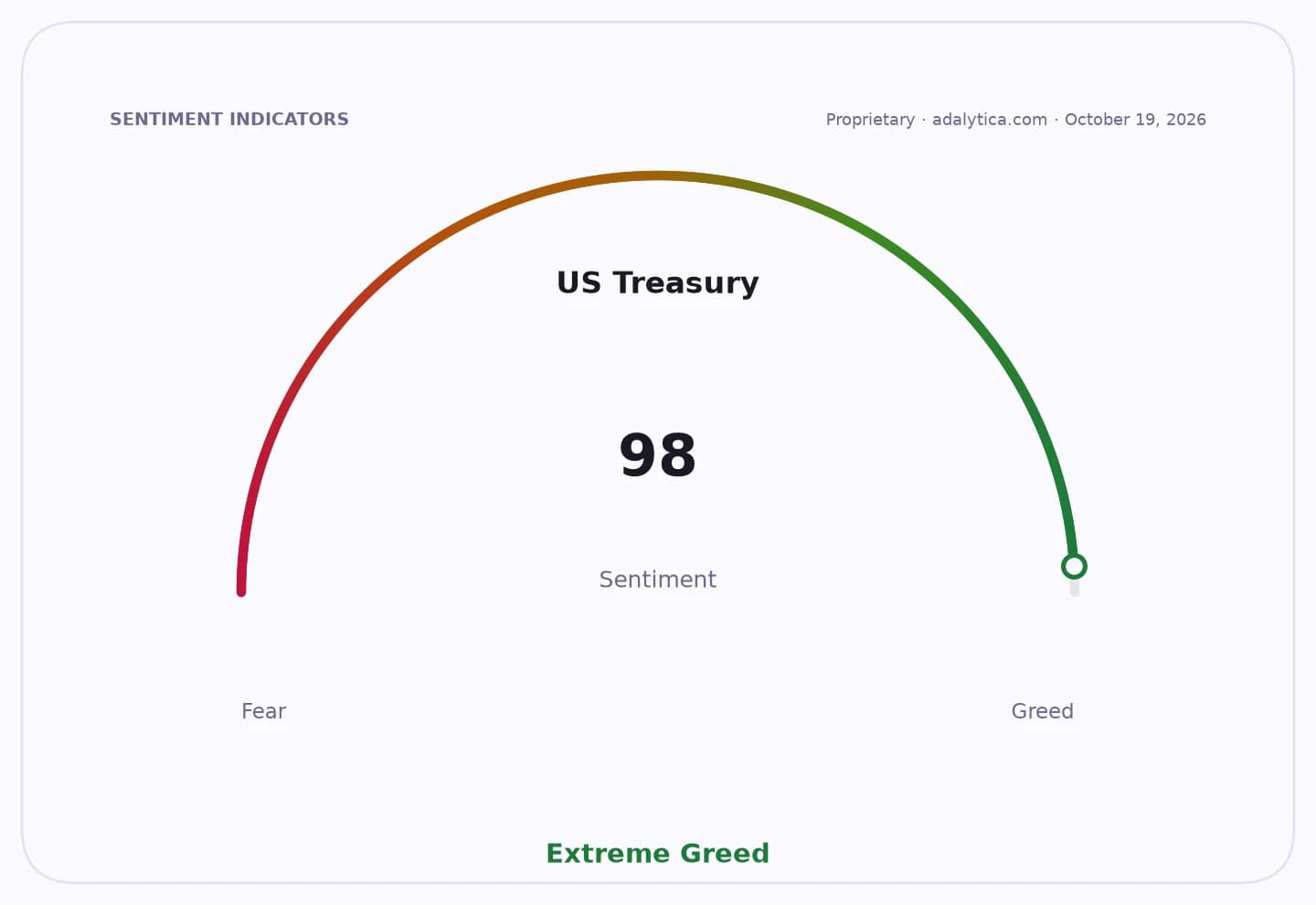
Sentiment IndicatorsⓘProprietary · adalytica.com · October 22, 2026
This is a snapshot — live sentiment, awareness and momentum for 130+ markets update continuously in the dashboard.Open AlphaPulse
The Secretariat of Finance and Public Credit, led by Édgar Amador Zamora, said it sold the securities in a fourth simultaneous auction of Bondes G and Bono S on Oct. 15. Total bids reached 104.531 billion pesos, well above the 40 billion pesos placed. That kind of oversubscription suggests steady demand from banks, pensions and other institutional buyers for sovereign paper tied to floating-rate and sustainable financing mandates.
The sale was split between 33.4 billion pesos in Bondes G and 6.6 billion pesos in Bono S. In the Bondes G tranche, the government placed 5.1 billion pesos at two years, 8.6 billion at three years, 9.55 billion at four years and 10.15 billion at six years, with spreads of 0.1000, 0.1400, 0.1720 and 0.1992 percentage points, respectively. The Bono S was issued at 10 years with an 8% coupon and a 9.36% yield. That yield level underscores the cost of borrowing remains meaningful, but the fact the issue cleared comfortably points to healthy appetite for duration and sustainability-themed paper.
For investors, the auction offers a read-through on Mexico’s sovereign credit profile and funding flexibility. Robust demand helps support local bond prices and can ease pressure on secondary-market yields, while weaker coverage would have raised questions about rollover risk or the need to offer wider concessions. The result is also relevant for the peso and broader emerging-market sentiment because sovereign funding stress often spills into currency and credit markets.
The government said the transaction stayed within this year’s authorized debt ceilings, which allow up to 1.78 trillion pesos of domestic borrowing and $15.5 billion of external debt. That compliance is important for market confidence, especially as investors continue to monitor fiscal discipline and the trajectory of public borrowing across emerging markets.
The broader backdrop is a global bond market that has become less forgiving of heavy issuance. Against that setting, Mexico’s ability to place debt at more than double the offered amount looks constructive rather than complacent. The key question now is whether that demand holds as the Treasury moves deeper into its financing calendar and as yields, inflation expectations and risk appetite shift.
| Entity | Gains | Losses |
|---|---|---|
| Mexico Treasury | ▲Easier funding | ▼Lower urgency to concede on yields |
| Domestic bond investors | ▲Access to sovereign paper | ▼Accept 8% to 9.36% returns, but not higher |
| Secondary bondholders | ▲Support for market prices | ▼Less upside if primary supply stays heavy |
| Taxpayers / fiscal accounts | ▲Stable refinancing | ▼Ongoing high borrowing costs |