President Javier Milei is trying to recast Argentina’s most politically potent economic complaint — that families cannot make it to month-end — as a myth, even as official data and private surveys show incomes are lagging inflation and households are leaning harder on debt.
Argentina incomes lag inflation as election looms
The dispute matters because it goes to the heart of Milei’s economic narrative heading into an election year: that stabilization is working, the fiscal accounts are fixed and inflation is tamer, even if much of the public still feels squeezed. For investors, it is a test of whether the disinflation trade can survive a political backlash over disposable income, especially in sectors tied to consumer spending, banking and the peso.
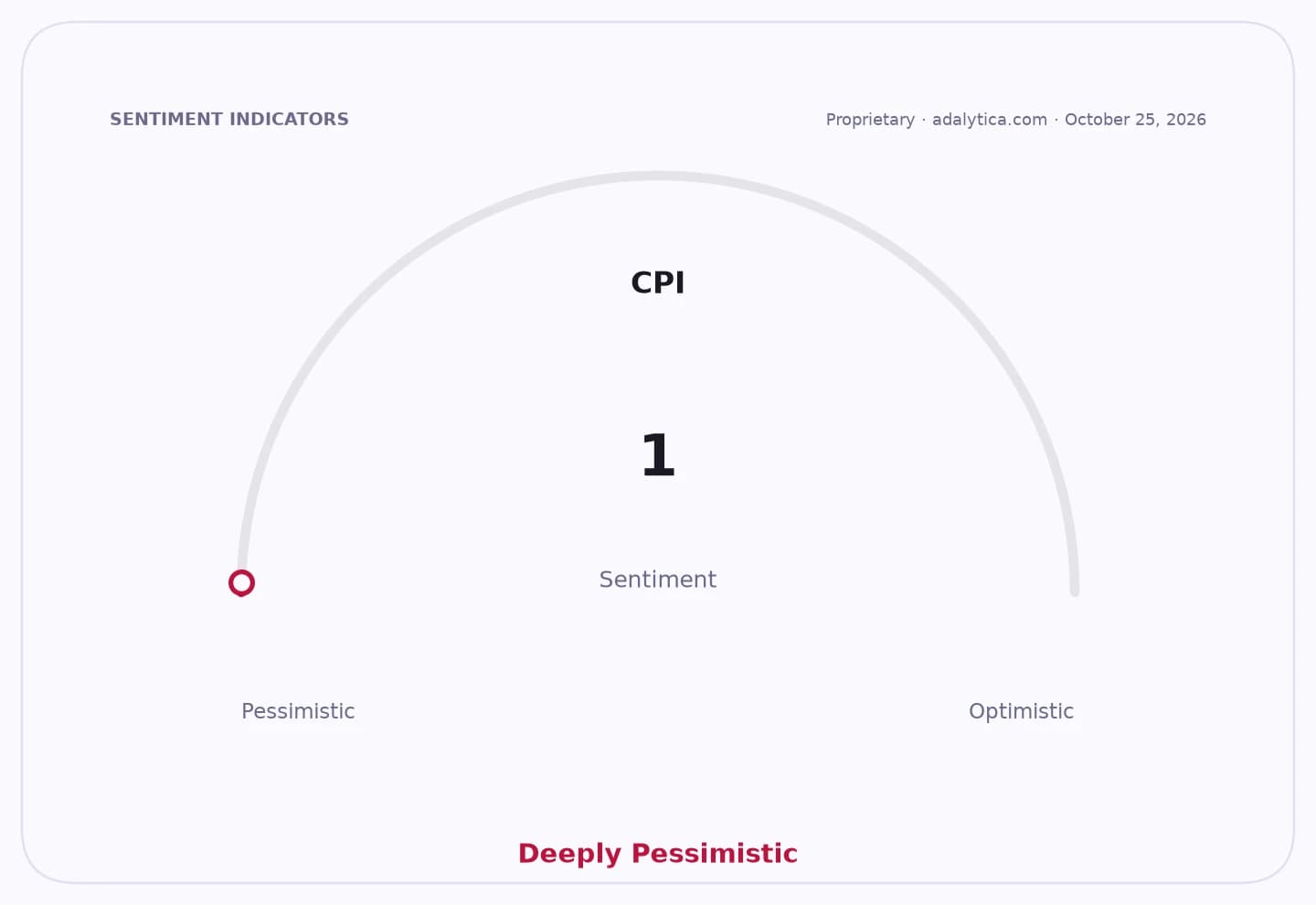
Sentiment IndicatorsⓘProprietary · adalytica.com · October 26, 2026
This is a snapshot — live sentiment, awareness and momentum for 130+ markets update continuously in the dashboard.Open AlphaPulse
Milei made the case on Monday in Neuquén, in front of an audience tied to the oil and gas industry, arguing that claims people “do not make it to the end of the month” are “a pelotudez” because those who truly ran out of money would not be able to survive 10 days without food or water. He used the stage to tout the government’s overhaul of economic rules and to portray Argentina as entering the election period “in peace,” with no run on the currency.
The timing was not accidental. The trip coincided with a year in which exports surpassed $10 billion in a single month for the first time, a milestone that underscores the strength of energy, especially Vaca Muerta, and gives Milei a more supportive macro backdrop than the one he inherited. That matters for markets because stronger export earnings improve external balances, reduce pressure on reserves and help anchor the peso.
But the political risk sits elsewhere: in the household balance sheet. Argentina’s informal economy is still around 45%, with informal workers earning about 38% less than formal ones, which makes the monthly squeeze more severe for a large slice of the population. The government says it has restored order quickly, but the official statistics show that incomes are not keeping pace with living costs.
According to Indec, average household income rose 11.5% in the first half, well below the 19.6% increase in the total basic basket and the 21.4% rise in the food basket. In practical terms, that means purchasing power is still being eroded even after the sharp fiscal adjustment and slowdown in inflation that Milei has made the centerpiece of his administration.
Private surveys point to the same pressure. Consultancy Zentrix said 65.3% of Argentines run out of income by the 20th of each month, while 56.2% took on some debt in the last six months. Half of those borrowers used credit to buy food and medicine, a sign that debt is no longer being used mainly for durable goods but to finance current spending. That creates a rollover problem for next month’s paycheck and keeps consumer demand fragile.
For banks such as Grupo Financiero Galicia, the strain is a double-edged sword: higher demand for short-term credit can support lending volumes, but rising household stress increases credit risk and can cap broader consumer recovery. For Loma Negra and other domestically exposed companies, the more relevant issue is whether real wages and access to credit can recover enough to translate lower inflation into stronger sales.
The broader narrative is that Milei is winning the macro fight he chose to prioritize, but not yet the micro one that voters feel every day. With the election season approaching, the gap between Argentina’s improved external accounts and strained household budgets is likely to define both the political debate and the market’s view of how durable the recovery really is.
| Entity | Gains | Losses |
|---|---|---|
| Milei government | ▲macro stability narrative | ▼voter goodwill |
| Energy exporters/Vaca Muerta | ▲stronger export receipts | ▼less political cover for austerity |
| Banks | ▲short-term credit demand | ▼higher household default risk |
| Consumers/low-income households | ▲none | ▼purchasing power and monthly liquidity |