Two out of every three Argentines are exhausting their monthly income by the 20th day of the month, a stark sign that high inflation and weak wages are forcing households to borrow just to get through the month.
Argentina Households Run Out of Money by Day 20
The finding matters because it points to a broad deterioration in domestic demand and a rising credit-quality problem beneath the surface of Argentina’s economy. When family debt is no longer financing durable goods or deferred consumption, but food, health care and utility bills, it becomes a mechanism for survival rather than balance-sheet leverage that can be repaid comfortably.
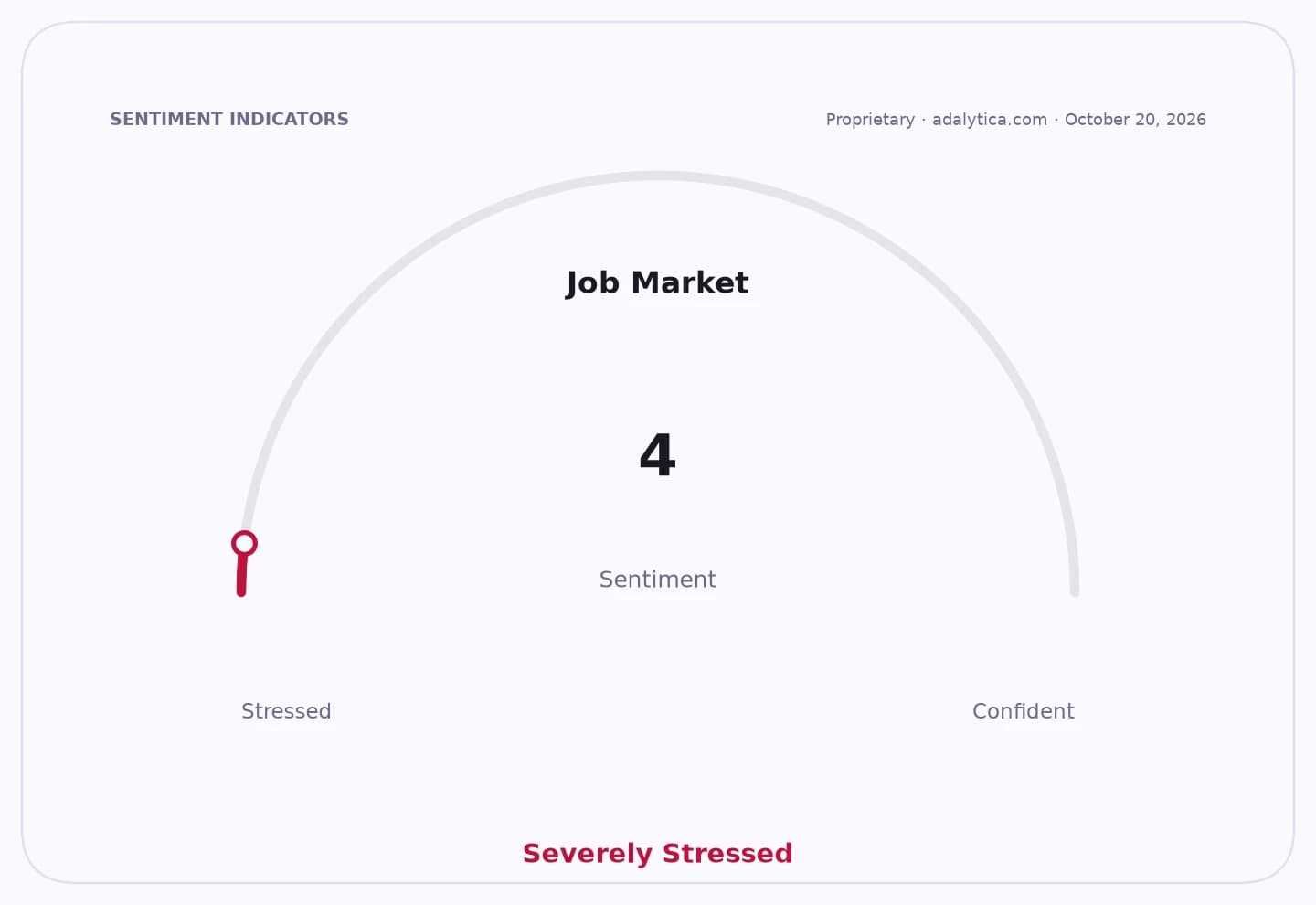
Sentiment IndicatorsⓘProprietary · adalytica.com · October 22, 2026
This is a snapshot — live sentiment, awareness and momentum for 130+ markets update continuously in the dashboard.Open AlphaPulse
A Monitor de Opinión Pública survey by Zentrix Consultora found that 66% of people run out of money no later than day 20, while 72% of those under 40 and 83.3% of lower-income households hit that point before month-end. Only 34% said they can cover the full month and just 9.8% have any savings capacity.
The survey also showed 56.2% of the population took on debt in the past six months, with borrowing especially common among younger adults. Of those who borrowed, 55.1% used the funds for food and health expenses, 21.3% for tariffs and public services, and only 11.8% for durable goods. That split is important: it suggests credit demand is being driven by falling real incomes, not confidence in future spending power.
The picture is most severe at the bottom of the income scale. In the lower class, 59.6% exhaust income before day 15 and 83.3% before day 20, while savings capacity falls to 0.9%. In the middle class, 51.4% run out before month-end and nearly half borrowed, with the highest share using credit to pay utilities. Among higher-income households, 61.9% can save and credit is more often directed toward durable purchases, highlighting how inequality is shaping both cash flow and credit behavior.
For investors, the implications reach beyond consumer stress. Household borrowing used to bridge one month’s budget into the next tends to increase delinquency risk, particularly for banks, retailers and non-bank lenders exposed to payroll and consumer finance. Zentrix said the “cycle feeds back on itself,” warning that arrears are shifting from isolated events toward a structural risk for families using debt as a bridge.
That is a concern for Argentina’s banks, which rely on consumer repayment behavior and are already sensitive to swings in macro stability, inflation and activity. It also helps explain why a majority of respondents want the state to intervene: 67% believe government action is needed, and 61.3% prefer tighter regulation of credit issuance and terms over a bailout or debt forgiveness.
The political economy is straightforward. A country where most households cannot reach month-end without borrowing is one where inflation remains the central constraint on growth, consumption and asset quality. Unless wages begin to outpace prices consistently, household debt will keep rising as a coping mechanism rather than a financing choice — a setup that preserves short-term spending but raises the risk of a broader credit slowdown later.
| Entity | Gains | Losses |
|---|---|---|
| Banks and lenders | ▲Higher short-term loan demand | ▼Rising arrears risk |
| Lower-income households | ▲Access to bridge credit | ▼Savings and purchasing power |
| Consumer and retail sectors | ▲Some near-term sales support | ▼Weaker durable-goods demand |
| Argentine state | ▲Pressure to regulate credit | ▼Political cost of inaction |