Mendoza’s private formal labor market is contracting fast enough to matter for growth, household income and consumption, with the province losing 11,978 registered salaried jobs in the year to July 2026 — roughly one job every 44 minutes.
Mendoza private formal jobs fall 4.9% in a year
That is not just a statistical wobble. It means fewer workers with payroll deductions, social security contributions and stable purchasing power, at a time when Argentina’s recovery is still leaning heavily on fragile, uneven labor conditions. For investors, the message is blunt: where formal employment falls, discretionary spending, credit quality and small-business revenues usually follow.
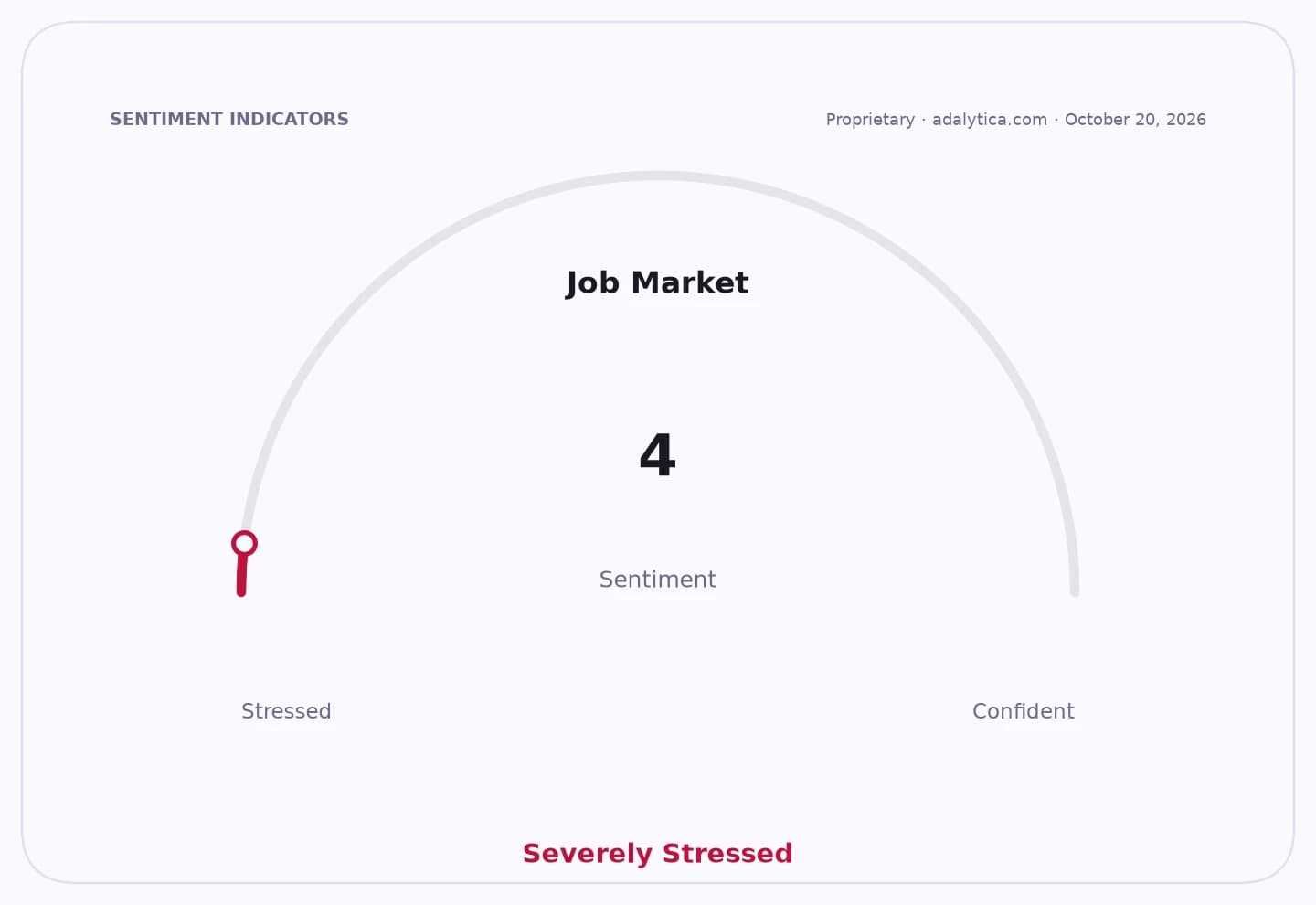
Sentiment IndicatorsⓘProprietary · adalytica.com · October 20, 2026
This is a snapshot — live sentiment, awareness and momentum for 130+ markets update continuously in the dashboard.Open AlphaPulse
According to data from Argentina’s labor ministry cited by El Sol, Mendoza had 246,651 registered private-sector salaried workers in July 2025 and 234,673 a year later, a drop of 4.9%. The province was the third-largest loser in absolute terms nationally, behind Buenos Aires province and the city of Buenos Aires, even though its registered workforce is far smaller than either.
That makes the decline more concerning than the headline number alone suggests. Mendoza lost more formal jobs than Córdoba and Santa Fe, two much larger industrial provinces, which points to a sharper relative hit to local activity. The fall also underscores how the labor market’s adjustment is being absorbed not by new formal hiring, but increasingly by informality, self-employment and lower-quality work arrangements.
The official data do not break out whether the losses came from layoffs, contract expirations, resignations or retirements. But when formal salaried employment falls steadily for a full year, the economic reading is usually the same: employers are guarding margins, delaying new hires or cutting headcount as demand softens.
That matters because formal jobs are the backbone of household spending. A worker on payroll is more likely to spend consistently, borrow formally and support local demand across retail, housing, transport and services. When those jobs disappear, families often compensate by sending a second earner into the labor force — not because the economy is improving, but because income is under strain. That dynamic tends to raise participation while leaving unemployment and underemployment elevated.
The broader Argentine backdrop is a labor market where registered private employment has shown little real expansion for years, while policy makers are trying to unlock hiring through labor reform and wider structural changes. Economists quoted in the local report argued that labor reform alone will not be enough without tax and pension changes that give employers more predictability on costs and rules.
For Mendoza, the investment implication is straightforward: the province is entering a weaker earnings environment just as the rest of the country is still searching for durable growth. That should keep pressure on local consumption, service-sector revenues and the cash flow of small and mid-sized businesses. It also suggests that any national rebound will remain uneven, favoring provinces and sectors that can still attract capital, energy-linked activity or export demand.
The market lesson is to stay selective. In Argentina, the places creating jobs are the ones with the strongest balance sheets, the clearest policy tailwinds and the best access to hard-currency revenue. Mendoza is not there yet. Until formal hiring stabilizes, this is a story of economic leakage, not recovery — and that should keep investors focused on defensives, exporters and businesses less exposed to local wage weakness.
| Entity | Gains | Losses |
|---|---|---|
| Informal workers | ▲More labor absorption | ▼Lower protection |
| Formal employers | ▲Short-term cost control | ▼Future demand weakness |
| Mendoza households | ▲Second-income necessity | ▼Wage security |
| Local retailers/services | ▲Niche resilient demand | ▼Consumer spending power |