Javier Milei’s economic overhaul is no longer the only risk investors are pricing in Argentina; the bigger question is what kind of president he becomes if he wins again in 2027.
Argentina Investors Weigh Milei's 2027 Second Term Risk

That shift matters because it changes the country from a pure policy story into a political-duration story. Businesses and asset managers that had been willing to tolerate sharp adjustment, fiscal austerity and weak activity are now asking whether the next phase brings pragmatic consolidation or a harder ideological line that could delay recovery, complicate financing and keep Argentina locked out of cheaper capital.
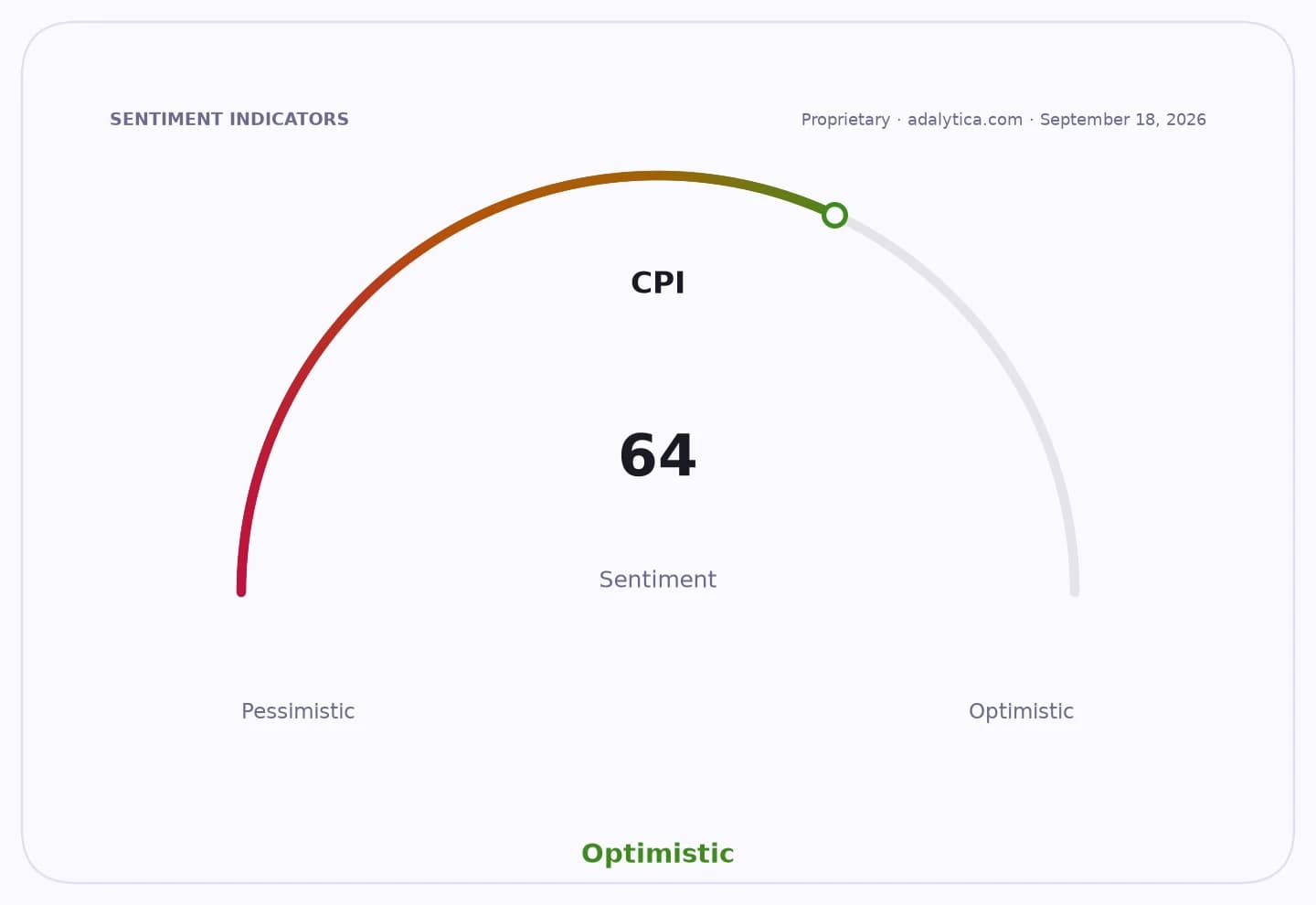
Sentiment IndicatorsⓘProprietary · adalytica.com · October 4, 2026
This is a snapshot — live sentiment, awareness and momentum for 130+ markets update continuously in the dashboard.Open AlphaPulse
The anxiety surfaced repeatedly at the IDEA business forum in Mar del Plata, where executives praised the direction of the program but worried about its durability. The debate is no longer simply whether Milei can stabilize prices and restore confidence. It is whether a second mandate would extend the current blend of market-friendly pragmatism — including selective credit easing, mortgage funding through the pension system and broader dollar lending to firms — or whether it would drift toward dogma and deepen the uncertainty that already hangs over local markets.
The timing is awkward for the government. Argentina’s country risk, measured by JPMorgan’s EMBI spread, rose to 655 basis points this week, its highest level of the year, after climbing 7.9% in the first two days of October. That move came alongside a deterioration in domestic data and weaker confidence indicators. Economic activity fell 2.9% in July from June, poverty rose to 32.3% in the first half from 28.2% at end-2025, unemployment edged higher and the Universidad Torcuato Di Tella’s government confidence index dropped to 1.94 in September, its weakest reading since Milei took office.
For investors, the danger is not just another bout of volatility. It is the possibility that the market starts discounting a second Milei term as a separate regime risk, with policy continuity on one hand and institutional friction on the other. One senior banker called it the “risk Milei,” arguing that the concern is less about Luis Caputo’s debt management than about what happens if the administration doubles down on ideology instead of broadening the recovery. That worry sits alongside the familiar “risk Kicillof” scenario and the more generic fear of any opposition comeback.
The contrast with Uruguay, invoked by former President Luis Lacalle Pou at the same gathering, sharpened the point. His message that parties and institutions act as a “mechanism of restraint” resonated with Argentine executives precisely because it underscored what they feel is missing at home: predictability beyond the personality in office. For capital allocators, that distinction matters as much as fiscal arithmetic. Argentina can keep narrowing its deficit and still trade at a premium if investors believe the rules may swing again after 2027.
Caputo’s Paris roadshow underscores the other side of the story. The government said it secured US$27 billion in investment commitments during its Argentina Week in the French capital, a sign that global capital is willing to look through the recession if it sees political and policy continuity. But those commitments are easier to announce than to convert into durable financing if the election cycle starts to price in a more confrontational second act.
That is why the 2027 question is already feeding into asset prices. Argentine dollar bonds have been volatile, the peso remains exposed to shifts in external sentiment and global risk appetite, and Adalytica’s global stability gauge sits at “Extreme Fear,” reflecting a broader backdrop in which investors are more sensitive to political tails. By contrast, broader emerging-market funds such as EEM have held up far better, highlighting how much of Argentina’s underperformance is now country-specific rather than purely macro-driven.
The bullish case is that Milei, if re-elected, would have every incentive to preserve the market access and credibility gains he has won so far, making him more pragmatic in a second term than in the first. The bearish case is that a renewed mandate could embolden confrontation, slow institutional compromise and keep domestic recovery hostage to political style. For now, investors are not choosing between those outcomes. They are trying to price both at once.
What matters next is whether the government can turn stabilization into a broader recovery before the 2027 debate hardens into a new sovereign discount. If it cannot, the market may decide that Argentina’s central risk is no longer just who governs the country, but which version of Milei returns to do it.
| Entity | Gains | Losses |
|---|---|---|
| Milei and La Libertad Avanza | ▲Re-election case from continuity | ▼Doubts over a more dogmatic second term |
| Argentine bonds | ▲If pragmatism persists | ▼If political risk widens |
| Local firms and investors | ▲Policy stability and investment inflows | ▼Higher risk premium and weaker financing |
| Opposition blocs | ▲Potential opening if recovery stalls | ▼A cohesive pro-market narrative around continuity |