Javier Milei’s weakening economy is giving Argentina’s battered Peronist opposition a new political life, as stalled growth, sticky prices and soft formal employment erode the president’s promise of an irreversible liberal turn.
Argentina Milei Economy Slows as Peronists Gain Ground
The shift matters because Milei’s plan now hinges less on delivering quick results than on surviving long enough to make them possible. A slower economy raises financing costs, complicates the 2027 re-election path and strengthens the case for a Peronist comeback that had looked far less plausible after Milei’s 2025 victory.
Sentiment IndicatorsⓘProprietary · adalytica.com · October 4, 2026
This is a snapshot — live sentiment, awareness and momentum for 130+ markets update continuously in the dashboard.Open AlphaPulse
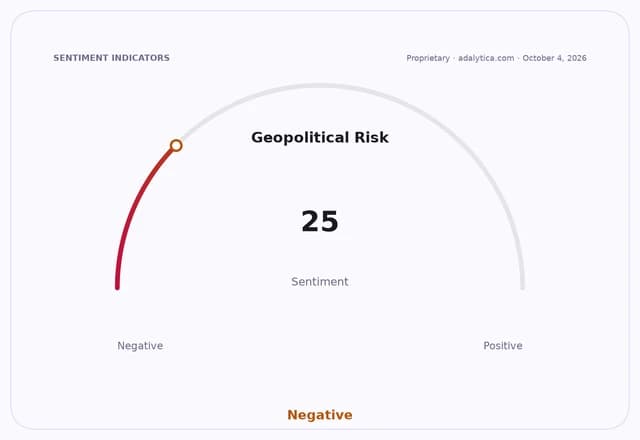
That reopening of the political field is already changing how power is traded in Buenos Aires. Peronist leaders from Buenos Aires province governor Axel Kicillof to former economy minister Sergio Massa and Cristina Kirchner are moving to exploit Milei’s vulnerability, while the government scrambles to protect its reform agenda and keep allies onside.
The immediate legislative fight is over the primaries known as PASO, a tool Peronists want to keep because it could settle internal rivalries without a bruising public split. Milei, by contrast, wants them removed or suspended as part of a broader political overhaul, and opposition lawmakers are now trying to use sensitive issues such as disability funding and debt relief to raise the price of any deal.
A separate congressional push to overturn decree 70/2023, the flagship deregulation package that launched Milei’s program, shows how quickly the opposition can turn the president’s weakened position into a political threat. Peronists say even forcing the government to defend the decree helps them extract concessions from wavering governors and other allies.
The economic backdrop helps explain the urgency. Milei has talked up reform, fiscal discipline and future growth, but the narrative of patience is colliding with a lack of immediate traction in activity and jobs. For investors, that means policy continuity is no longer just a function of election math; it depends on whether the administration can stabilize the economy before political fragmentation starts to dominate the agenda.
Market indicators reflect that strain. Argentine ADRs have been under pressure, with Grupo Financiero Galicia around $35.89, down sharply from above $52 in late October, while the Argentina ETF EWW has retreated to about $71.09 from an early-February peak above $80. Technicians would note both have slipped below their 50-day and 200-day moving averages, a sign that investors are demanding more evidence before betting on a quick recovery.
The broader regional mood is also darker. Adalytica’s Global Stability Sentiment gauge shows “Fear” at 25, with “Extreme Fear” awareness at 4, underscoring how political volatility and policy uncertainty remain a headwind for capital flows across emerging markets.
Milei still keeps competitive polling numbers, but the article’s central warning is that his combative style may be doing Peronism a favor by giving it a common enemy and a reason to unify. The next catalyst is congressional maneuvering over the PASO and decree 70 fight, which will show whether the government can still command enough political cover to keep its economic reset intact.
| Entity | Gains | Losses |
|---|---|---|
| Peronist opposition | ▲Unity against Milei | ▼Internal fragmentation |
| Milei government | ▲Short-term loyalist support | ▼Reform room and legislative control |
| Argentine equities/ADRs | ▲Policy clarity if reforms survive | ▼Political risk and weaker growth |
| Governors/ally blocs | ▲Bargaining power with Casa Rosada | ▼Pressure from both sides |