Javier Milei is betting Argentina’s economy can absorb a slowdown without tipping into recession, and that argument matters far beyond politics because it is tied to the country’s biggest growth engine: Vaca Muerta.
Argentina's Vaca Muerta growth case
The president’s message was simple in tone, if ambitious in scope. He rejected warnings that Argentina is already sliding into recession after a 2.9% monthly drop in July economic activity, pushed back against JPMorgan’s cut to 1.5% 2026 growth and insisted the country is still posting record highs in private consumption, exports and per-capita output. For investors, that is more than a rhetorical fight with economists. It is a defense of the policy mix that has been powering the re-rating of Argentine energy assets, especially YPF, while keeping regional players like Petrobras and Vista Energy on watch lists.
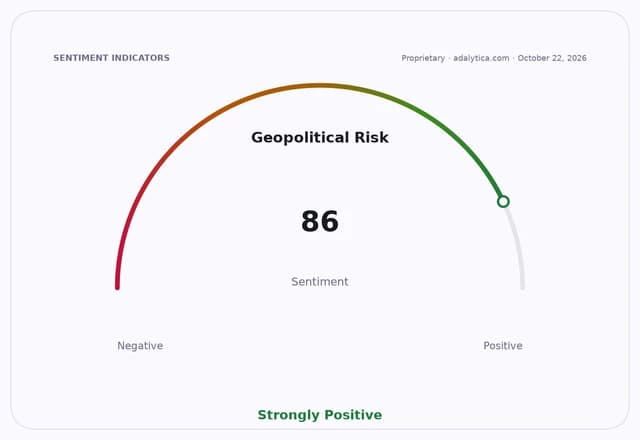
Sentiment IndicatorsⓘProprietary · adalytica.com · October 22, 2026
This is a snapshot — live sentiment, awareness and momentum for 130+ markets update continuously in the dashboard.Open AlphaPulse
At the center of Milei’s argument is Vaca Muerta, the shale basin that has become one of Argentina’s few reliable engines of hard-currency generation. He flatly rejected claims that the project does not “spill over” into the broader economy, saying the benefits are real and insisting that the criticism misses how resource investment cascades through transport, services, drilling, housing and local employment. That spillover is economically important because Argentina still needs energy exports, investment and foreign exchange to stabilize its macro picture. When Vaca Muerta grows, the country’s current account, fiscal coffers and industrial activity all get a lift.
For equity investors, the implication is straightforward: if Milei succeeds in preserving macro stability while keeping the door open to energy development, Argentina’s oil and gas producers remain one of the few ways to play a long-duration recovery story. YPF has already been one of the market’s strongest performers, with its shares still trading well above key long-term averages despite recent volatility. Petrobras has also benefited from broad enthusiasm around Latin American energy cash flows, while Vista Energy has ridden the same structural theme: production growth, export leverage and exposure to an underpenetrated basin with global-scale potential.
The political backdrop matters just as much as the geology. Milei used the interview to reinforce his alliance with Patricia Bullrich and dismiss talk of an internal split, signaling that the government is trying to keep its reform coalition intact while the market watches for signs of policy drift ahead of future elections. He also argued that the state has enough financing and reserves to withstand turbulence, a message meant to calm investors worried about a weaker peso, rising risk premium and delayed private investment. That is important because energy projects are capital-intensive and need policy continuity more than almost any other sector.
Still, investors should not ignore the risks. Milei’s optimism rests on a narrow base: energy exports, a stronger private sector and the hope that lower inflation and fewer distortions will eventually pull the broader economy back to growth. If consumer demand keeps softening or political noise rises, the benefits from Vaca Muerta may not be enough to offset a wider slowdown. That is why the current setup should be viewed as a long-term story, not a short-term trade.
For patient investors, the bigger lesson is that Argentina’s investment case still hinges on a few powerful secular drivers, and Vaca Muerta remains one of the best of them. If the government can keep macro volatility contained, energy producers could continue to compound for years. Worth watching, and for long-term investors, worth keeping on the watchlist.
| Entity | Gains | Losses |
|---|---|---|
| YPF and other shale producers | ▲Export growth, stronger valuations | ▼Political and macro volatility |
| Argentine economy | ▲Foreign exchange, jobs, investment | ▼Short-term consumer weakness |
| Bullish investors | ▲Exposure to a long-term energy theme | ▼Those expecting a deep recession |
| Critics of Vaca Muerta spillover | ▲Short-term argument leverage | ▼Credibility if activity keeps expanding |