Cathie Wood’s Ark Invest made a sharp bet on the next phase of the AI trade last week, cutting about $107 million of Nvidia while adding roughly $74.4 million to SpaceX, a shift that underscores how fast active managers are rotating within the artificial-intelligence complex.
Ark Invest Cuts Nvidia, Adds SpaceX
Nvidia Corp
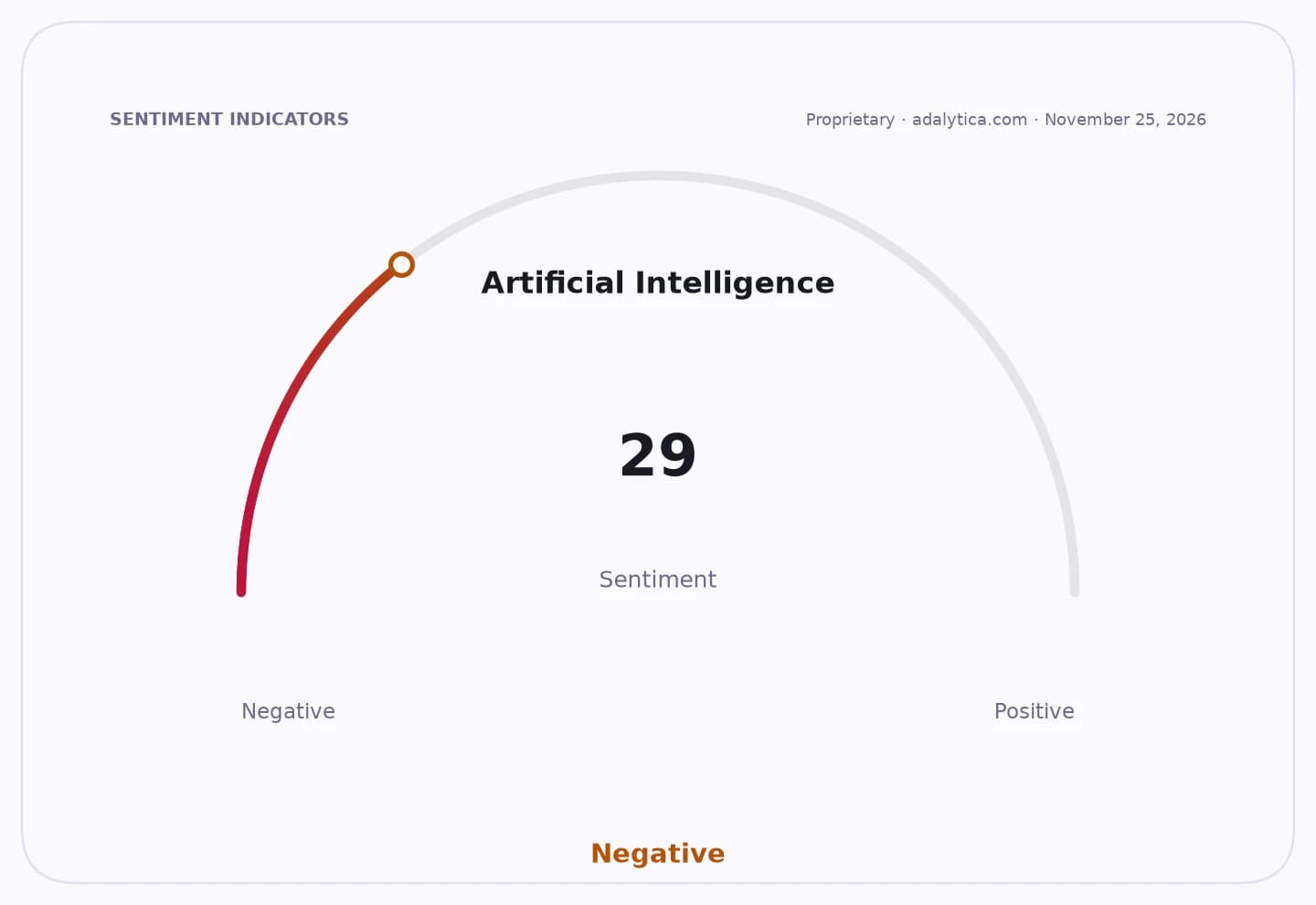
The move matters because Nvidia has been the market’s clearest AI bellwether, but its shares have been volatile and technically weakened after a steep pullback. The stock closed at $149.30 on Nov. 25, far below its 50-day moving average of $203.65 and 200-day average of $202.62, with RSI at 37.7 and a deeply negative MACD reading, indicating the stock had already moved into a weakened trend even before Ark’s trim. Adalytica’s NVIDIA Earnings Sentiment snapshot showed neutral sentiment at 46, with awareness still elevated, suggesting the name remains crowded even as near-term momentum softens.
Sentiment Indicators
Ark’s selling of Nvidia after buying about $16 million the prior week suggests the firm is taking profits, managing concentration risk, or responding to a less favorable risk-reward profile after the chipmaker’s earlier rally. For investors, that is notable not because one active fund can set the market, but because Ark’s trading is closely watched as a high-conviction gauge of where speculative growth capital is being deployed. Reducing Nvidia while buying more SpaceX hints at a preference for private-market optionality over a mature public-market AI leader that now faces higher expectations and more valuation scrutiny.
The SpaceX purchase was the largest in the weekly update and reflects Ark’s long-running appetite for assets it sees as disruptive but still underappreciated by public markets. Alongside that, Ark bought CoreWeave, AMD, Cerebras Systems, Shopify and Alphabet, while trimming names including Palantir, Broadcom, CrowdStrike, Datadog, Cloudflare, Amazon and Taiwan Semiconductor. That pattern points to a portfolio-wide reshuffling rather than a single-ticker call: Ark appears to be leaning into infrastructure, AI application layers and select enablers while paring some of the crowded winners.
The broader takeaway is that the AI trade is no longer just about owning the most obvious chipmaker. Investors are being forced to choose between public leaders with visible earnings power and less-liquid bets on the companies that may benefit later in the cycle. If Nvidia’s recent weakness turns into a deeper valuation reset, funds like Ark may be early in repositioning. If the stock stabilizes and AI spending broadens, the trim could prove premature. Either way, the week’s trading shows that even among aggressive growth investors, the next leg of the AI rally is being treated less as a one-stock story and more as a search for the next source of upside.
| Entity | Gains | Losses |
|---|---|---|
| SpaceX | ▲Larger Ark allocation | ▼Less capital in public AI |
| Nvidia | ▲Cash realized by seller | ▼Reduced Ark exposure |
| CoreWeave/AMD/Cerebras | ▲Fresh Ark buying | ▼Less attention than Nvidia |
| Palantir/Broadcom/CrowdStrike | ▲Position trimming pressure | ▼Lower Ark conviction |